Speedy™ Mouse BAFF One-Step ELISA Kit SE60006 proteintech
$449.00
In stock
SKU
SE60006
| Product name | Speedy™ Mouse BAFF One-Step ELISA Kit |
| Synonyms | B-cell-activating factor, CD257, Tnfsf13b, Tumor necrosis factor ligand superfamily member 13B, Tumor necrosis factor ligand superfamily member 13b, membrane form |
| Reactivity | Mouse |
| Host / Isotype | United States |
| Tests | 1 X 96 well plate |
| Sample type | Serum, Plasma, Cell culture supernatant |
| Assay type | Sandwich |
| Sensitivity | 15.6 pg/mL |
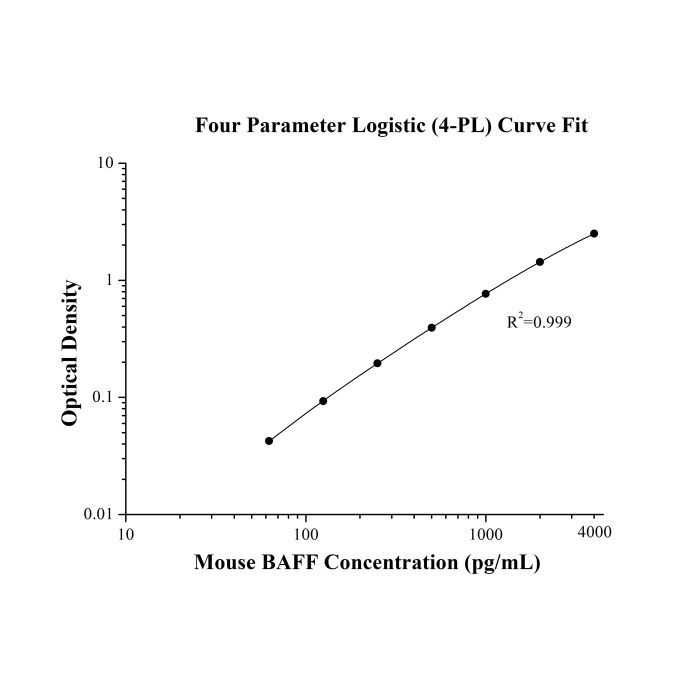
| Range | 62.5-4000 pg/mL |
| Tested applications | Sandwich ELISA |
| Gene ID (NCBI) | 24099 |
| Sample Type | Average Range |
| Mouse serum | 117% 107%-126% |
| Cell culture supernatant | 91% 75%-112% |
| Sample | n mean ( pg/mL ) SD CV% |
| 1 | 16 1,724.0 104.0 6.0 |
| 2 | 16 428.9 21.5 5.0 |
| 3 | 16 225.8 13.1 5.8 |
| Storage Instructions | All the reagents are stored at 2-8℃ for 6 months or -20℃ for 12 months. Refer to the protocol for further storage instructions. |
TNFSF13B, also named as BAFF, BLYS, TALL1, TNFSF20, ZTNF4 and CD257, is a cytokine that binds to TNFRSF13B/TACI and TNFRSF17/BCMA. TNFSF13B is localized in chromosome region 13q32-q34 and is implicated in the regulation of immune response to infections, autoimmune disease, and inflammation. BAFF is a critical cytokine supporting the survival of naive B cells, acting through the BAFFR receptor. At the placental level, it is believed that TNFSF13B has an antiapoptotic effect. TNFSF13B is overexpressed in several autoimmune patients although the mechanism behind this feature is unclear. Properties Storage Instructions All the reagents are stored at 2-8℃ for 6 months or -20℃ for 12 months. Refer to the protocol for further storage instructions. Synonyms B-cell-activating factor, CD257, Tnfsf13b, Tumor necrosis factor ligand superfamily member 13B, Tumor necrosis factor ligand superfamily member 13b, membrane form FAQ 1、I have limited sample diluent. How should I handle samples requiring high dilution factors? Answer: We recommend performing a serial dilution. For example, if human serum requires a 1,000,000-fold dilution, you can use a three-step 100× dilution method as follows: Step 1: Take 2 uL of human serum and add it to 198 uL of sample diluent, mix thoroughly to obtain a 100-fold diluted sample. Step 2: Take 2 uL of the 100-fold diluted sample and add it to 198 uL of sample diluent, mix thoroughly to obtain a 10,000-fold diluted sample. Step 3: Take 2 uL of the 10,000-fold diluted sample and add it to 198 uL of sample diluent, mix thoroughly to obtain a 1,000,000-fold diluted sample. If further dilution is required, additional serial steps can be used. We do not recommend using any other solutions or water for dilution, except for the sample diluent we suggest. If your sample diluent is still insufficient, please contact our customer service for more sample diluent. 2、If thermostatic shaker is not available, will it affect the duration of my experiment and the experimental data? Answer: If thermostatic shaker is not available, it may take 2.5 hours to complete this experiment. After adding the antibody cocktail, we suggest you incubate the plate at 37℃ for 2 hours. After adding TMB, you only need to incubate the plate at 37℃ for 15 minutes. Through comparative experiments, our R&D personnel have confirmed that you can still obtain valid experimental data, although the signal will be slightly reduced.