Speedy™ Mouse CX3CL1 One-Step ELISA Kit SE60022 proteintech
$449.00
In stock
SKU
SE60022
| Product name | Speedy™ Mouse CX3CL1 One-Step ELISA Kit |
| Synonyms | ABCD 3, CX3C, Cxc3, Scyd1 |
| Reactivity | Mouse |
| Host / Isotype | United States |
| Tests | 1 X 96 well plate |
| Sample type | Serum, Plasma, Tissue lysate, Tissue homogenate |
| Assay type | Sandwich |
| Sensitivity | 0.07 ng/mL |
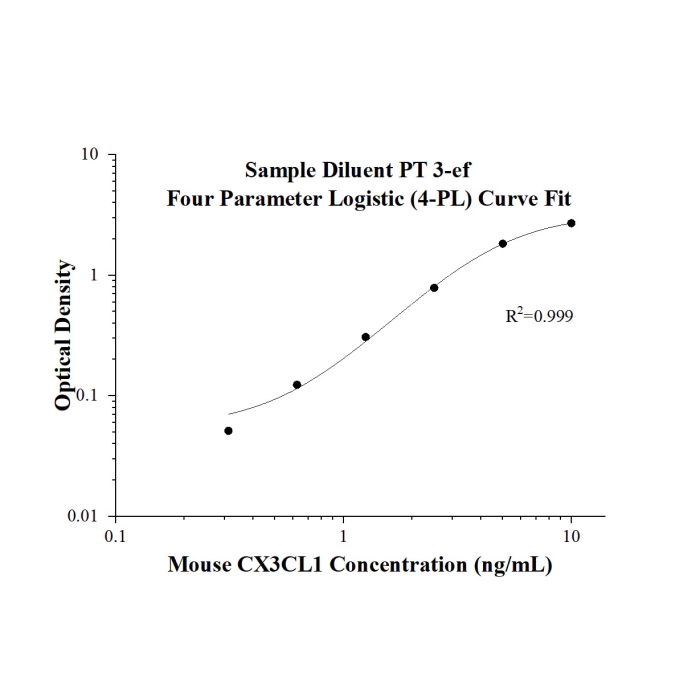
| Range | 0.313-10 ng/mL |
| Tested applications | Sandwich ELISA |
| Gene ID (NCBI) | 20312 |
| Sample Type | Average Range |
| Mouse serum | 97% 88%-107% |
| Tissue lysate | 108% 102%-120% |
| Tissue homogenate | 111% 104%-121% |
| Sample | n mean ( ng/mL ) SD CV% |
| 1 | 16 4.71 0.28 5.94 |
| 2 | 16 1.20 0.10 8.33 |
| 3 | 16 0.64 0.04 6.25 |
| Storage Instructions | All the reagents are stored at 2-8℃ for 6 months or -20℃ for 12 months. Refer to the protocol for further storage instructions. |
Chemokines direct the trafficking of white blood cells in immune surveillance, playing a key role in inflammatory and infectious diseases such as AIDS. CX3CL1, also known as fractalkine (FKN), is a unique, membrane-bound chemokine, with a transmembrane domain and the chemokine domain on top of a long mucinlike stalk. This protein can exist in two forms, a membrane-bound form or a shed soluble form, after extracellular proteolysis at a membrane-proximal dibasic cleavage site. The soluble CX3CL1 has potent chemoattractant activity for T cells and monocytes, and the cell-surface-bound protein, which is induced by primary proinflammatory signals in activated primary endothelial cells, promotes strong adhesion of those leukocytes. Presence of CX3CL1 and its receptor CX3CR1 in lymphocytes and their enhanced cellular expression during inflammatory conditions suggests that the CX3CL1-CX3CR1 duo participates in immune-related inflammatory diseases. Properties Storage Instructions All the reagents are stored at 2-8℃ for 6 months or -20℃ for 12 months. Refer to the protocol for further storage instructions. Synonyms ABCD 3, CX3C, Cxc3, Scyd1 FAQ 1、I have limited sample diluent. How should I handle samples requiring high dilution factors? Answer: We recommend performing a serial dilution. For example, if human serum requires a 1,000,000-fold dilution, you can use a three-step 100× dilution method as follows: Step 1: Take 2 uL of human serum and add it to 198 uL of sample diluent, mix thoroughly to obtain a 100-fold diluted sample. Step 2: Take 2 uL of the 100-fold diluted sample and add it to 198 uL of sample diluent, mix thoroughly to obtain a 10,000-fold diluted sample. Step 3: Take 2 uL of the 10,000-fold diluted sample and add it to 198 uL of sample diluent, mix thoroughly to obtain a 1,000,000-fold diluted sample. If further dilution is required, additional serial steps can be used. We do not recommend using any other solutions or water for dilution, except for the sample diluent we suggest. If your sample diluent is still insufficient, please contact our customer service for more sample diluent. 2、If thermostatic shaker is not available, will it affect the duration of my experiment and the experimental data? Answer: If thermostatic shaker is not available, it may take 2.5 hours to complete this experiment. After adding the antibody cocktail, we suggest you incubate the plate at 37℃ for 2 hours. After adding TMB, you only need to incubate the plate at 37℃ for 15 minutes. Through comparative experiments, our R&D personnel have confirmed that you can still obtain valid experimental data, although the signal will be slightly reduced.