Rat KIM-1/HAVCR1 ELISA Kit KE20012 proteintech
$299.00
In stock
SKU
KE20012
| Product name | Rat KIM-1/HAVCR1 ELISA Kit |
| Synonyms | CD365, HAVCR1, Kidney injury molecule 1, KIM 1, KIM1, KIM-1, TIM 1, TIM1, TIM-1 |
| Reactivity | Rat |
| Host / Isotype | United States |
| Tests | 1 X 96 well plate |
| Sample type | Serum, Plasma, Cell culture supernatants, Urine |
| Assay type | Sandwich |
| Sensitivity | 0.4 pg/mL |
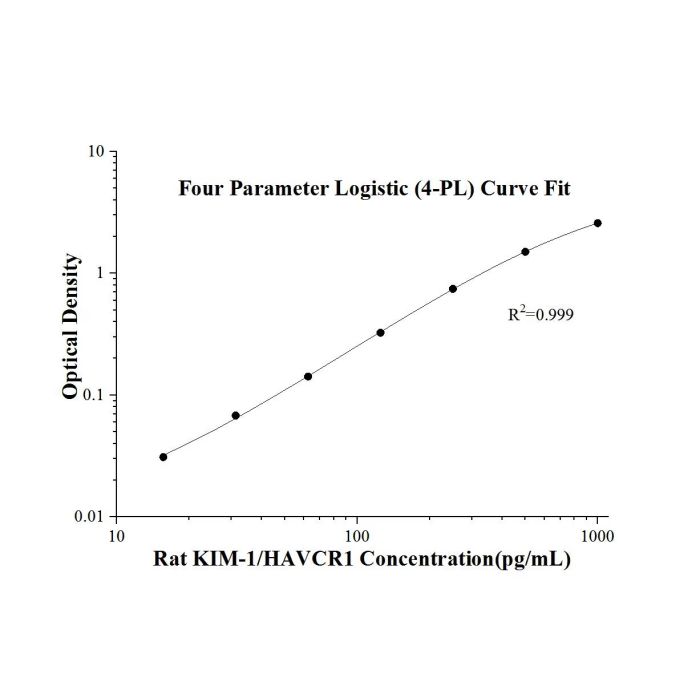
| Range | 15.6-1000 pg/mL |
| Tested applications | Sandwich ELISA |
| Gene ID (NCBI) | 286934 |
| Sample Type | Average Range |
| Rat Serum | 116% 105%-126% |
| cell culture supernatants | 95% 82%-105% |
| rat urine | 100% 84%-116% |
| Sample | n mean ( pg/mL ) SD CV% |
| 1 | 24 439.3 29.5 6.7 |
| 2 | 24 107.9 9.6 8.9 |
| 3 | 24 26.4 2.6 9.8 |
| Storage Instructions | All the reagents are stored at 2-8℃ for 6 months or -20℃ for 12 months. Refer to the protocol for further storage instructions. |
| rat | serum J Ethnopharmacol Xanthoceras sorbifolium leaves alleviate hyperuricemic nephropathy by inhibiting the PI3K/AKT signaling pathway to regulate uric acid transport Authors - Yuchao Liu View Article |
Kidney injury molecule 1 (KIM-1), also known as Hepatitis A virus cellular receptor 1 (HAVCR1) or T-cell immunoglobulin and mucin domain 1 (TIM-1), is a class I integral membrane glycoprotein, with an ectodomain containing Ig-like domain and a mucin domain. KIM-1 acts as a membrane receptor for hepatitis A virus (HAV). KIM-1 provides a costimulatory signal for T cell activation and inhibits the development of peripheral tolerance. KIM-1 may be involved in the regulation of asthma and allergic diseases. It has been reported that KIM-1 is shed into urine after acute kidney damage and is a marker of renal tubular injury. Properties Storage Instructions All the reagents are stored at 2-8℃ for 6 months or -20℃ for 12 months. Refer to the protocol for further storage instructions. Synonyms CD365, HAVCR1, Kidney injury molecule 1, KIM 1, KIM1, KIM-1, TIM 1, TIM1, TIM-1 FAQ 1、I have limited sample diluent. How should I handle samples requiring high dilution factors? Answer: We recommend performing a serial dilution. For example, if human serum requires a 1,000,000-fold dilution, you can use a three-step 100× dilution method as follows: Step 1: Take 2 uL of human serum and add it to 198 uL of sample diluent, mix thoroughly to obtain a 100-fold diluted sample. Step 2: Take 2 uL of the 100-fold diluted sample and add it to 198 uL of sample diluent, mix thoroughly to obtain a 10,000-fold diluted sample. Step 3: Take 2 uL of the 10,000-fold diluted sample and add it to 198 uL of sample diluent, mix thoroughly to obtain a 1,000,000-fold diluted sample. If further dilution is required, additional serial steps can be used. We do not recommend using any other solutions or water for dilution, except for the sample diluent we suggest. If your sample diluent is still insufficient, please contact our customer service for more sample diluent.
Publications