Mouse CCL4 ELISA Kit KE10030 proteintech
$299.00
In stock
SKU
KE10030
| Product name | Mouse CCL4 ELISA Kit |
| Synonyms | ACT2,ACT-2,C-C motif chemokine 4,Ccl4,Immune activ |
| Reactivity | Mouse |
| Host / Isotype | United States |
| Tests | 1 X 96 well plate |
| Sample type | Cell culture supernatant |
| Assay type | Sandwich |
| Sensitivity | 5.0 pg/mL |
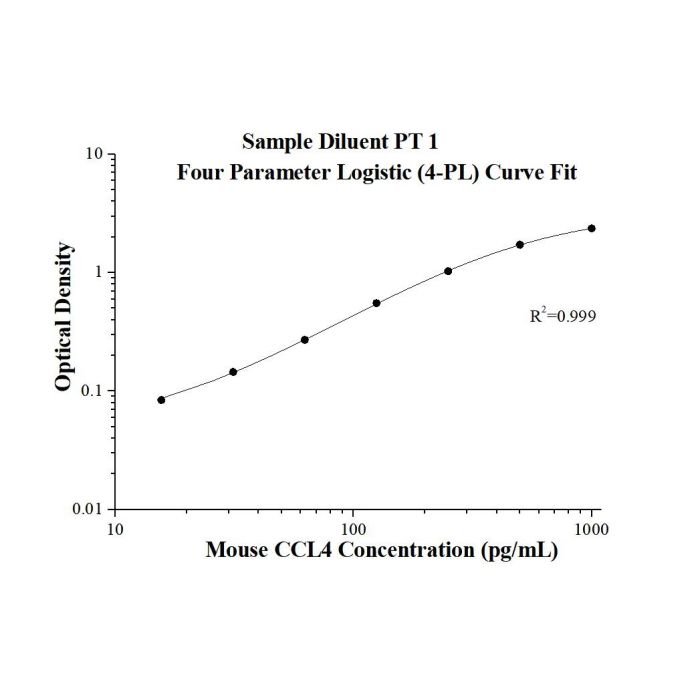
| Range | 15.6-1000 pg/mL |
| Tested applications | Sandwich ELISA |
| Gene ID (NCBI) | 20303 |
| Sample Type | Average Range |
| Cell culture supernatant | 101% 85%-110% |
| Sample | n mean ( pg/mL ) SD CV% |
| 1 | 24 486.5 26.2 5.4 |
| 2 | 24 117.0 3.2 2.7 |
| 3 | 24 60.8 2.9 4.8 |
| Storage Instructions | All the reagents are stored at 2-8℃ for 6 months or -20℃ for 12 months. Refer to the protocol for further storage instructions. |
| mouse | Neuropharmacology CCR5 antagonist maraviroc alleviates doxorubicin-induced neuroinflammation and neurobehavioral deficiency by regulating NF-κB/NLRP3 signaling in a breast cancer mouse model Authors - Yuanyuan Wu View Article |
CCL4(C-C chemokine ligand 4), also known as MIP-1β, plays a key role in inflammation and immune regulation. CCL4 is a major HIV-suppressive factor produced by CD8+ T cells. CCL4 is produced by a wide variety of cells including: immune cells (monocytes, B and T cells), fibroblasts, endothelial, and epithelial cells. CCL4 has a broad spectrum of target cells including immature dendritic cells, which express the cognate receptor CCR5. Increased expression of CCL4 was reported in the monocytes and blood of elderly individuals. Concentration of CCL4 within the body increases with age, which may cause chronic inflammation and liver damage. Properties Storage Instructions All the reagents are stored at 2-8℃ for 6 months or -20℃ for 12 months. Refer to the protocol for further storage instructions. Synonyms ACT2,ACT-2,C-C motif chemokine 4,Ccl4,Immune activ FAQ 1、I have limited sample diluent. How should I handle samples requiring high dilution factors? Answer: We recommend performing a serial dilution. For example, if human serum requires a 1,000,000-fold dilution, you can use a three-step 100× dilution method as follows: Step 1: Take 2 uL of human serum and add it to 198 uL of sample diluent, mix thoroughly to obtain a 100-fold diluted sample. Step 2: Take 2 uL of the 100-fold diluted sample and add it to 198 uL of sample diluent, mix thoroughly to obtain a 10,000-fold diluted sample. Step 3: Take 2 uL of the 10,000-fold diluted sample and add it to 198 uL of sample diluent, mix thoroughly to obtain a 1,000,000-fold diluted sample. If further dilution is required, additional serial steps can be used. We do not recommend using any other solutions or water for dilution, except for the sample diluent we suggest. If your sample diluent is still insufficient, please contact our customer service for more sample diluent.
Publications