Human ASGR1 ELISA Kit KE00548 proteintech
$299.00
In stock
SKU
KE00548
| Product name | Human ASGR1 ELISA Kit |
| Synonyms | ASGR1, asialoglycoprotein receptor 1, HL-1, ASGP R 1, ASGPR |
| Reactivity | Human |
| Host / Isotype | United States |
| Tests | 1 X 96 well plate |
| Sample type | Serum, Plasma, Cell lysate |
| Assay type | Sandwich |
| Sensitivity | 2.0 pg/mL |
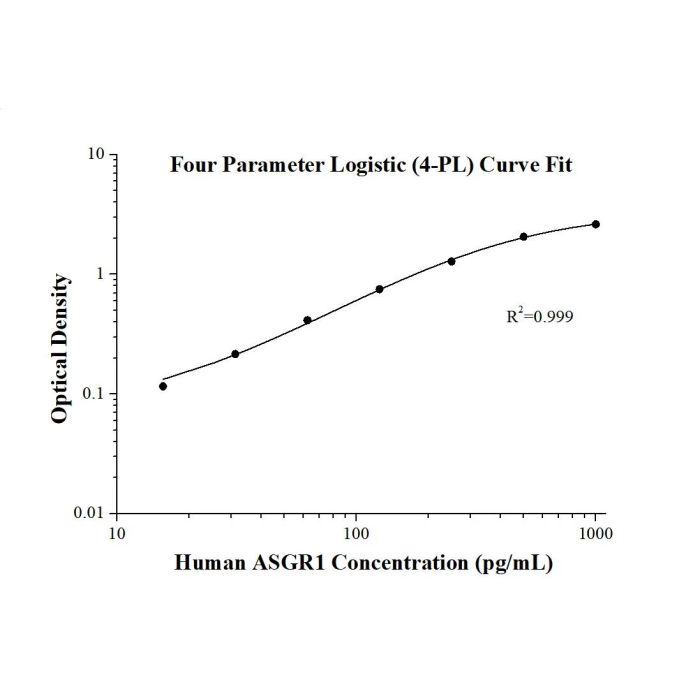
| Range | 15.6-1000 pg/mL |
| Tested applications | Sandwich ELISA |
| Gene ID (NCBI) | 432 |
| Sample Type | Average Range |
| Human serum | 98% 84%-111% |
| Cell lysate | 85% 77%-94% |
| Sample | n mean ( pg/mL ) SD CV% |
| 1 | 16 546.7 39.7 7.3 |
| 2 | 16 121.2 5.7 4.7 |
| 3 | 16 37.3 2.2 6.0 |
| Storage Instructions | All the reagents are stored at 2-8℃ for 6 months or -20℃ for 12 months. Refer to the protocol for further storage instructions. |
Asialoglycoprotein receptor (ASGPR), also known as the hepatic galactose/N-acetylglucosamine (GlcNAc) receptor or Ashwell receptor, is a C-type lectin expressed exclusively in hepatic parenchymal cells. ASGPR consists of two subunits, a major subunit (ASGR1, HL-1) and a minor subunit (ASGR2, HL-2), and specifically recognizes terminal β-linked galactose or GlcNAc on circulating glycoproteins or cells. This receptor plays a critical role in serum glycoprotein homeostasis by mediating the endocytosis and lysosomal degradation of glycoproteins that contain terminal galactose or GlcNAc residues. ASGPR may facilitate hepatic infection by multiple viruses, including hepatitis B, and is also a target for liver-specific drug delivery. Properties Storage Instructions All the reagents are stored at 2-8℃ for 6 months or -20℃ for 12 months. Refer to the protocol for further storage instructions. Synonyms ASGR1, asialoglycoprotein receptor 1, HL-1, ASGP R 1, ASGPR FAQ 1、I have limited sample diluent. How should I handle samples requiring high dilution factors? Answer: We recommend performing a serial dilution. For example, if human serum requires a 1,000,000-fold dilution, you can use a three-step 100× dilution method as follows: Step 1: Take 2 uL of human serum and add it to 198 uL of sample diluent, mix thoroughly to obtain a 100-fold diluted sample. Step 2: Take 2 uL of the 100-fold diluted sample and add it to 198 uL of sample diluent, mix thoroughly to obtain a 10,000-fold diluted sample. Step 3: Take 2 uL of the 10,000-fold diluted sample and add it to 198 uL of sample diluent, mix thoroughly to obtain a 1,000,000-fold diluted sample. If further dilution is required, additional serial steps can be used. We do not recommend using any other solutions or water for dilution, except for the sample diluent we suggest. If your sample diluent is still insufficient, please contact our customer service for more sample diluent.