Human DDR1 ELISA Kit KE00676 proteintech
$299.00
In stock
SKU
KE00676
| Product name | Human DDR1 ELISA Kit |
| Synonyms | CAK, CD167, CD167 antigen-like family member A, CD167a, Cell adhesion kinase |
| Reactivity | Human |
| Host / Isotype | United States |
| Tests | 1 X 96 well plate |
| Sample type | Serum, Plasma, Cell culture supernatant, Cell lysate |
| Assay type | Sandwich |
| Sensitivity | 1.1 pg/mL |
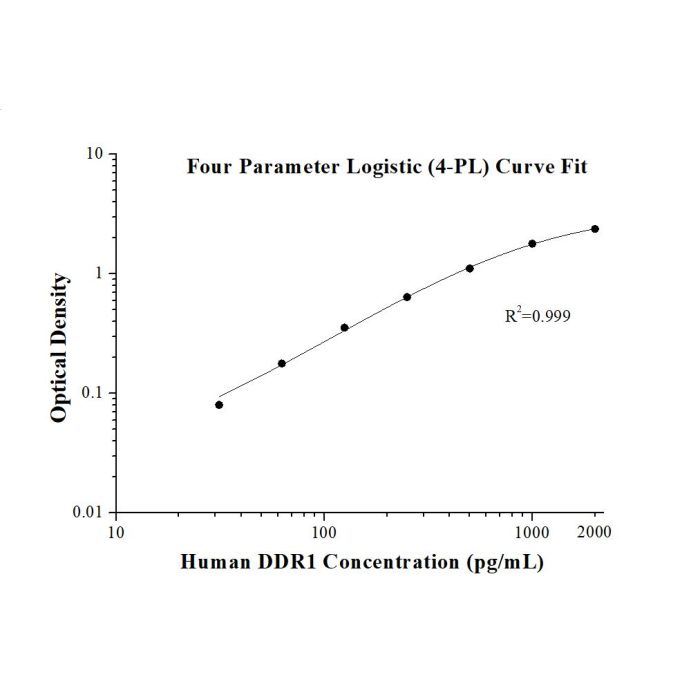
| Range | 31.25-2000 pg/mL |
| Tested applications | Sandwich ELISA |
| Gene ID (NCBI) | 780 |
| Sample Type | Average Range |
| Human serum | 103% 98%-111% |
| Cell culture supernatant | 102% 93%-107% |
| Cell lysate | 105% 98%-116% |
| Sample | n mean ( pg/mL ) SD CV% |
| 1 | 16 1,436.7 85.8 6.0 |
| 2 | 16 348.0 34.2 9.8 |
| 3 | 16 171.5 20.0 11.7 |
| Storage Instructions | All the reagents are stored at 2-8℃ for 6 months or -20℃ for 12 months. Refer to the protocol for further storage instructions. |
DDR1 (Discoidin Domain Receptor 1) is a receptor tyrosine kinase (RTK) that belongs to the DDR family. It binds to extracellular matrix (ECM) components such as collagen through its extracellular discoidin domain, activates intracellular tyrosine kinase activity, and regulates processes including cell proliferation, migration, differentiation, and apoptosis. DDR1 plays important roles in various physiological and pathological processes, including tissue repair, inflammatory responses, and tumorigenesis. In oncology, the abnormal expression of DDR1 is associated with the invasiveness and metastatic potential of various cancers, making it a potential therapeutic target. Additionally, DDR1 is involved in the progression of cardiovascular and neurodegenerative diseases. Studying the signaling pathways and functional mechanisms of DDR1 helps to develop new therapeutic strategies for the treatment of cancer, cardiovascular diseases, and neurodegenerative diseases. Properties Storage Instructions All the reagents are stored at 2-8℃ for 6 months or -20℃ for 12 months. Refer to the protocol for further storage instructions. Synonyms CAK, CD167, CD167 antigen-like family member A, CD167a, Cell adhesion kinase FAQ 1、I have limited sample diluent. How should I handle samples requiring high dilution factors? Answer: We recommend performing a serial dilution. For example, if human serum requires a 1,000,000-fold dilution, you can use a three-step 100× dilution method as follows: Step 1: Take 2 uL of human serum and add it to 198 uL of sample diluent, mix thoroughly to obtain a 100-fold diluted sample. Step 2: Take 2 uL of the 100-fold diluted sample and add it to 198 uL of sample diluent, mix thoroughly to obtain a 10,000-fold diluted sample. Step 3: Take 2 uL of the 10,000-fold diluted sample and add it to 198 uL of sample diluent, mix thoroughly to obtain a 1,000,000-fold diluted sample. If further dilution is required, additional serial steps can be used. We do not recommend using any other solutions or water for dilution, except for the sample diluent we suggest. If your sample diluent is still insufficient, please contact our customer service for more sample diluent.