Mouse MCP-1/CCL2 ELISA Kit KE10123 proteintech
$299.00
In stock
SKU
KE10123
| Product name | Mouse MCP-1/CCL2 ELISA Kit |
| Synonyms | Ccl2, MCP1, MCP-1, C-C motif chemokine 2, CCL 2 |
| Reactivity | Mouse |
| Host / Isotype | United States |
| Tests | 1 X 96 well plate |
| Sample type | Serum, Plasma, Cell culture supernatant, Tissue lysate |
| Assay type | Sandwich |
| Sensitivity | 1.2 pg/mL |
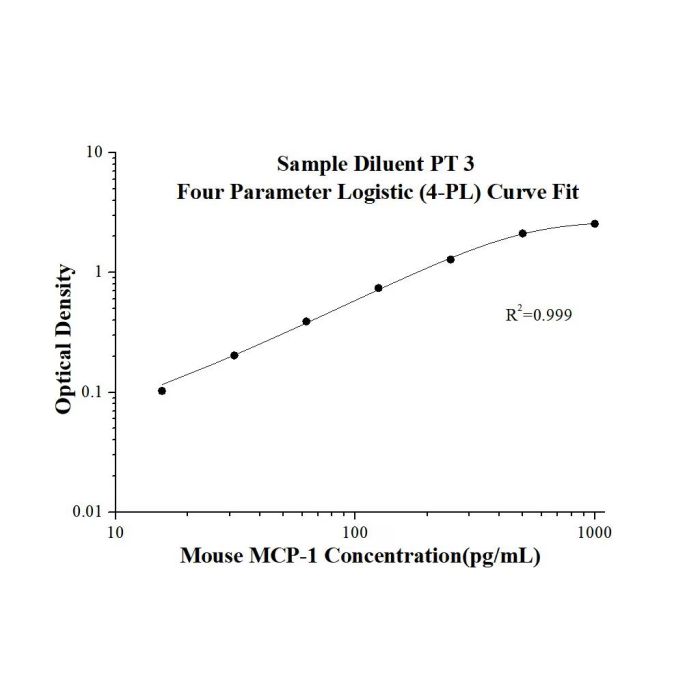
| Range | 15.6-1000 pg/mL |
| Tested applications | Sandwich ELISA |
| Gene ID (NCBI) | 20296 |
| Sample Type | Average Range |
| Mouse serum | 110% 79%-129% |
| Cell culture supernatant | 95% 85%-117% |
| Tissue lysate | 100% 92%-115% |
| Sample | n mean ( pg/mL ) SD CV% |
| 1 | 24 508.0 33.1 6.5 |
| 2 | 24 122.5 6.6 5.4 |
| 3 | 24 29.8 1.9 6.2 |
| Storage Instructions | All the reagents are stored at 2-8℃ for 6 months or -20℃ for 12 months. Refer to the protocol for further storage instructions. |
| mouse | Cell culture supernatant Eur J Pharmacol Glycin-proline-hydroxyproline modified N-terminal 20 peptide from CEMP1 blocks calcium ion influx to alleviate inflammatory response in gingival fibroblasts. Authors - Yuxiang Sun View Article |
| FH Dan (Verified Customer) (02-27-2026) | Mouse serum samples from DNA therapy treated animals or normal controls Applications: Other Cell Tissue Type: mouse serum |
Monocyte chemotactic protein 1 (MCP-1; also known as CCL2), is chemotactic for monocyte/macrophage, B-cell, and T-lymphocyte, and belongs to the CC subfamily of chemokines. Chemokines are a superfamily of secreted proteins involved in immunoregulatory and inflammatory processes. The human ortholog has been implicated in the pathogenesis of diseases characterized by monocytic infiltrates, such as psoriasis, rheumatoid arthritis, and atherosclerosis. Properties Storage Instructions All the reagents are stored at 2-8℃ for 6 months or -20℃ for 12 months. Refer to the protocol for further storage instructions. Synonyms Ccl2, MCP1, MCP-1, C-C motif chemokine 2, CCL 2 FAQ 1、I have limited sample diluent. How should I handle samples requiring high dilution factors? Answer: We recommend performing a serial dilution. For example, if human serum requires a 1,000,000-fold dilution, you can use a three-step 100× dilution method as follows: Step 1: Take 2 uL of human serum and add it to 198 uL of sample diluent, mix thoroughly to obtain a 100-fold diluted sample. Step 2: Take 2 uL of the 100-fold diluted sample and add it to 198 uL of sample diluent, mix thoroughly to obtain a 10,000-fold diluted sample. Step 3: Take 2 uL of the 10,000-fold diluted sample and add it to 198 uL of sample diluent, mix thoroughly to obtain a 1,000,000-fold diluted sample. If further dilution is required, additional serial steps can be used. We do not recommend using any other solutions or water for dilution, except for the sample diluent we suggest. If your sample diluent is still insufficient, please contact our customer service for more sample diluent.
Publications