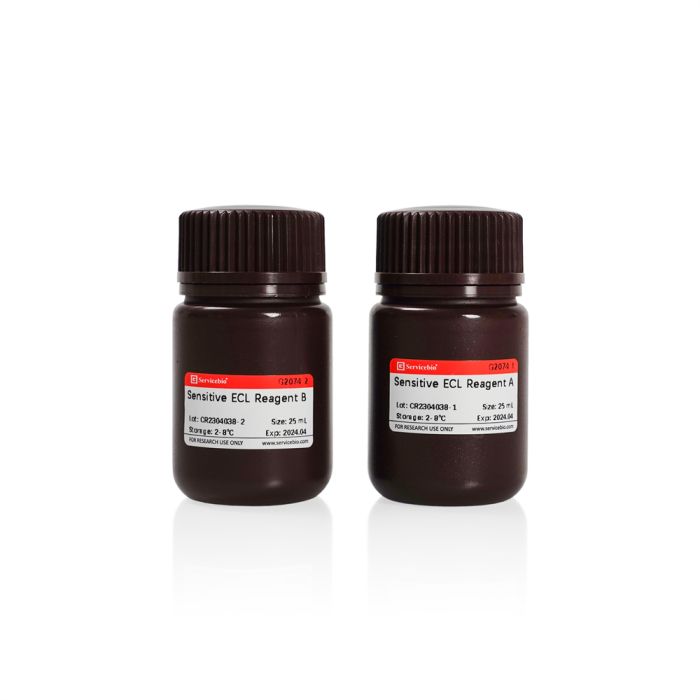
Sensitive ECL Chemiluminescent Kit (Picogram) servicebio G2074-50ML
$50.00
In stock
SKU
G2074-50ML
Product Information
| Product Name: Sensitive ECL Chemiluminescent Kit (Picogram) | Cat. No.: G2074-50ML |
| Spec.: 2×25 mL | G2074-100ML |
| 2×50 mL | G2074-500ML |
| 2×250 mL |
Product Description
This product is a chemiluminescence kit with high sensitivity, the basic principle is luminol-based chemiluminescence; it can react with horseradish peroxidase (HRP) coupled to the secondary antibody and emit light, which can be detected by X-ray film exposure or other imaging methods (e.g., fluorescence or chemiluminescence imaging equipment); Low concentration samples can still detect signals and save samples. After incubation with low concentration of antibodies (primary antibody and secondary antibody), the signal can still be detected and precious antibodies can be saved, and the signal value is at least 10 times higher than that of normal ECL chemiluminescence kit (G2014).
Shipping and Storage
Ship with wet ice; Store at 2-8℃, valid for 12 months.
Product Components
| Component Number: G2074-1 | Component: Sensitive ECL Solution A |
| G 2074- 50 ML: 25 mL | G 2074- 1 00 ML: 50 mL |
| G 2074- 5 00 ML: 250 mL | Component Number: G2074-2 |
| Component: Sensitive ECL Solution B | G 2074- 50 ML: 25 mL |
| G 2074- 1 00 ML: 50 mL | G 2074- 5 00 ML: 250 mL |
| Manual | 1 pc |
Assay Protocol/Procedures
1. Preparation of ECL working solution: Mix ECL solution A and ECL solution B in equal volume, room temperature preparation, ready to use.
2. In the Western Blot experiment, the PVDF membrane (or NC membrane) was incubated with the secondary antibody, washed several times, and the excess liquid was removed by filter paper; the membrane was placed in the middle of two pieces of clean cling film (or PE gloves), and the ECL working solution was added to cover the surface of the membrane, and the process should be completed carefully to avoid the formation of air bubbles between the membrane.
3. After the full reaction, use filter paper or absorbent paper to absorb the excess ECL working liquid, and then carry out tablet pressing test or fluorescence imager detection.
4. Develop and fix the pressed film with developing and fixing reagents (recommended G2019, G2023, G2024) (ignore this step for fluorescence imager exposure); adjust the exposure conditions according to the intensity of luminescence.
Note
1. Be sure to change the pipette tips during pipetting of Reagent A and B to avoid cross-contamination, which may result in the failure of active components.
2. Please wear gloves and use clean equipment such as tweezers to avoid contamination by exogenous proteins and metal ions during contact with the membrane.
3. Sodium azide inhibits HRP activity and all related reagents should be avoided.
4. Please use up the ECL working solution within one day after it has been configured, do not leave it until the next day, so as not to affect the accuracy of the experimental results.
5. After the use of each solution, please keep the bottle tightly capped and keep it away from light to prevent failure; especially solution B, which contains oxidizing agents and is easily reduced and become ineffective. In addition, liquid A should not be stored close to the inner wall of the refrigerator to prevent the precipitation of crystals due to the local temperature is too low. If crystals are precipitated, dissolve and mix in 37℃ warm water bath before use.
6. ECL chemiluminescence reagent kit selection refer to Table 1, primary antibody and secondary antibody recommended dilution ratio test data are from self-research antibody.
7. Refer to Table 2 for common problems and solutions for ECL chemiluminescent assays.
8. ECL chemiluminescence kit A/B solution are harmful to human body, must be careful when handling, pay attention to effective protection, avoid direct contact with the human body or inhalation of the respiratory tract.
9. For your safety and health, please wear safety glasses, gloves, or protective clothing.
Table 1: ECL Chemiluminescent Kit Selection Reference Table
| Product Name: Cat. No. | Normal ECL Chemiluminescence Kit: G2014 |
| Sensitive ECL Chemiluminescent Kit: G2074 | Hypersensitive ECL Chemiluminescence Kit: G2020 |
| Product Name: Detection limit | Normal ECL Chemiluminescence Kit: Nanogram |
| Sensitive ECL Chemiluminescent Kit: Picogram | Hypersensitive ECL Chemiluminescence Kit: Femtogram |
| Product Name: Recommended dilution ratio of primary antibody (1 mg/mL storage solution) | Normal ECL Chemiluminescence Kit: 1:1000-1:5000 |
| Sensitive ECL Chemiluminescent Kit: 1:4000-1:10000 | Hypersensitive ECL Chemiluminescence Kit: 1:10000-30000 |
| Product Name: Recommended dilution ratio of secondary antibody(1 mg/mL storage solution) | Normal ECL Chemiluminescence Kit: 1:1000-1:6000 |
| Sensitive ECL Chemiluminescent Kit: 1:3000-1:60000 | Hypersensitive ECL Chemiluminescence Kit: 1:6000-150000 |
| Product Name: Characteristics and applicability | Normal ECL Chemiluminescence Kit: Wide range, broad applicability |
| Sensitive ECL Chemiluminescent Kit: Wide range, broad applicability, high sensitivity, medium-abundance proteins, antibody-sparing | Hypersensitive ECL Chemiluminescence Kit: Very high sensitivity, low abundance proteins, low or precious antibody potency |
Table2:Common problems and Solutions of ECL Chemiluminescence Detection
Switching to a more sensitive ECL chemiluminescence kit
| C ommon Pr oblems: High background (high background or no specific bands) | Possible C auses: Primary and secondary antibody dilution without using the correct buffer and concentration |
| Solutions: Appropriately reduce the dilution ratio, reduce the concentration of primary and secondary antibodies | Blocking time or washing time is too short, or blocking solution is incorrect |
| Phosphorylated protein assays should always be closed with BSA or protein-free closures; the smaller the membrane pore size, the longer the closure and elution time should be | Inadequate incubation of primary antibody |
| Appropriately prolonged incubation time (overnight incubation at 4°C) | C ommon Pr oblems: Weak or No Signal |
| Possible C auses: Low concentration of primary and secondary antibodies used | Solutions: Increase the concentration of primary and secondary antibodies used |
| Low protein abundance | Increase sample volume |
| C ommon Pr oblems: Rapid fluorescence burst, hollow bands (ghost bands) appear | Possible C auses: The fluorescence of the target band is too strong, which rapidly consumes the luminescent substrate, and after the substrate is consumed, it will be anti-white. |
| Solutions: Reduce the amount of protein uploaded or the amount of primary and secondary antibodies | C ommon Pr oblems: Brown or yellow bands appear on the membrane |
| Possible C auses: Over-abundance of HRP in the target region generates large amounts of free radicals, resulting in oxidative inactivation of HRP | Solutions: Reduce the amount of protein uploaded or the amount of primary and secondary antibodies |