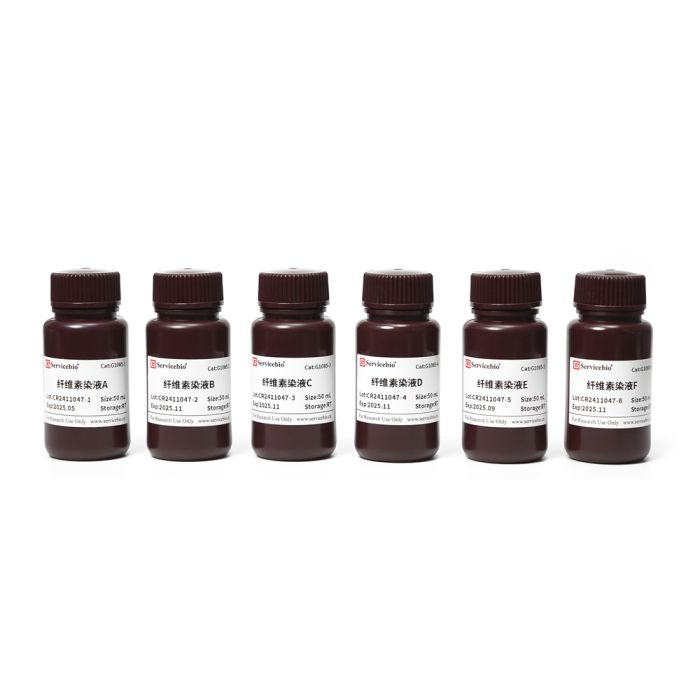
Cellulose Dyeing Kit (MSB method) servicebio G1085-50ML
$50.00
In stock
SKU
G1085-50ML
Product Information
| Product Name | Cat. No. |
| Spec.. | Cellulose Dyeing Kit (MSB method) |
| G1085-50ML | 6×50 mL |
Product Description/Introduction
Cellulose, also known as fibrin, is a special protein formed by the polymerization of fibrinogen molecules present in the blood. Cellulose can be linked to each other in a network, or can be fused with together.Cellulose staining is utilized to verify the presence of cellulose within tissues or the vascular lumen. The manifestation of cellulose in the tissue may result from the rupture of the blood vessel wall, leading to the direct overflow of blood components. Alternatively, it could be attributed to severe damage to the blood vessel wall, increasing its permeability and allowing fibrinogen molecules to pass through, a phenomenon frequently observed in localized inflammatory or allergic reactions.. Fibrinous exudates observed in conditions such as lobar pneumonia, diphtheria, bacillary dysentery and fibrinous pericarditis, along with inflammatory edema fluid in differentiated tissues (exudates, with fibrinous) and leaky fluid (no fibrinous), thrombosis, thromboembolism and disseminated intravascular coagulation (DIC), rheumatic granuloma, arteriolar walls of malignant hypertension, and some diseased connective tissue can all be effectively demonstrated and identified through cellulose staining (MSB).
The principle of this product's cellulose dyeing kit (MSB method) is to selectively stain high-density red blood cells using low-molecular-weight Martius Yellow, followed by the use of medium-molecular-weight acid magenta and ponceau to dye cellulose and muscle fibers red, and finally employing high-macromolecular-weight aniline blue to stain loose collagen fibers blue. This method is often used in the investigation of inflammation, connective tissue diseases and myocardial diseases, which are primarily characterized by cellulose exudation.
Storage and Shipping Conditions
Store at room temperature away from light for 12 months.
Product Content
| Component Number | Component |
| G1085-50ML | G1085-1 |
| Cellulose Dyeing Kit (MSB method) solution A | 50 mL |
| G1085-2 | Cellulose Dyeing Kit (MSB method) solution B |
| 50 mL | G1085-3 |
| Cellulose Dyeing Kit (MSB method) solution C | 50 mL |
| G1085-4 | Cellulose Dyeing Kit (MSB method) solution D |
| 50 mL | G1085-5 |
| Cellulose Dyeing Kit (MSB method) solution E | 50 mL |
| G1085-6 | Cellulose Dyeing Kit (MSB method) solution F |
| 50 mL | G1085-7 |
| Cellulose Dyeing Kit (MSB method) pretreatment solution | 50 mL |
| Manual | 1 pc |
Assay Protocol / Procedures
1. Slice preparation
Paraffin sections: Put the slice into Environmental dewaxing solution (G1128) Ⅰ10 min- Environmental dewaxing solution (G1128) Ⅱ10 min- Environmental dewaxing solution (G1128) Ⅲ10 min- anhydrous ethanol Ⅰ5 min- anhydrous ethanol Ⅱ5 min- anhydrous ethanol Ⅲ5 min- wash with distilled water
Frozen slice: After the slice is taken out of the -20℃ refrigerator, it is reheated at room temperature for 10 min, and then immersed in pure water for 5 min before use.
2. Pretreatment: The sections are immersed in the Cellulose Dyeing Kit (MSB method) pretreatment solution and placed in the oven at 65℃ for 30 min. At the same time, the Cellulose Dyeing Kit (MSB method) solution D and Cellulose Dyeing Kit (MSB method) solution F are preheated in a 55℃ water bath.
3. Cellulose Dyeing Kit (MSB method) solution A and Cellulose Dyeing Kit (MSB method) solution B are mixed in equal proportion and left for 1 min. Sections are stained in the mixed solution for 3 min, then washed with tap water, differentiated into 1% hydrochloric acid alcohol solution for 3-4 s, and washed with tap water.
4. Put slice into 95% ethanol and wash slightly, then stain in Cellulose Dyeing Kit (MSB method) solution C for 3 min, and wash with running water.
5. Put slice into Cellulose Dyeing Kit (MSB method) solution D for 15-25 min, and wash with tap water.
6. Put slice into the Cellulose Dyeing Kit (MSB method) solution E impregnated for 1 min, and wash with tap water.
7. Put slice into the Cellulose Dyeing Kit (MSB method) solution F staining 15-25 s.
8. Put slice rapidly into three cylinders of 1% acetic acid solution for differentiation,about 3 s per cylinder.
9. Put slice into three cylinders of anhydrous ethanol for 10 s each, two cylinders of xylene transparent for 5 min each, then seal with neutral gum.
Staining result
Red blood cells are colored yellow, cellulose is colored red, collagen fibers are colored blue, platelets are colored gray.
Note
1. The staining time of liquid D was 15 min for kidney and 25 min for thrombus heart and blood vessels. Cellulose Dyeing Kit (MSB method) solution F staining time was 15 s for thrombus and 25 s for kidney, heart and blood vessels. If the time is too long, the situation of over-dyeing is likely to occur.
2. If you feel that the red background is too deep, you can extend it to 20 s when you pass the first cylinder of alcohol at step 9, you can wash off the excess background, but the specific red color will not fade.
3. If the red and blue are too dark, they can be faded in 1% ammonia solution and then re-dyed.
4. If the color of the C solution of the Cellulose Dyeing Kit (MSB method) is light in yellow, you need to replace the dye solution.
5. On the one hand, the treatment of Cellulose Dyeing Kit (MSB method) solution E is to differentiate the red collagen fibers to nearly colorless; On the other hand, it acts as a mordant for collagen fiber, which makes collagen fiber and F liquid bond more firmly.
6. After dyeing with F solution, 1% glacial acetic acid solution can make the slices bright and clear.
7. When using this kit for the first time, it is recommended to take 1-2 samples for pre-test to determine the appropriate staining and differentiation time.
For your safety and health, please wear a lab coat and disposable gloves.