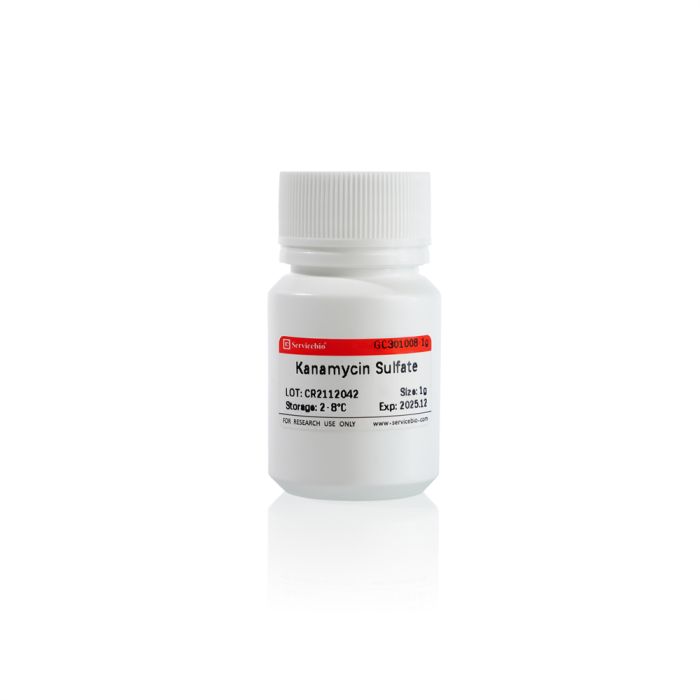
Kanamycin Sulfate servicebio GC301008-1g
$50.00
In stock
SKU
GC301008-1g
Product Information
| Product Name | Cat. No. |
| Spec. | Kanamycin Sulfate |
| GC301008-1g | 1 g |
| GC301008-5g | 5 g |
Introduction
Kanamycin sulfate is an aminoglycoside antibiotic that inhibits Gram-positive and gram-negative bacteria as well as mycoplasma. The mechanism of action is to target the binding of 70S ribosomal subunit in bacteria, thereby inhibiting ribosomal translocation and causing miscoding to further interfere with protein synthesis. Kanamycin sulfate can be used to inhibit bacterial contamination in cell culture. In molecular biology, it is often used to selectively screen bacterial clones that successfully transformed kanamycin resistance gene (Kan gene). It is also commonly used in Agrobacterium mediated transformation experiments to selectively screen plant tissues carrying NPT II (APH3) gene. This product is USP grade and easily soluble in water (50 mg/ml). It should be used after filtration and sterilization. The recommended working concentration is 30-50 µg/ml.
Basic Attributes
| Name | Kanamycin sulfate |
| Synonym | Kanamycin |
| CAS | 25389-94-0 |
| Molecular formula | C18H36N4O11·H2SO4 |
| Molecular mass | 582.58 |
| Purity | USP,potency (Anhybrous) (mcg/mg) ≥750 |
| Appearance (character) | White powder |
| Storage conditions | 2-8℃ |
| Unit | Bottle |
| Spec. | 1 g, 5 g |
| Pubchem CID | 441374 |
| MDL No. | MFCD00070289 |
| EC No. | 246-933-9 |
| Related categories | Biochemical reagent, Anti-biotic |
| Solubility | 100 mg/mL in Water |
| Validity | 36 months |
Storage and Handling Conditions
Transport and storage at 2-8℃, valid for 36 months.
Instruction
The usage and dosage of biochemical reagents are mainly based on the customer's experimental purpose and the experimental methods in the existing literature or books, and the following uses are for reference only.
1. It is commonly used in molecular biology to selectively screen for bacterial clones that have successfully transformed the kanamycin resistance gene (kan gene). It is soluble in water (50 mg/ml) and should be filtered and sterilized for use at a recommended working concentration of 30-100 µg/ml. (i.e., 30-100 µg in 1 ml of deionized water).
2. It is used in Agrobacterium-mediated transformation experiments to selectively screen plant tissues carrying the npt II (APH3) gene. It is soluble in water (50 mg/ml) and should be filtered and sterilized for use. The recommended working concentration is 30-100 µg/ml (i.e., take 30-100 µg, dissolve in 1ml of deionized water).
Note
For your safety and health, please wear lab coat and disposable gloves.
Security Information
| Warning statement | P201,P308+P313 |
| RTECS | NZ3225030 |
| WGK | 3 |
Note: The product may be optimized and upgraded. The actual label information shall prevail.
For Research Use Only!