WB (FAQ Protocol), ELISA (FAQ Protocol), IP (FAQ Protocol)
Species reactivity
Reacts with: Rat
Specificity
Rat Ephrin-B1
Immunogen
Recombinant Rat Ephrin-B1 / EFNB1 protein (Catalog#80106-R08H)
Preparation
Produced in rabbits immunized with purified, recombinant Rat Ephrin-B1 / EFNB1 (Catalog#80106-R08H; P52796; Met1-Thr229). Ephrin-B1 / EFNB1 specific IgG was purified by Rat Ephrin-B1 / EFNB1 affinity chromatography.
Source
Polyclonal Rabbit IgG
Purification
Protein A & Antigen Affinity
Formulation
0.2 μm filtered solution in PBS
Conjugate
Unconjugated
Form
Liquid
Shipping
This antibody is shipped as liquid solution at ambient temperature. Upon receipt, store it immediately at the temperature recommended below.
Storage
This antibody can be stored at 2℃-8℃ for one month without detectable loss of activity. Antibody products are stable for twelve months from date of receipt when stored at -20℃ to -80℃. Preservative-Free. Avoid repeated freeze-thaw cycles.
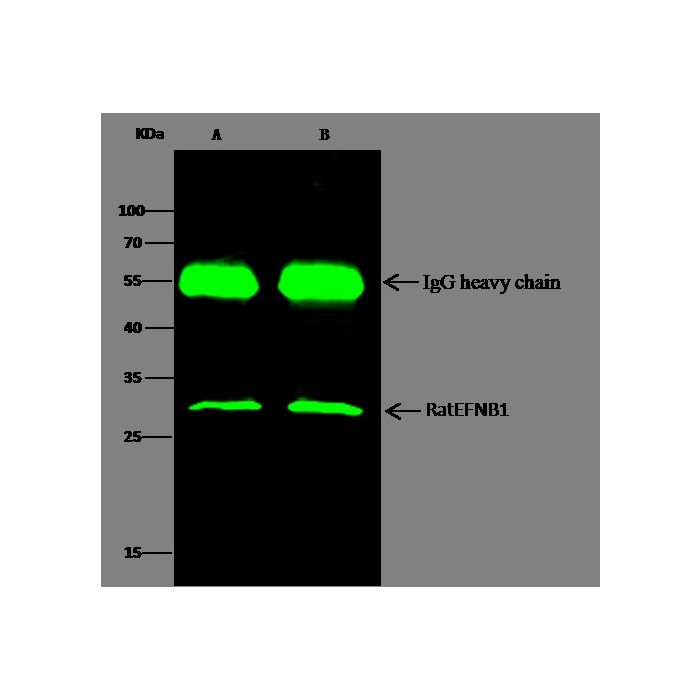
rat EFNB1 was immunoprecipitated using: Lane A:0.5 mg Hela Whole Cell Lysate Lane B:0.5 mg HepG2 Whole Cell Lysate 2 µL anti-rat EFNB1 rabbit polyclonal antibody and 15 μl of 50 % Protein G agarose. Primary antibody: Anti-rat EFNB1 rabbit polyclonal antibody,at 1:500 dilution Secondary antibody: Dylight 800-labeled antibody to rabbit IgG (H+L), at 1:5000 dilution Developed using the odssey technique. Performed under reducing conditions. Predicted band size: 33 kDa Observed band size: 33 kDa
rat EFNB1 was immunoprecipitated using: Lane A:0.5 mg Hela Whole Cell Lysate Lane B:0.5 mg HepG2 Whole Cell Lysate 2 µL anti-rat EFNB1 rabbit polyclonal antibody and 15 μl of 50 % Protein G agarose. Primary antibody: Anti-rat EFNB1 rabbit polyclonal antibody,at 1:500 dilution Secondary antibody: Dylight 800-labeled antibody to rabbit IgG (H+L), at 1:5000 dilution Developed using the odssey technique. Performed under reducing conditions. Predicted band size: 33 kDa Observed band size: 33 kDa
Ephrin-B1 also known as EFNB1, is a member of the ephrin family. The transmembrane- associated ephrin ligands and their Eph family of receptor tyrosine kinases are expressed by cells of the SVZ. Eph/ephrin interactions are implicated in axon guidance, neural crest cell migration, establishment of segmental boundaries, and formation of angiogenic capillary plexi. Eph receptors and ephrins are divided into two subclasses, A and B, based on binding specificities. Ephrin subclasses are further distinguished by their mode of attachment to the plasma membrane: ephrin-A ligands bind EphA receptors and are anchored to the plasma membrane via a glycosylphosphatidylinositol (GPI) linkage, whereas ephrin-B ligands bind EphB receptors and are anchored via a transmembrane domain. An exception is the EphA4 receptor, which binds both subclasses of ephrins. EphrinB1 and B class Eph receptors provide positional cues required for the normal morphogenesis of skeletal elements. Another malformation, preaxial polydactyly, was exclusively seen in heterozygous females in which expression of the X-linked ephrinB1 gene was mosaic, so that ectopic EphB-ephrinB1 interactions led to restricted cell movements and the bifurcation of digital rays.
References
Davy A, et al. (2004) Ephrin-B1 forward and reverse signaling are required during mouse development. Genes Dev. 18(5): 572-83.
Compagni A, et al. (2003) Control of skeletal patterning by ephrinB1-EphB interactions. Dev Cell. 5(2): 217-30.
Wieland I, et al. (2004) Mutations of the ephrin-B1 gene cause craniofrontonasal syndrome. Am J Hum Genet. 74(6): 1209-15.


-HB08JU0612-IP.png)
-HB08JU0612-WB.png)