Recombinant Anti-CD4 Antibody, Rabbit Monoclonal sinobiological 50134-R766

$114.00
In stock
SKU
50134-R766
Catalog No.SizePrice (USD)
50134-R766-2020 µL$118.49
50134-R766-5050 µL$177.58
50134-R766-100100 µL$340.51

General Information

Product nameRecombinant Anti-CD4 Antibody, Rabbit Monoclonal
Validated applicationsIHC-P (FAQ Protocol)
Species reactivityReacts with: Mouse
SpecificityMouse CD4
ImmunogenRecombinant Mouse CD4 Protein (Catalog#50134-M08H)
PreparationThis antibody was obtained from a rabbit immunized with purified, recombinant Mouse CD4 (rM CD4; Catalog#50134-M08H; NP_038516.1; Met1-Thr394).
SourceMonoclonal Rabbit IgG Clone #766
PurificationProtein A
Formulation0.2 μm filtered solution in PBS
ConjugateUnconjugated
FormLiquid
ShippingThis antibody is shipped as liquid solution at ambient temperature. Upon receipt, store it immediately at the temperature recommended below.
StorageThis antibody can be stored at 2℃-8℃ for one month without detectable loss of activity. Antibody products are stable for twelve months from date of receipt when stored at -20℃ to -80℃. Preservative-Free. Avoid repeated freeze-thaw cycles.

Synonyms: Anti-Cd4 Antibody; Anti-L3T4 Antibody; Anti-Ly-4 Antibody

Image / Experimental Information

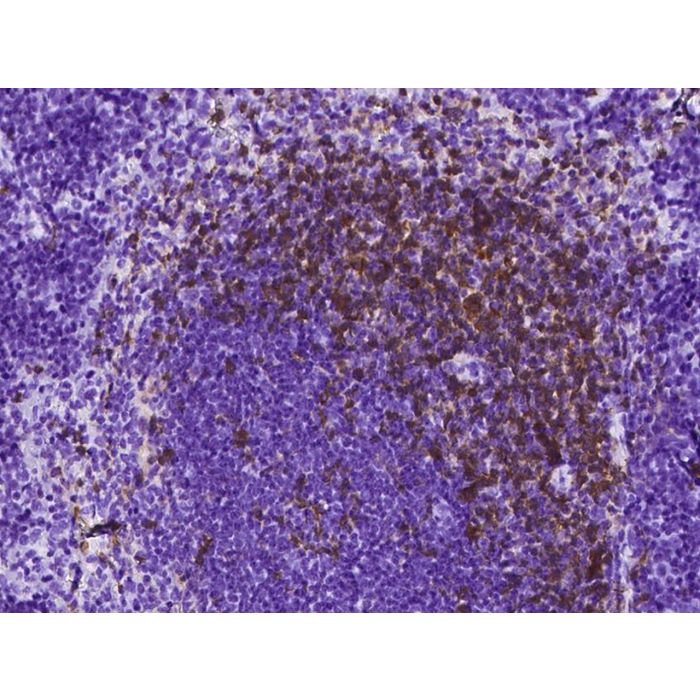
Image 1 DescriptionImmunochemical staining of mouse CD4 in mouse spleen with rabbit monoclonal antibody at 1:200 dilution, formalin-fixed paraffin embedded sections.
Image 1 Alt TextMouse CD4 Immunohistochemistry(IHC) 22683
Image 1 URLSource image
Image 2 DescriptionImmunochemical staining of mouse CD4 in mouse spleen with rabbit monoclonal antibody at 1:200 dilution, formalin-fixed paraffin embedded sections.
Image 2 Alt TextMouse CD4 Immunohistochemistry(IHC) 22684
Image 2 URLSource image
Image 3 DescriptionImmunochemical staining of mouse CD4 in mouse spleen with rabbit monoclonal antibody at 1:200 dilution, formalin-fixed paraffin embedded sections.
Image 3 Alt TextMouse CD4 Immunohistochemistry(IHC) 22685
Image 3 URLSource image

Background Information

Full NameCD4 molecule
DescriptionT-cell surface glycoprotein CD4, is a single-pass type I membrane protein. CD4 contains three Ig-like C2-type (immunoglobulin-like) domains and one Ig-like V-type (immunoglobulin-like) domain. CD4 is a glycoprotein expressed on the surface of T helper cells, regulatory T cells, monocytes, macrophages, and dendritic cells. The CD4 surface determinant, previously associated as a phenotypic marker for helper/inducer subsets of T lymphocytes, has now been critically identified as the binding/entry protein for human immunodeficiency viruses (HIV). The human CD4 molecule is readily detectable on monocytes, T lymphocytes, and brain tissues. All human tissue sources of CD4 bind radiolabeled gp120 to the same relative degree; however, the murine homologous protein, L3T4, does not bind the HIV envelope protein. CD4 is a co-receptor that assists the T cell receptor (TCR) to activate its T cell following an interaction with an antigen-presenting cell. Using its portion that resides inside the T cell, CD4 amplifies the signal generated by the TCR. CD4 interacts directly with MHC class II molecules on the surface of the antigen-presenting cell via its extracellular domain. The CD4 molecule is currently the object of intense interest and investigation both because of its role in normal T-cell function, and because of its role in HIV infection. CD4 is a primary receptor used by HIV-1 to gain entry into host T cells. HIV infection leads to a progressive reduction of the number of T cells possessing CD4 receptors. Viral protein U (VpU) of HIV-1 plays an important role in downregulation of the main HIV-1 receptor CD4 from the surface of infected cells. Physical binding of VpU to newly synthesized CD4 in the endoplasmic reticulum is an early step in a pathway leading to proteasomal degradation of CD4. Amino acids in both helices found in the cytoplasmic region of VpU in membrane-mimicking detergent micelles experience chemical shift perturbations upon binding to CD4, whereas amino acids between the two helices and at the C-terminus of VpU show no or only small changes, respectively. Paramagnetic spin labels were attached at three sequence positions of a CD4 peptide comprising the transmembrane and cytosolic domains of the receptor. VpU binds to a membrane-proximal region in the cytoplasmic domain of CD4.
Related Pathways
  • NF-kB (NFkB) Pathway
  • T Cell Receptor Signaling Pathway
References
  1. Farrar WL, et al. (1988) Characterization of CD4 glycoprotein determinant-HIV envelope protein interactions: perspectives for analog and vaccine development. Crit Rev Immunol. 8(4): 315-39.
  2. Biddison WE, et al. (1989) CD4 expression and function in HLA class II-specific T cells. Immunol Rev. 109: 5-15.
  3. Singh SK, et al. (2012) Mapping the interaction between the cytoplasmic domains of HIV-1 viral protein U and human CD4 with NMR spectroscopy. FEBS J. 279(19):3705-14.

title: HMG Box-containing Protein 1 (HBP1) Protects Against Pancreatic Injury in Acute Pancreatitis but Promotes Neoplastic Progression
authors: Seung-Won Lee; Taelor Ekstrom; ...; Jungsun Kim
journal: Cellular and molecular gastroenterology and hepatology
date: 2025-01-01
pmid: 40404099
doi: 10.1016/j.jcmgh.2025.101536
cited_by_count: 1
techniques: Activation Assay; Blocking Assay; Expressing; Immunohistochemistry; Immunostaining; Incubation; Marker
bioz_score: 93

title: Expression of the membrane tetraspanin claudin 18 on cancer cells promotes T lymphocyte infiltration and antitumor immunity in pancreatic cancer.
authors: Francesco De Sanctis; Silvia Dusi; ...; Vincenzo Bronte
journal: Immunity
date: 2024-06-12
pmid: 38749447
doi: 10.1016/j.immuni.2024.04.021
cited_by_count: 17
techniques: Amplex Red Cholesterol Assay; Bicinchoninic Acid Protein Assay; Control; Enzyme-linked Immunosorbent Assay; Extraction; Infection; Labeling; Lysis; Membrane; Microarray; Phospholipid Assay; Plasmid Preparation; Protease Inhibitor; Purification; Recombinant; Reverse Transcription; SYBR Green Assay; Staining; Transfection; Virus; cDNA Synthesis
bioz_score: 93

title: Preclinical characterization and phase 1 results of ADG106 in patients with advanced solid tumors and non-Hodgkin's lymphoma.
authors: Yuxiang Ma; Fan Luo; ...; Hongyun Zhao
journal: Cell Reports Medicine
date: 2024-02-23
pmid: 38330942
doi: 10.1016/j.xcrm.2024.101414
cited_by_count: 11
techniques: ATP Bioluminescent Assay; Activation Assay; Activity Assay; Bioprocessing; Cell Culture; Concentration Assay; Control; Enzyme-linked Immunosorbent Assay; Expressing; Histopathology; Immunohistochemistry; Incubation; Isolation; Luciferase; Staining
bioz_score: 93

title: Anti-tumor activity of intratumoral xenogeneic urothelial cell monotherapy or in combination with chemotherapy in syngeneic murine models of bladder cancer
authors: Chi-Ping Huang; Hsin-Ling Lu; Chih-Rong Shyr
journal: American journal of cancer research
date: 2023-06-15
pmid: 37424801
pmcid: 10326576
cited_by_count: 5
techniques: Cytometry; Enzyme-linked Immunosorbent Assay; Fluorescence; Immunohistochemistry; Incubation; Isolation; Light Microscopy; Quantitation Assay; Software; Staining
bioz_score: 93

title: Intratumoral xenogeneic tissue-specific cell immunotherapy inhibits tumor growth by increasing antitumor immunity in murine triple negative breast and pancreatic tumor models.
authors: Chi-Ping Huang; Liang-Chih Liu; ...; Chih-Rong Shyr
journal: Cancer letters
date: 2022-08-16
pmid: 35902043
doi: 10.1016/j.canlet.2021.10.044
cited_by_count: 11
techniques: Control; Immunohistochemistry; Incubation; Light Microscopy; Staining
bioz_score: 93

title: Single-dose immunisation with a multimerised SARS-CoV-2 receptor binding domain (RBD) induces an enhanced and protective response in mice.
authors: Ralf Salzer; Jordan J Clark; ...; Jan Löwe
journal: FEBS letters
date: 2021-10-13
pmid: 34331769
cited_by_count: 24
techniques: Blocking Assay; Incubation
bioz_score: 93

Reviews

Write Your Own Review
You're reviewing:Recombinant Anti-CD4 Antibody, Rabbit Monoclonal sinobiological 50134-R766
Your Rating
Copyright © 2025 Biogege, Inc. All rights reserved.