Produced in rabbits immunized with E. coli-derived Human CD6 fragment, and purified by antigen affinity chromatography.
Source
Polyclonal Rabbit IgG
Purification
Protein A & Antigen Affinity
Formulation
PBS, pH7.0 with 0.03% Proclin300
Conjugate
Unconjugated
Form
Liquid
Shipping
This antibody is shipped as liquid solution at ambient temperature. Upon receipt, store it immediately at the temperature recommended below.
Storage
This antibody can be stored at 2℃-8℃ for one month without detectable loss of activity. Antibody products are stable for twelve months from date of receipt when stored at -20℃ to -80℃. Avoid repeated freeze-thaw cycles.
Synonyms: Anti-TP120 Antibody
Image / Experimental Information
Image 1 Description
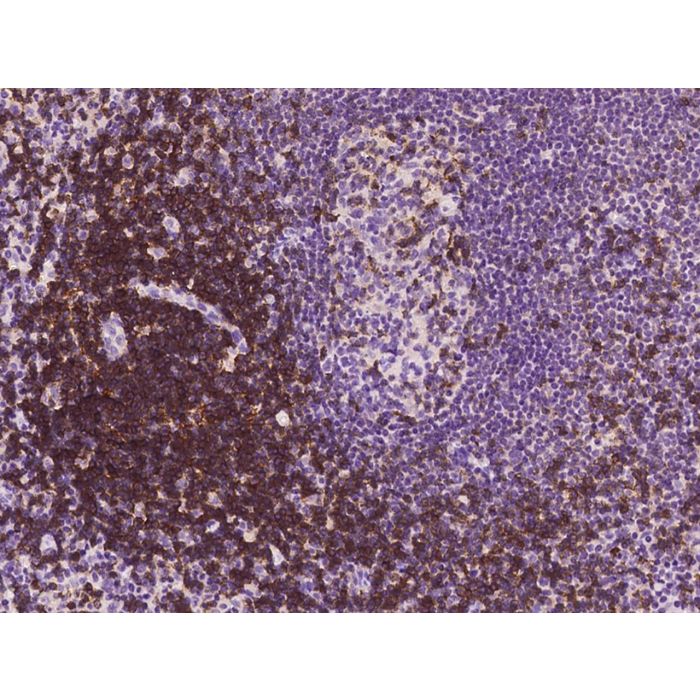
Immunochemical staining of human CD6 in human lymph node with rabbit polyclonal antibody at 1:100 dilution, formalin-fixed paraffin embedded sections.
T-cell differentiation antigen CD6, also known as TP12 and CD6, is a single-pass type I membrane protein which contains threeSRCR domains. CD6 / TP12 is a cell surface glycoprotein expressed primarily on T cells, it may function as a costimulatory molecule and may play a role in autoreactive immune responses. CD6 / TP12 is expressed by thymocytes, mature T-cells, a subset of B-cells known as B-1 cells, and by some cells in the brain. CD6 ligand termed CD166 (previously known as activated leukocyte cell adhesion molecule, ALCAM ) has been identified and shown to be expressed on activated T cells, B cells, thymic epithelium, keratinocytes, and in rheumatoid arthritis synovial tissue. CD6 / TP12 binds to activated leukocyte cell adhesion molecule ( CD166 ), and is considered as a costimulatory molecule involved in lymphocyte activation and thymocyte development. CD6 / TP12 partially associates with the TCR / CD3 complex and colocalizes with it at the center of the mature immunological synapse (IS) on T lymphocytes. During thymic development CD6-dependent signals may contribute both to thymocyte survival, and to the overall functional avidity of selection in both man and mouse.
Research Areas
ITIM/ITAM Immunoreceptors and Related Molecules
References
Joo YS. et al., 2000, Arthritis Rheum. 43 (2): 329-35.
Singer NG. et al., 2002, Int Immunol. 14 (6): 585-97.
Gimferrer I. et al., 2005, J Immunol. 175 (3): 1406-14.
Alonso R. et al., 2010, J Autoimmun. 35 (4): 336-41.

-HD12JL0903-100-human-lymph-node-IHC-P.png)
-HD12JL0903-100-human-spleen-IHC-P.png)