
Anti-CD69 Antibody, Rabbit Polyclonal sinobiological 50731-T50
$243.00
In stock
SKU
50731-T50
| Catalog No. | Size | Price (USD) |
| 50731-T50-100 | 100 µL | $251.64 |
| Catalog No. | Size | Price (USD) |
| 50731-T50-100 | 100 µL | $251.64 |
General Information
| Product name | Anti-CD69 Antibody, Rabbit Polyclonal |
| Validated applications | WB (FAQ Protocol), ELISA (FAQ Protocol), ICC/IF (FAQ Protocol) |
| Species reactivity | Reacts with: Mouse |
| Specificity | Mouse CD69 |
| Immunogen | Recombinant Mouse CD69 Protein (Catalog#50731-M08H) |
| Preparation | Produced in rabbits immunized with purified, recombinant Mouse CD69 (rM CD69; Catalog#50731-M08H; NP_001028294.1; Asn62-Arg199). CD69 specific IgG was purified by Mouse CD69 affinity chromatography. |
| Source | Polyclonal Rabbit IgG |
| Purification | Protein A & Antigen Affinity |
| Formulation | 0.2 μm filtered solution in PBS |
| Conjugate | Unconjugated |
| Form | Liquid |
| Shipping | This antibody is shipped as liquid solution at ambient temperature. Upon receipt, store it immediately at the temperature recommended below. |
| Storage | This antibody can be stored at 2℃-8℃ for one month without detectable loss of activity. Antibody products are stable for twelve months from date of receipt when stored at -20℃ to -80℃. Preservative-Free. Avoid repeated freeze-thaw cycles. |
Synonyms: Anti-5830438K24Rik Antibody; Anti-AIM Antibody; Anti-Cd69 Antibody; Anti-VEA Antibody
Image / Experimental Information
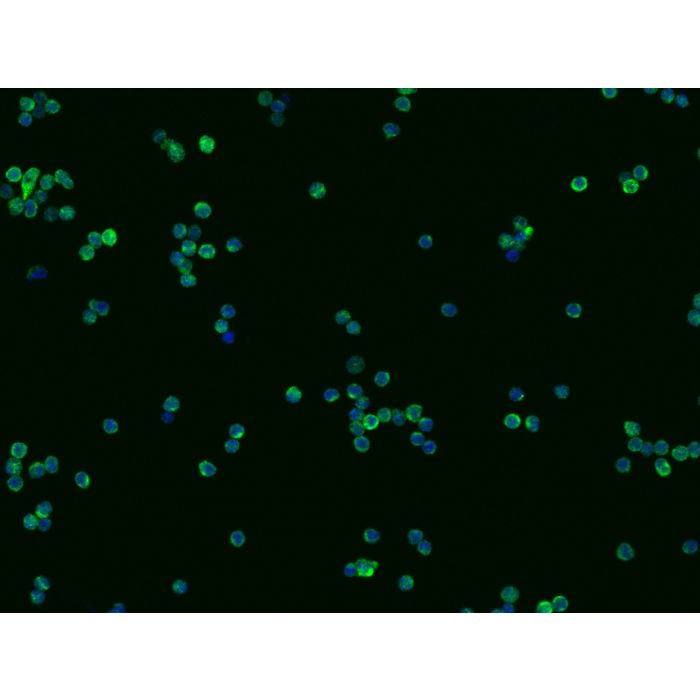
| Image 1 Description | Immunofluorescence staining of S3-mCD69-His in mouse splenocytes cells. Cells were fixed with 4% PFA, permeabilzed with 0.3% Triton X-100 in PBS,blocked with 10% serum, and incubated with rabbit anti-mouse S3-mCD69-His polyclonal antibody (dilution ratio 1:100) at 4℃ overnight. Then cells were stained with the Alexa Fluor®488-conjugated Goat Anti-rabbit IgG secondary antibody (green) and counterstained with DAPI (blue).Positive staining was localized to Cytoplasm. |
| Image 1 Alt Text | Mouse CD69 Immunofluorescence(IF) 36884 |
| Image 1 URL | Source image |
| Image 2 Description | Immunofluorescence staining of S3-mCD69-His in mouse splenocytes cells. Cells were fixed with 4% PFA, permeabilzed with 0.3% Triton X-100 in PBS,blocked with 10% serum, and incubated with rabbit anti-mouse S3-mCD69-His polyclonal antibody (dilution ratio 1:100) at 4℃ overnight. Then cells were stained with the Alexa Fluor®488-conjugated Goat Anti-rabbit IgG secondary antibody (green) and counterstained with DAPI (blue).Positive staining was localized to Cytoplasm. |
| Image 2 Alt Text | Mouse CD69 Western blot (WB) 36883 |
| Image 2 URL | Source image |
Background Information
| Full Name | CD69 molecule |
| Description | Early activation antigen CD69, also known as activation inducer molecule (AIM), is a single-pass type II membrane protein. Recently, cDNA clones encoding human and mouse CD69 were isolated and showed CD69 to be a member of the C-type lectin superfamily. It is one of the earliest cell surface antigens expressed by T cells following activation. Once expressed, CD69 acts as a costimulatory molecule for T cell activation and proliferation. In addition to mature T cells, CD69 is inducibly expressed by immature thymocytes, B cells, natural killer (NK) cells, monocytes, neutrophils and eosinophils, and is constitutively expressed by mature thymocytes and platelets. CD69 is involved in lymphocyte proliferation and functions as a signal transmitting receptor in lymphocytes, natural killer (NK) cells, and platelets. The structure, chromosomal localization, expression and function of CD69 suggest that it is likely a pleiotropic immune regulator , potentially important in the activation and differentiation of a wide variety of hematopoietic cells. This membrane molecule transiently expresses on activated lymphocytes, and its selective expression in inflammatory infiltrates suggests that it plays a role in the pathogenesis of inflammatory diseases. CD69 plays a crucial role in the pathogenesis of allergen-induced eosinophilic airway inflammation and hyperresponsiveness and that CD69 could be a possible therapeutic target for asthmatic patients. |
| References |
|
-HD16NO2835-100-mouse splenocytes-IF.png)
-HD16NO2835-WB.png)