Recombinant Human CD8 alpha/CD8A Protein (Catalog#10980-H08H)
Preparation
This antibody was produced from a hybridoma resulting from the fusion of a mouse myeloma with B cells obtained from a mouse immunized with purified, recombinant Human CD8 alpha/CD8A (rh CD8 alpha/CD8A; Catalog#10980-H08H; NP_001759.3; Met1-Asp182) and conjugated with FITC under optimum conditions, the unreacted FITC was removed.
Source
Monoclonal Mouse IgG2b Clone #48
Purification
Protein A
Formulation
PBS solution containing 0.5% BSA and 0.03%ProClin300
Concentration
5 μl/Test, 0.1 mg/ml
Conjugate
FITC
Form
Liquid
Shipping
This antibody is shipped as liquid solution at ambient temperature. Upon receipt, store it immediately at the temperature recommended below.
Storage
This antibody can be stored at 2℃-8℃ for twelve months without detectable loss of activity. Protected from prolonged exposure to light. Do not freeze !
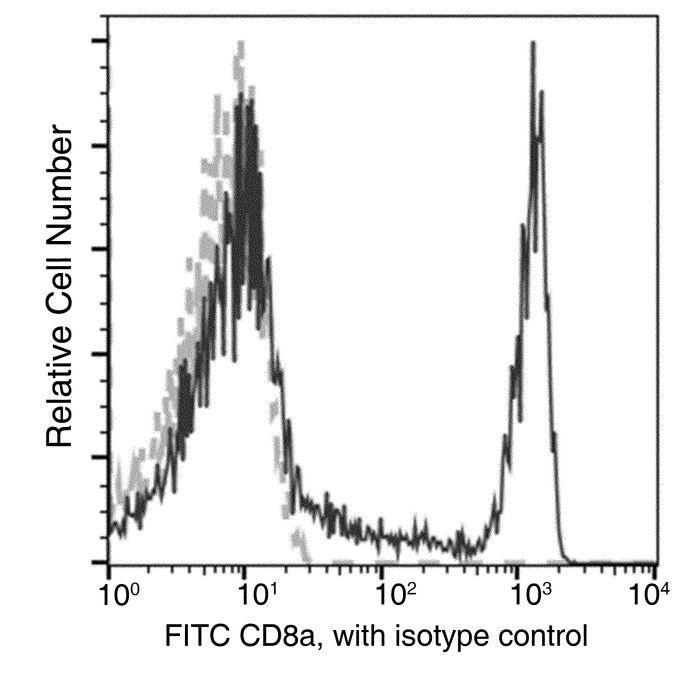
Flow cytometric analysis of Human CD8a expression on human whole blood lymphocyte. Cells were stained with FITC-conjugated anti-Human CD8a. The fluorescence histograms were derived from gated events with the forward and side light-scatter characteristics of viable lymphocytes.
T-cell surface glycoprotein CD8 alpha chain, also known as CD8a, is a single-pass type I membrane protein. The CD8 glycoprotein is expressed by thymocytes, mature T cells and natural killer (NK) cells and has been implicated in the recognition of monomorphic determinants on major histocompatibility complex (MHC) Class I antigens, and in signal transduction during the course of T-cell activation. Both human and rodent CD8 antigens are comprised of two distinct polypeptide chains, alpha and beta. The Ig domains of CD8 alpha are involved in controlling the ability of CD8 to be expressed. Mutation of B- and F-strand cysteine residues in CD8 alpha reduced the ability of the protein to fold properly and, therefore, to be expressed. Defects in CD8A are a cause of familial CD8 deficiency. Familial CD8 deficiency is a novel autosomal recessive immunologic defect characterized by absence of CD8+ cells, leading to recurrent bacterial infections.