Supplied as sterile 50 mM Hepes, 150 mM NaCl, 10% Trehalose, pH 7.2. Please contact us for any concerns or special requirements. Please refer to the specific buffer information in the hardcopy of datasheet or the lot-specific COA.
Endotoxin
< 1.0 EU per μg of the protein as determined by the LAL method
Shipping
It is supplied and shipped as liquid with dry ice.
Stability & Storage
Samples are stable for up to twelve months from date of receipt at -70℃. Store it under sterile conditions at -70℃ or lower. It is recommended that the protein be aliquoted for optimal storage. Avoid repeated freeze-thaw cycles.
Activity
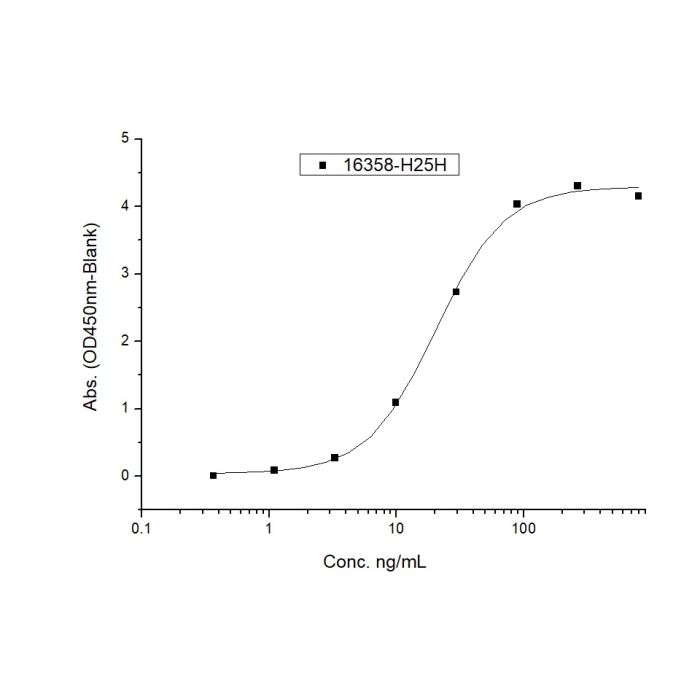
Immobilized Recombinant Human Claudin-4-VLP Protein (Cat:16358-H25H) at 5 μg/mL (100 μL/well) can bind Anti-Human Claudin-4 Monoclonal antibody, Human IgG1, the EC 50 is 10-30 ng/mL.
Protein Construction
A DNA sequence encoding the Human CLDN4-VLP (Full Length) (O14493) (Met1-Val209) was fused with a flag tag at the C-terminus.
Expressed Host
HEK293 Cells
Species
Human
Predicted N Terminal
Met 1
Molecule Mass
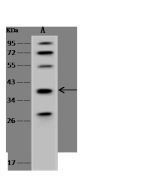
The recombinant Human CLDN4-VLP (Full Length) consisting of 222 amino acids and has a calculated molecular mass of 23.39 kDa.
Immobilized Recombinant Human Claudin-4-VLP Protein (Cat:16358-H25H) at 5 μg/mL (100 μL/well) can bind Anti-Human Claudin-4 Monoclonal antibody, Human IgG1, the EC 50 is 10-30 ng/mL.
CLDN4 (encoding claudin-4), a cell tight junction (TJ) protein, is highly expressed in human epithelial ovarian carcinomas (EOC) but undetectable in normal ovaries. Claudins form a large family of tight junction proteins that have essential roles in the control of paracellular ion flux and the maintenance of cell polarity. CLDN4 has been identified as a specific receptor for C terminus of Clostridium perfringens enterotoxin (C-CPE), a nontoxic molecule that may disrupt TJ barrier function and enhance cellular absorption. Claudin-4, encoding a protein for tight junction formation and function, is highly overexpressed in pancreatic ductal adenocarcinoma and is also associated with invasive adenocarcinomas arising in intraductal papillary mucinous neoplasms of the pancreas. Claudin-4 expression is associated with neoplastic progression of intraductal papillary mucinous neoplasms and, especially, with a distinct pathway to intestinal differentiation. CLDN4 is a tight junction protein involved in blood-brain barrier integrity.