Recombinant Human ACE2 Protein (Catalog#10108-H08H)
Preparation
This antibody was produced from a hybridoma resulting from the fusion of a mouse myeloma with B cells obtained from a mouse immunized with purified, recombinant Human ACE2 (rh ACE2; Catalog#10108-H08H; NP_068576.1; Met1-Ser740) and conjugated with PE under optimum conditions, the unreacted PE was removed.
Source
Monoclonal Mouse IgG1 Clone #37
Purification
Protein A
Formulation
PBS solution containing 0.5% BSA and 0.03%ProClin300
Concentration
5 μl/Test, 0.1 mg/ml
Conjugate
PE
Form
Liquid
Shipping
This antibody is shipped as liquid solution at ambient temperature. Upon receipt, store it immediately at the temperature recommended below.
Storage
This antibody can be stored at 2℃-8℃ for twelve months without detectable loss of activity. Protected from prolonged exposure to light. Do not freeze !
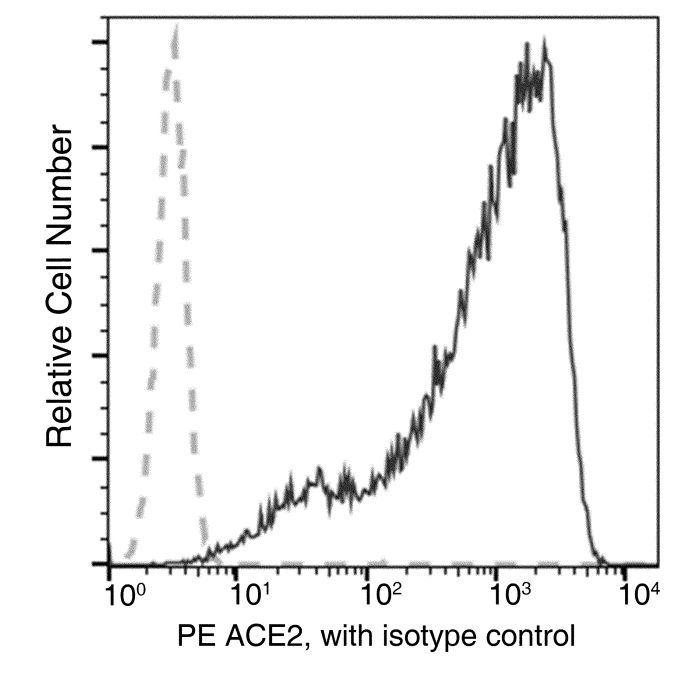
Flow cytometric analysis of Human ACE2 expression on ACE2-transfected 293T cells. Cells were stained with PE-conjugated anti-Human ACE2. The fluorescence histograms were derived from gated events with the forward and side light-scatter characteristics of intact cells.
Angiotensin-converting enzyme 2 (ACE2), a first homolog of ACE, regulates the renin angiotensin system (RAS) by counterbalancing ACE activity. Accumulating evidence in recent years has demonstrated a physiological and pathological role of ACE2 in the cardiovascular, renal and respiratory systems. ACE2 also has an important role in blood pressure control. This enzyme, an homolog of ACE, hydrolyzes angiotensin (Ang) I to produce Ang-(1-9), which is subsequently converted into Ang-(1-7) by a neutral endopeptidase and ACE. ACE2 releases Ang-(1-7) more efficiently than its catalysis of Ang-(1-9) by cleavage of Pro(7)-Phe(8) bound in Ang II. Thus, the major biologically active product of ACE2 is Ang-(1-7), which is considered to be a beneficial peptide of the RAS cascade in the cardiovascular system. A physiological role for ACE2 has been implicated in hypertension, cardiac function, heart function and diabetes, and as a receptor of the severe acute respiratory syndrome coronavirus. In the acute respiratory distress syndrome (ARDS), ACE, AngII, and AT1R promote the disease pathogenesis, whereas ACE2 and the AT2R protect from ARDS. Importantly, ACE2 has been identified as a key SARS-coronavirus receptor and plays a protective role in severe acute respiratory syndrome (SARS) pathogenesis. Furthermore, the recent explosion of research into the ACE2 homolog, collectrin, has revealed a new physiological function of ACE2 as an amino acid transporter, which explains the pathogenic role of gene mutations in Hartnup disorder. This review summarizes and discusses the recently unveiled roles for ACE2 in disease pathogenesis.
References
Koitka A, et al. (2008) Angiotensin converting enzyme 2 in the kidney. Clin Exp Pharmacol Physiol. 35(4): 420-5.
Raizada MK, et al. (2007) ACE2: a new target for cardiovascular disease therapeutics. J Cardiovasc Pharmacol. 50(2): 112-9.
Imai Y, et al. (2007) Angiotensin-converting enzyme 2 (ACE2) in disease pathogenesis. Circ J. 74(3): 405-10.
Turner AJ, et al. (2004) ACE2: from vasopeptidase to SARS virus receptor. Trends Pharmacol Sci. 25(6): 291-4.