Recombinant Human EGFR Protein (Site-Specific AF 647 Conjugation, ECD, His Tag) sinobiological 10001-H86H-SG

$497.00
In stock
SKU
10001-H86H-SG
Catalog No.SizePrice (USD)
10001-H86H-SG-2525 µg$515.43
10001-H86H-SG-100100 µg$1,655.88

General Information

FormulationThis product is Lyophilized from sterile PBS, pH 7.4, with 5 %-8 % trehalose. Please contact us for any concerns or special requirements. Please refer to the specific buffer information in the hardcopy of datasheet or the lot-specific COA.
Endotoxin< 1.0 EU per μg protein as determined by the LAL method.
ShippingIt is provided as lyophilized powder which are shipped at ambient temperature.
Stability & StorageTwelve months from date of receipt at -20℃ to -70℃ in lyophilized form and 3 months at -70℃ under sterile conditions after reconstitution. Protect from prolonged exposure to light and avoid repeated freeze-thaw cycles.
ReconstitutionTo find reconstitution info, click on 'COA' at the top of the page, enter the lot number and product size for the lot-specific COA.
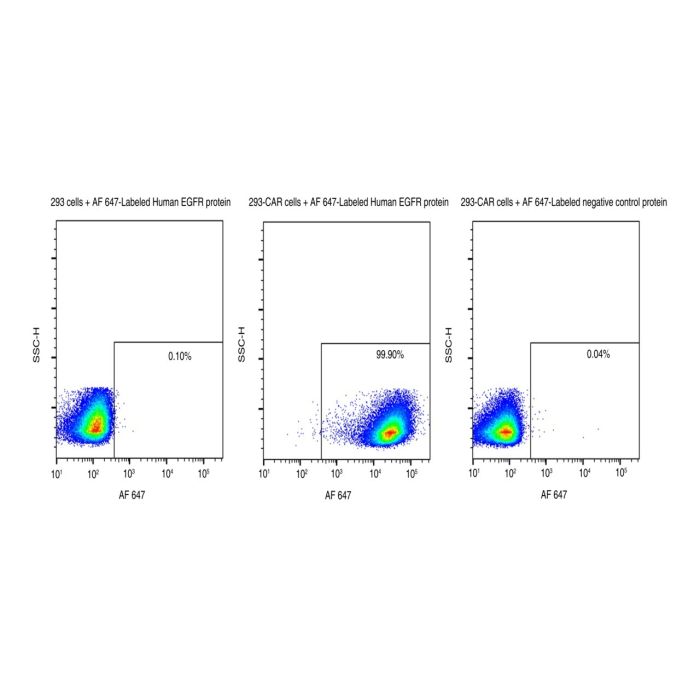
Activity1.Flow cytometric analysis of anti-EGFR CAR expression. 5e5 of anti-EGFR CAR-293 cells were stained with 100 μL of 1 μg/ml of AF 647-conjugated human EGFR Protein (Site-Specific AF 647 Conjugation, ECD, His Tag, Cat. No. 10001-H86H-SG) and negative control protein. Non-transduced 293 cells were used as a control (left). AF 647 signal was used to evaluate the binding activity (QC tested). 2.Binding activity of AF 647-conjugated EGFR protein to PBMC cells. PBMC cells were stained with FITC conjugated anti-CD3 antibody and AF 647-conjugated human EGFR Protein (Site-Specific AF 647 Conjugation, ECD, His Tag, Cat. No. 10001-H86H-SG) and detected by flow cytometry. FITC signal was used to evaluate the content of CD3+ T cells in PBMCs. AF 647 signal was used to evaluate the non-specific binding activity to PBMCs (QC tested).
Protein ConstructionA DNA sequence encoding the extracellular domain (Met 1-Ser 645) of human EGFR (NP_005219.2) was expressed with a C-terminal polyhistidine tag. The protein is site-specifically conjugated with AF 647 (Excitation Max.= 655 nm, Emission Max.= 680 nm).
Expressed HostHEK293 Cells
SpeciesHuman
Predicted N TerminalLeu 25
Molecule MassThe protein has a predicted molecular mass of 74.3 kDa.

Synonyms: ERBB Protein, Human; ERBB1 Protein, Human; ERRP Protein, Human; HER1 Protein, Human; mENA Protein, Human; NISBD2 Protein, Human; PIG61 Protein, Human

Image / Experimental Information

Image 1 DescriptionFlow cytometric analysis of anti-EGFR CAR expression. 5e5 of anti-EGFR CAR-293 cells were stained with 100 μL of 1 μg/ml of AF 647-conjugated human EGFR Protein (Site-Specific AF 647 Conjugation, ECD, His Tag, Cat. No. 10001-H86H-SG) and negative control protein. Non-transduced 293 cells were used as a control (left). AF 647 signal was used to evaluate the binding activity (QC tested).
Image 1 Alt TextHuman EGFR Protein 45034
Image 1 URLSource image
Image 2 DescriptionFlow cytometric analysis of anti-EGFR CAR expression. 5e5 of anti-EGFR CAR-293 cells were stained with 100 μL of 1 μg/ml of AF 647-conjugated human EGFR Protein (Site-Specific AF 647 Conjugation, ECD, His Tag, Cat. No. 10001-H86H-SG) and negative control protein. Non-transduced 293 cells were used as a control (left). AF 647 signal was used to evaluate the binding activity (QC tested).
Image 2 Alt TextHuman EGFR Protein 45035
Image 2 URLSource image

Background Information

Full Nameepidermal growth factor receptor
DescriptionAs a member of the epidermal growth factor receptor (EGFR) family, EGFR protein is type I transmembrane glycoprotein that binds a subset of EGF family ligands including EGF, amphiregulin, TGF-α, betacellulin, etc. EGFR protein plays a crucial role in signaling pathway in the regulation of cell proliferation, survival and differentiation. Binding of a ligand induces EGFR protein homo- or heterodimerization, the subsequent tyrosine autophosphorylation and initiates various down stream pathways (MAPK, PI3K/PKB and STAT). In addition, EGFR signaling also has been shown to exert action on carcinogenesis and disease progression, and thus EGFR protein is proposed as a target for cancer therapy currently.
Research Areas
  • Cancer Drug Targets
  • Receptor Tyrosine Kinases (RTKs)
Related Pathways
  • EGFR Signaling Pathway
  • Jak-Stat Signaling Pathway
Tags
  • Cancer Immunotherapy
  • Immune Checkpoint
  • Immunotherapy
  • Targeted Therapy
References
  1. Schlessinger, J. (2000) Cell signaling by receptor tyrosine kinases. Cell 103(2): 211-25.
  2. Giaccone, G. (2005) HER1/EGFR-targeted agents: predicting the future for patients with unpredictable outcomes to therapy. Ann. Oncol. 16(4): 538-48.
  3. Yarden, Y., et al. (2001) Untangling the ErbB signalling network. Nat. Rev. Mol. Cell. Biol. 2(2): 127-37.

title: Enzymes Photocrosslinked to Live Cell Receptors Retain Activity and EGFR Inhibition After Both Internalization and Recycling
authors: Shambojit Roy; Michael Brasino; ...; Andrew P. Goodwin
journal: Bioconjugate Chemistry
date: 2023-06-22
pmid: 31840981
doi: 10.1021/acs.bioconjchem.9b00781
pmcid: 10286729
cited_by_count: 5
techniques: Irradiation; Molecular Weight; Purification; SDS Page
bioz_score: 93

title: Expanding the Therapeutic Window of EGFR-Targeted PE24 Immunotoxin for EGFR-Overexpressing Cancers by Tailoring the EGFR Binding Affinity
authors: Sei-Yong Jun; Dae-Seong Kim; ...; Alessandro Poggi
journal: International Journal of Molecular Sciences
date: 2022-12-13
pmcid: 9779439
cited_by_count: 4
techniques: Construct; Expressing; Modification; Plasmid Preparation; Polymerase Chain Reaction; Purification; Sequencing; Synthesized
bioz_score: 93

title: Anti-EGFR Affibodies with Site-Specific Photo-Cross-Linker Incorporation Show Both Directed Target-Specific Photoconjugation and Increased Retention in Tumors
authors: Michael Brasino; Shambojit Roy; ...; Andrew P. Goodwin
journal: Journal of the American Chemical Society
date: 2019-09-19
pmid: 30203972
pmcid: 6689236
cited_by_count: 12
techniques: Binding Assay; Concentration Assay; Irradiation; Labeling; Microscale Thermophoresis; Mutagenesis; Polyacrylamide Gel Electrophoresis; Purification; SDS Page
bioz_score: 93

title: Dsg2 via Src-mediated transactivation shapes EGFR signaling towards cell adhesion
authors: Hanna Ungewiß; Vera Rötzer; ...; Jens Waschke
journal: Cellular and Molecular Life Sciences: CMLS
date: 2018-07-06
pmid: 29980799
pmcid: 11105603
cited_by_count: 27
techniques: Activation Assay; Activity Assay; Adhesive; Binding Assay; Cell Counting; Co-Immunoprecipitation Assay; Generated; Immunofluorescence; Immunoprecipitation; Immunostaining; Incubation; Inhibition; Knock-Out; Microscopy; Plasmid Preparation; Pull Down Assay; Recombinant; Software; Staining; Surface Biotinylation Assay; Transfection; Western Blot
bioz_score: 93

Reviews

Write Your Own Review
You're reviewing:Recombinant Human EGFR Protein (Site-Specific AF 647 Conjugation, ECD, His Tag) sinobiological 10001-H86H-SG
Your Rating
Copyright © 2025 Biogege, Inc. All rights reserved.