Produced in rabbits immunized with E. coli-derived Human CDC14A fragment, and purified by antigen affinity chromatography.
Source
Polyclonal Rabbit IgG
Purification
Protein A & Antigen Affinity
Formulation
PBS, pH7.0 with 0.03% Proclin300
Conjugate
Unconjugated
Form
Liquid
Shipping
This antibody is shipped as liquid solution at ambient temperature. Upon receipt, store it immediately at the temperature recommended below.
Storage
This antibody can be stored at 2℃-8℃ for one month without detectable loss of activity. Antibody products are stable for twelve months from date of receipt when stored at -20℃ to -80℃. Avoid repeated freeze-thaw cycles.
Cdc14 enzymes compose a family of highly conserved phosphatases that are present in a wide range of organisms, including yeast and humans, and that preferentially reverse the phosphorylation of Cyclin-Dependent Kinase (Cdk) substrates. The budding yeast Cdc14 orthologue has essential functions in the control of late mitosis and cytokinesis. In mammals, however, the two Cdc14 homologues, Cdc14A and Cdc14B, do not play a prominent role in controlling late mitotic events, suggesting that some Cdc14 functions are not conserved across species. Cdc14A codes for a conserved proline-directed phosphatase, and mutations in the gene are associated with autosomal-recessive severe to profound deafness, due to defective kinocilia. Human Cdc14A is an evolutionary conserved dual-specificity protein phosphatase that reverses the modifications effected by cyclin-dependent kinases and plays an important role in centrosome duplication and mitotic regulation.
Research Areas
Phosphatases and Regulators
References
Uddin B, et al. (2019) The human phosphatase cdc14a modulates primary cilium length by regulating centrosomal actin nucleation. EMBO Rep 20 (1): e46544.
Ovejero S, et al. (2018) Biochemical analyses reveal amino acid residues critical for cell cycle-dependent phosphorylation of human cdc14a phosphatase by cyclin-dependent kinase 1. Sci Rep 8 (1): 11871.
Lin H, et al. (2015) Cdc14a and cdc14b redundantly regulate DNA double-strand break repair. Mol Cell Biol 35 (21): 3657-3668.

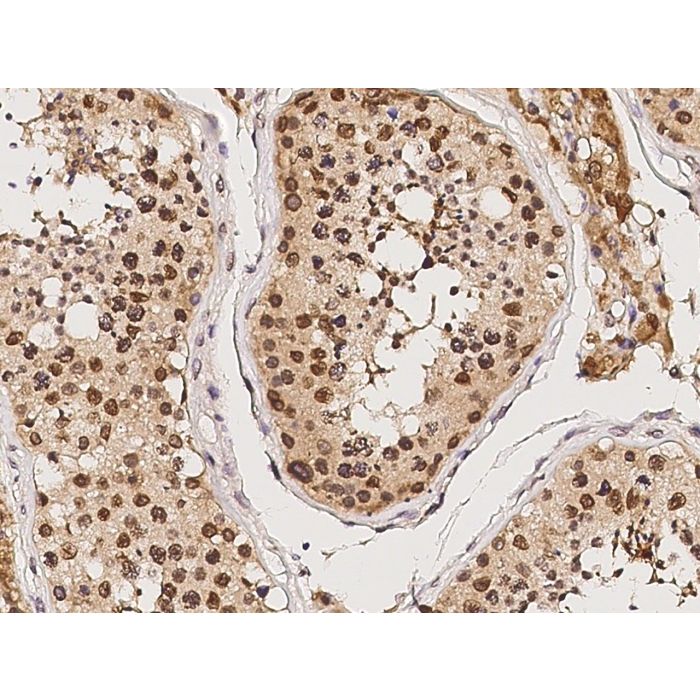

-HD14FE2512-500-human-testis-IHC-P.png)
-HD14FE2512-500-human-kidney-IHC-P.png)