Produced in rabbits immunized with E. coli-derived Human CEACAM16 fragment, and purified by antigen affinity chromatography.
Source
Polyclonal Rabbit IgG
Purification
Protein A & Antigen Affinity
Formulation
PBS, pH7.0 with 0.03% Proclin300
Conjugate
Unconjugated
Form
Liquid
Shipping
This antibody is shipped as liquid solution at ambient temperature. Upon receipt, store it immediately at the temperature recommended below.
Storage
This antibody can be stored at 2℃-8℃ for one month without detectable loss of activity. Antibody products are stable for twelve months from date of receipt when stored at -20℃ to -80℃. Avoid repeated freeze-thaw cycles.
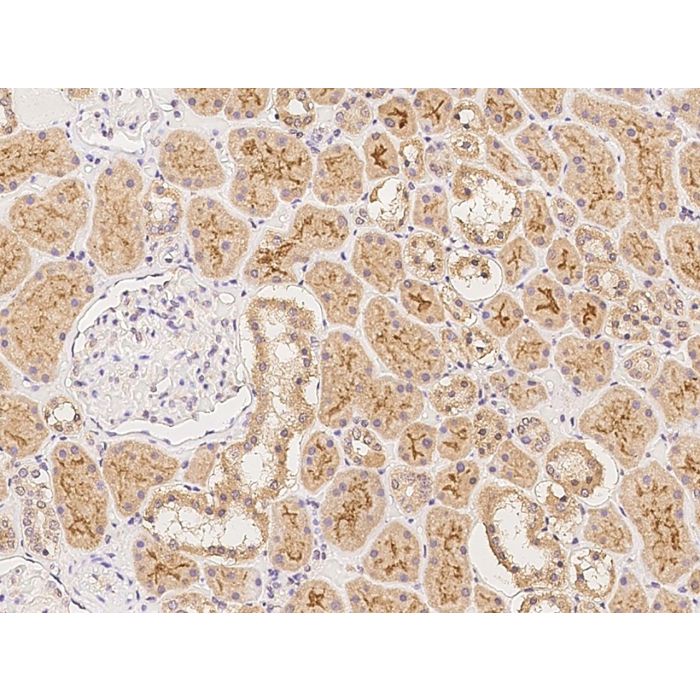
Immunochemical staining of human CEACAM16 in human kidney with rabbit polyclonal antibody at 1:100 dilution, formalin-fixed paraffin embedded sections.
Immunochemical staining of human CEACAM16 in human kidney with rabbit polyclonal antibody at 1:100 dilution, formalin-fixed paraffin embedded sections.
One gene essential to normal tectorial membrane (TM) function is CEACAM16. It is expressed almost exclusively in the inner ear, where it is transcribed and translated in the supporting cells and secreted into the matrix of the TM. The encoded 425-amino acid (aa) peptide belongs to the large and diverse carcinoembryonic antigen-related cell adhesion molecule (CEACAM) family. Unlike other members of this family, CEACAM16 has two lg-like V-type domains flanking two Ig-like C2-type domains and no transmembrane domain/anchor. CEACAM16 interacts with other TM proteins like TECTA and TECTB and its targeted deletion in mice results in patho-morphological defects of the TM and hearing loss. CEACAM16 is a non-collagenous protein of the tectorial membrane, an extracellular structure of the cochlea essential for normal hearing. Dominant and recessive mutations in CEACAM16 have been reported to cause postlingual and progressive forms of deafness in humans.
References
Goodyear RJ, et al. (2019) Accelerated age-related degradation of the tectorial membrane in the ceacam16(βgal/βgal) null mutant mouse, a model for late-onset human hereditary deafness dfnb113. Front Mol Neurosci 12 147.
Booth KT, et al. (2018) Old gene, new phenotype: Splice-altering variants in ceacam16 cause recessive non-syndromic hearing impairment. J Med Genet 55 (8): 555-560.


-HD13SE2044-100-human-kidney-IHC-P.png)
-HD13SE2044-100-human-placenta-IHC-P.png)