Recombinant Human CHI3L2 Protein (Catalog#12162-H08H)
Preparation
Produced in rabbits immunized with purified, recombinant Human CHI3L2 (rh CHI3L2; Catalog#12162-H08H; NP_003991.2; Met1-Leu390). CHI3L2 specific IgG was purified by Human CHI3L2 affinity chromatography.
Source
Polyclonal Rabbit IgG
Purification
Protein A & Antigen Affinity
Formulation
0.2 μm filtered solution in PBS
Conjugate
Unconjugated
Form
Liquid
Shipping
This antibody is shipped as liquid solution at ambient temperature. Upon receipt, store it immediately at the temperature recommended below.
Storage
This antibody can be stored at 2℃-8℃ for one month without detectable loss of activity. Antibody products are stable for twelve months from date of receipt when stored at -20℃ to -80℃. Preservative-Free. Avoid repeated freeze-thaw cycles.
Chondrocyte protein 39 (YKL-39), also known as Chitinase 3-like 2 (CHI3L2), is a secretory protein of articular chondrocytes belonging to the glycosyl hydrolase 18 family. Its highest expression is in chondrocytes, followed by synoviocytes, lung and heart. YKL-39/CHI3L2 is not detected in spleen, pancreas, and liver. YKL-39/CHI3L2 may also be expressed in developing brain and placenta. YKL-39/CHI3L2, a cartilage-related protein, is found to induce arthritis accompanied by pathologic changes in bone and cartilage. A better understanding of the immune response against cartilage-related components including YKL-39 may help to elucidate the pathological processes of arthritic disorders. Upregulation of YKL-39/CHI3L2 in osteoarthritic cartilage suggests that YKL-39/CHI3L2 may be a more accurate marker of chondrocyte activation than YKL-40, although it has yet to be established as a suitable marker in synovial fluid and serum. The decreased expression of YKL-40 by osteoarthritic chondrocytes is surprising as increased levels have been reported in rheumatoid and osteoarthritic synovial fluid, where it may derive from activated synovial cells or osteophytic tissue or by increased matrix destruction in the osteoarthritic joint. YKL-39 and YKL-40 are potentially interesting marker molecules for arthritic joint disease because they are abundantly expressed by both normal and osteoarthritic chondrocytes.
References
Sakata M, et al . (2002) YKL-39, a human cartilage-related protein, induces arthritis in mice. Clin Exp Rheumatol. 20(3): 343-50.
Areshkov PA, et al . (2010) Chitinase 3-like protein 2 (CHI3L2, YKL-39) activates phosphorylation of extracellular signal-regulated kinases ERK1/ERK2 in human embryonic kidney (HEK293) and human glioblastoma (U87 MG) cells. Tsitol Genet. 44(1): 3-9.
Steck E, et al . (2002) Enhanced expression of the human chitinase 3-like 2 gene (YKL-39) but not chitinase 3-like 1 gene (YKL-40) in osteoarthritic cartilage. Biochem Biophys Res Commun. 299(1): 109-15.


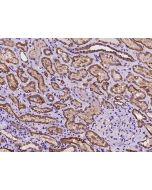
-HD14MA2505-1000-human-kidney-IHC-P.png)
-HD14MA2505-1000-human-hepatoma-IHC-P.png)