
Anti-Citrate Synthase Antibody, Rabbit Polyclonal sinobiological 200992-T10
$243.00
In stock
SKU
200992-T10
| Catalog No. | Size | Price (USD) |
| 200992-T10-100 | 100 µL | $251.64 |
| Catalog No. | Size | Price (USD) |
| 200992-T10-100 | 100 µL | $251.64 |
General Information
| Product name | Anti-Citrate Synthase Antibody, Rabbit Polyclonal |
| Validated applications | IHC-P (FAQ Protocol), ICC/IF (FAQ Protocol) |
| Species reactivity | Reacts with: Human |
| Specificity | Human Citrate Synthase |
| Immunogen | E. coli-derived Human Citrate Synthase fragment |
| Preparation | Produced in rabbits immunized with E. coli-derived Human Citrate Synthase fragment, and purified by antigen affinity chromatography. |
| Source | Polyclonal Rabbit IgG |
| Purification | Protein A & Antigen Affinity |
| Formulation | PBS, pH7.0 with 0.03% Proclin300 |
| Conjugate | Unconjugated |
| Form | Liquid |
| Shipping | This antibody is shipped as liquid solution at ambient temperature. Upon receipt, store it immediately at the temperature recommended below. |
| Storage | This antibody can be stored at 2℃-8℃ for one month without detectable loss of activity. Antibody products are stable for twelve months from date of receipt when stored at -20℃ to -80℃. Avoid repeated freeze-thaw cycles. |
Image / Experimental Information
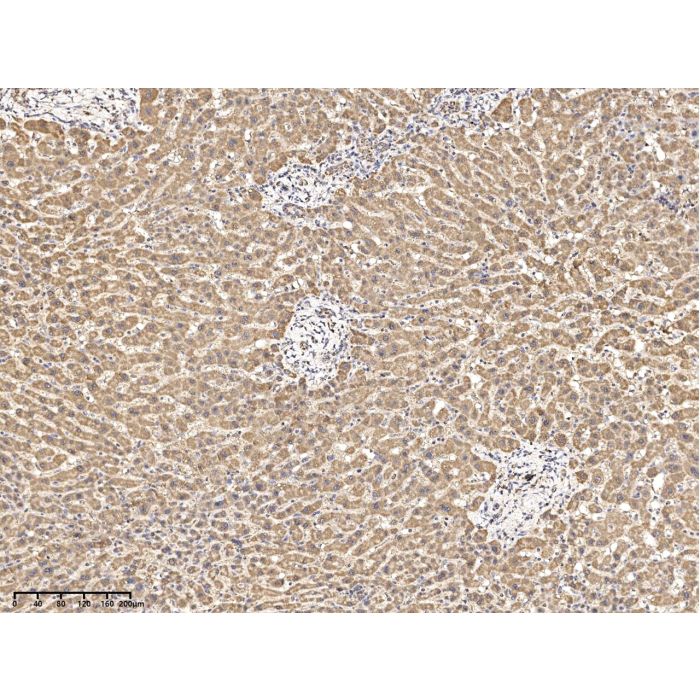
| Image 1 Description | Immunochemical staining of human Citrate Synthase in human liver with rabbit polyclonal antibody at 1:100 dilution, formalin-fixed paraffin embedded sections. |
| Image 1 Alt Text | Human Citrate Synthase Immunohistochemistry(IHC) 38862 |
| Image 1 URL | Source image |
| Image 2 Description | Immunochemical staining of human Citrate Synthase in human liver with rabbit polyclonal antibody at 1:100 dilution, formalin-fixed paraffin embedded sections. |
| Image 2 Alt Text | Human Citrate Synthase Immunohistochemistry(IHC) 38863 |
| Image 2 URL | Source image |
| Image 3 Description | Immunochemical staining of human Citrate Synthase in human liver with rabbit polyclonal antibody at 1:100 dilution, formalin-fixed paraffin embedded sections. |
| Image 3 Alt Text | Human Citrate Synthase Immunofluorescence(IF) 38864 |
| Image 3 URL | Source image |
Background Information
| Full Name | citrate synthase |
| Description | Chondroitin sulphate (CS) glycosaminoglycan chains on cell and extracellular matrix proteoglycans (PGs) can no longer be regarded as merely hydrodynamic space fillers. Overwhelming evidence over recent years indicates that sulphation motif sequences within the CS chain structure are a source of significant biological information to cells and their surrounding environment. CS sulphation motifs have been shown to interact with a wide variety of bioactive molecules, e.g. cytokines, growth factors, chemokines, morphogenetic proteins, enzymes and enzyme inhibitors, as well as structural components within the extracellular milieu. They are therefore capable of modulating a panoply of signalling pathways, thus controlling diverse cellular behaviours including proliferation, differentiation, migration and matrix synthesis. Chondroitin sulfate (CS) is a sulfated glycosaminoglycan composed of a long chain of repeating disaccharide units that are attached to core proteins, resulting in CS proteoglycans (CSPGs). In the mature brain, CS is concentrated in perineuronal nets (PNNs), which are extracellular structures that surround synapses and regulate synaptic plasticity. In addition, CS is rapidly synthesized after CNS injury to create a physical and chemical barrier that inhibits axon growth. |
-HD17AU2801-100-human-liver-IHC-P.png)
-HD17AU2801-100-human-kidney-IHC-P.png)
-HD17AU2801-100-HeLa-IF.png)