A synthetic peptide corresponding to the center region of the Mouse COMP
Preparation
Produced in rabbits immunized with a synthetic peptide corresponding to the center region of the Mouse COMP, and purified by antigen affinity chromatography.
Source
Polyclonal Rabbit IgG
Purification
Protein A & Antigen Affinity
Formulation
PBS, pH7.0 with 0.03% Proclin300
Conjugate
Unconjugated
Form
Liquid
Shipping
This antibody is shipped as liquid solution at ambient temperature. Upon receipt, store it immediately at the temperature recommended below.
Storage
This antibody can be stored at 2℃-8℃ for one month without detectable loss of activity. Antibody products are stable for twelve months from date of receipt when stored at -20℃ to -80℃. Avoid repeated freeze-thaw cycles.
Synonyms: Anti-Comp Antibody; Anti-TSP5 Antibody
Image / Experimental Information
Image 1 Description
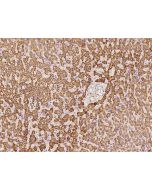
Anti-COMP rabbit polyclonal antibody at 1:500 dilution Lane A: Jurkat Whole Cell Lysate Lysates/proteins at 30 μg per lane. Secondary Goat Anti-Rabbit IgG (H+L)/HRP at 1/10000 dilution. Developed using the ECL technique. Performed under reducing conditions. Predicted band size:84 kDa Observed band size:94 kDa
Cartilage Oligomeric Matrix Protein (COMP), also referred to as Thrombospondin-5, is a non-collagenous extracellular matrix (ECM) protein and belongs to the subgroup B of the thrombospondin protein family. This protein is expressed primarily in cartilage, ligament, and tendon, and binds to other ECM proteins such as collagen I, II and IX with high affinities depending on the divalent cations Zn2+ or Ni2+. COMP is a secreted glycoprotein that is important for growth plate organization and function. It is suggested to play a role in cell growth and development, and recent studies have revealed the possible mechanism that it protects cells against death by elevating members of the IAP (inhibitor of apoptosis protein) family of survival proteins. Mutations in COMP cause two skeletal dysplasias, pseudoachondroplasia (PSACH) and multiple epiphyseal dysplasia (EDM1), and up-regulated expression of COMP are observed in rheumatoid arthritis and certain carcinomas.
References
Posey KL, et al. (2004) Role of TSP-5/COMP in pseudoachondroplasia. Int J Biochem Cell Biol. 36(6): 1005-12.
Chen FH, et al. (2005) Interaction of cartilage oligomeric matrix protein/thrombospondin 5 with aggrecan. J Biol Chem. 282(34): 24591-8.
Posey KL, et al. (2008) The role of cartilage oligomeric matrix protein (COMP) in skeletal disease. Curr Drug Targets. 9(10): 869-77.
Tan K, et al. (2009) The crystal structure of the signature domain of cartilage oligomeric matrix protein: implications for collagen, glycosaminoglycan and integrin binding. FASEB J. 23(8): 2490-501.


-HD12MA1533-WB.png)