Human Mouse, Rat (Species predicted to react based on 100% sequence homology)
Immunogen
A synthetic peptide corresponding to the N-terminus of the Human ACTA2
Preparation
Produced in rabbits immunized with a synthetic peptide corresponding to the N-terminus of the Human ACTA2, and purified by antigen affinity chromatography.
Source
Polyclonal Rabbit IgG
Purification
Protein A & Antigen Affinity
Formulation
0.2 μm filtered solution in PBS
Conjugate
Unconjugated
Form
Liquid
Shipping
This antibody is shipped as liquid solution at ambient temperature. Upon receipt, store it immediately at the temperature recommended below.
Storage
This antibody can be stored at 2℃-8℃ for one month without detectable loss of activity. Antibody products are stable for twelve months from date of receipt when stored at -20℃ to -80℃. Preservative-Free. Avoid repeated freeze-thaw cycles.
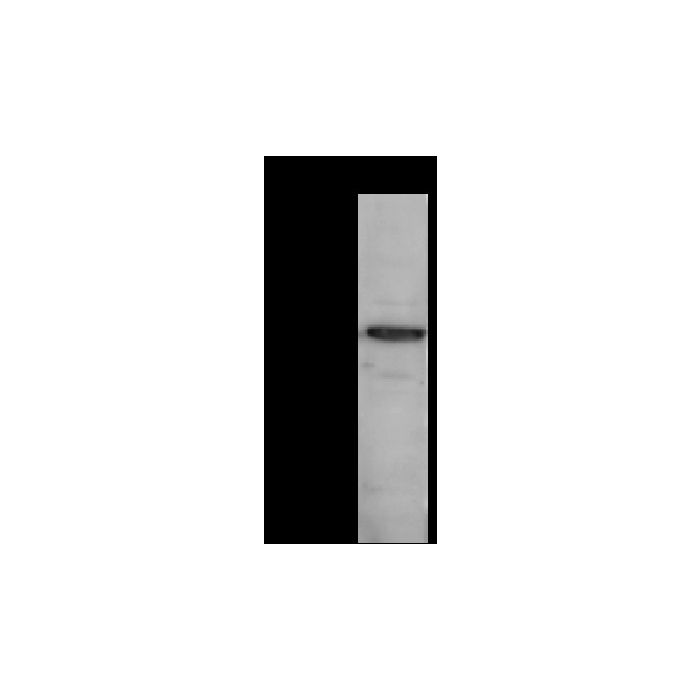
Anti-ACTA2 rabbit polyclonal antibody at 1:500 dilution Lane A: NIH-3T3 Whole Cell Lysate Lysates/proteins at 30 μg per lane. Secondary Goat Anti-Rabbit IgG (H+L)/HRP at 1/10000 dilution. Developed using the ECL technique. Performed under reducing conditions. Predicted band size:42 kDa Observed band size:42 kDa
Actins are globular multi-functional proteins which can be detected in all eukaryotic cells. In vertebrates, there are three main groups of actins that possess slightly different functions: alpha, beta, and gamma. The alpha actins, found in muscle tissues, are a major constituent of the contractile apparatus. Beta-actin, found at the expanding edge of cells, uses the projection of its cellular structure as its mean of mobility. Gamma-actin is found in the filaments of stress fibres. ACTA2 is an alpha actin that is found in skeletal muscle. Expression of alpha skeletal, alpha cardiac, alpha vascular, and gamma enteric actins are restricted to specialized muscle cell type. Smooth muscle alpha actin is of further interest because it is one of a few genes whose expression is relatively restricted to vascular smooth muscle cells. Further more, expression of smooth muscle alpha actin is regulated by hormones, cell proliferation, and altered by pathological conditions including oncogenic transformation and atherosclerosis.
Research Areas
Cardiac Stem Cell Markers
References
Ueyama H, et al., 1990, Jinrui Idengaku Zasshi. 35(2): 145-50.
Snásel J, et al., 1997, Folia Biol. 42(5): 227-30.
Adams LD, et al., 1992, AIDS Res Hum. 8(2): 291-5.

-HD16OC2101-WB.png)