Reacts with: Human Predicted to React with: Species predicted to react based on 100% sequence homology: Mouse, Rat, Cynomolgus, Bovine, Pig, Goat Phospho-CREB (Ser133), cross with Phospho-ATF-1 (Ser63)
Specificity
Human Species predicted to react based on 100% sequence homology: Mouse, Rat, Cynomolgus, Bovine, Pig, Goat Phospho-CREB (Ser133), cross with Phospho-ATF-1 (Ser63)
Immunogen
A synthetic phosphopeptide corresponding to residues around Ser133 of human CREB.
Preparation
Produced in rabbits immunized with a synthetic peptide corresponding to residues around Ser133 of human CREB, and purified by antigen affinity chromatography.
Source
Polyclonal Rabbit IgG
Purification
Protein A & Antigen Affinity
Formulation
0.2 μm filtered solution in PBS
Conjugate
Unconjugated
Form
Liquid
Shipping
This antibody is shipped as liquid solution at ambient temperature. Upon receipt, store it immediately at the temperature recommended below.
Storage
This antibody can be stored at 2℃-8℃ for one month without detectable loss of activity. Antibody products are stable for twelve months from date of receipt when stored at -20℃ to -80℃. Avoid repeated freeze-thaw cycles.
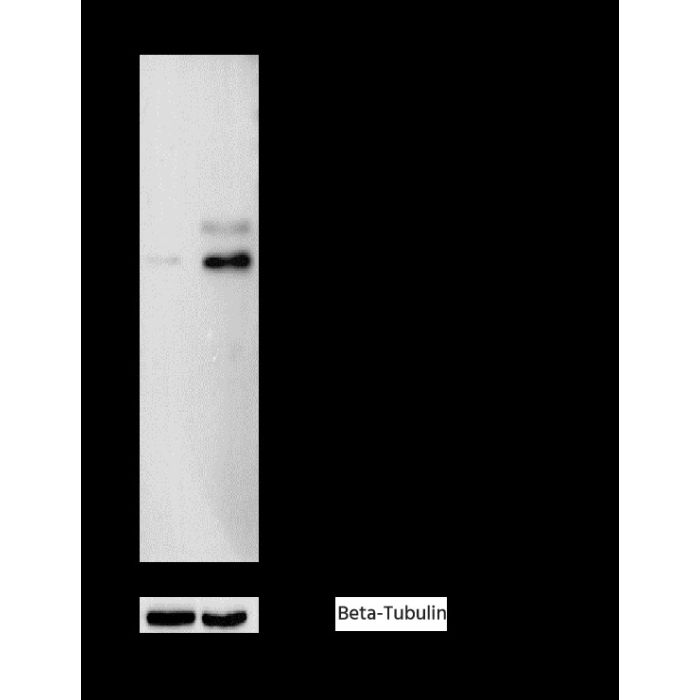
Western blot analysis of extracts from serum-starved Hela, untreated (-) or treated with TPA (100 nM, 15 min; +), using Phospho-CREB (Ser133) Rabbit Ployclonal Antibody at 1:1000 dilution (upper) or Beta-Tubulin Loading Control Antibody, Mouse Mab (Cat: 100109-MM05T) (lower) at 1:20000 dilution.
Western blot analysis of extracts from serum-starved Hela, untreated (-) or treated with TPA (100 nM, 15 min; +), using Phospho-CREB (Ser133) Rabbit Ployclonal Antibody at 1:1000 dilution (upper) or Beta-Tubulin Loading Control Antibody, Mouse Mab (Cat: 100109-MM05T) (lower) at 1:20000 dilution.
Western blot analysis of extracts from serum-starved Hela, untreated (-) or treated with TPA (100 nM, 15 min; +), using Phospho-CREB (Ser133) Rabbit Ployclonal Antibody at 1:1000 dilution (upper) or Beta-Tubulin Loading Control Antibody, Mouse Mab (Cat: 100109-MM05T) (lower) at 1:20000 dilution.
Western blot analysis of extracts from serum-starved Hela, untreated (-) or treated with TPA (100 nM, 15 min; +), using Phospho-CREB (Ser133) Rabbit Ployclonal Antibody at 1:1000 dilution (upper) or Beta-Tubulin Loading Control Antibody, Mouse Mab (Cat: 100109-MM05T) (lower) at 1:20000 dilution.
CAMP responsive element binding protein 1, also known as CREB-1, plays multiple functions as a transcription factor in gene regulation. This protein is a CREB transcription factor that is a member of the leucine zipper family of DNA-binding proteins. CREB1 proteins are also known to be expressed in several spliced isoforms that act as transcriptional activators or repressors. The activator isoforms, possessing the functional domains for kinase induction and for interaction with other transcriptional regulators, act as transcriptional activators.The protein is phosphorylated by several protein kinases, and induces transcription of genes in response to hormonal stimulation of the cAMP pathway. CREB-1 has a complex influence on behavioural responses to drugs of abuse which varies depending on the brain region in which it is expressed. CREB-1 is important for serotonin (5-HT)-induced long-term facilitation (LTF) of the sensorimotor synapse in Aplysia.
Related Pathways
AKT Signaling Pathway
AMPK Signaling Pathway
B Cell Receptor Signaling Pathway
MAPK-Erk Pathway
P38 MAPK Signaling Pathway
T Cell Receptor Signaling Pathway
References
Sadamoto H, et al . (2011) Direct observation of dimerization between different CREB1 isoforms in a living cell. PLoS One. 6 (6): e20285.
Liu RY, et al . (2011) The requirement for enhanced CREB1 expression in consolidation of long-term synaptic facilitation and long-term excitability in sensory neurons of Aplysia. J Neurosci. 31 (18): 6871-9.
Hoeffler JP, et al . (1988) Cyclic AMP-responsive DNA-binding protein: structure based on a cloned placental cDNA. Science. 242 (4884): 1430-3.


-HD17DE0801-WB.png)
-pAb(A)-HD17DE0801-100-human-renal carcinoma-IHC-P.png)
-pAb(A)-HD17DE0801-100-human-breast carcinoma-IHC-P.png)
-pAb(A)-HD17DE0801-100-human-thyroid cancer-IHC-P.png)