Produced in rabbits immunized with E. coli-derived Human ADAMTSL4 fragment, and purified by antigen affinity chromatography.
Source
Polyclonal Rabbit IgG
Purification
Protein A & Antigen Affinity
Formulation
PBS, pH7.0 with 0.03% Proclin300
Conjugate
Unconjugated
Form
Liquid
Shipping
This antibody is shipped as liquid solution at ambient temperature. Upon receipt, store it immediately at the temperature recommended below.
Storage
This antibody can be stored at 2℃-8℃ for one month without detectable loss of activity. Antibody products are stable for twelve months from date of receipt when stored at -20℃ to -80℃. Avoid repeated freeze-thaw cycles.
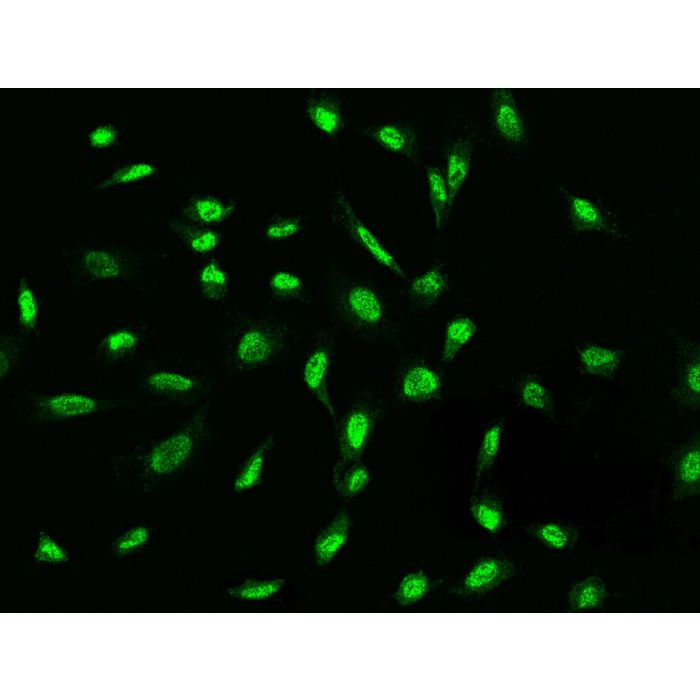
Immunofluorescence staining of ADAMTSL4 in HeLa cells. Cells were fixed with 4% PFA, permeabilzed with 0.3% Triton X-100 in PBS,blocked with 10% serum, and incubated with rabbit anti-Human ADAMTSL4 polyclonal antibody (dilution ratio 1:200) at 4℃ overnight. Then cells were stained with the Alexa Fluor®488-conjugated Goat Anti-rabbit IgG secondary antibody (green). Positive staining was localized to Nucleus.
The ADAMTS (a disintegrin-like and metalloproteinase domain with thrombospondin-type 1 motifs) protein superfamily includes 19 secreted metalloproteases and 7 secreted ADAMTS-like (ADAMTSL) glycoproteins. ADAMTSL4, a secreted glycoprotein, was earlier found to play a critical role in a prognostic signature for primary glioblastoma multiforme (pGBM). ADAMTSL4 mutations seem to be the most common cause of isolated ectoplia lentis (EL) and thus are important concerning the differential diagnosis of connective tissue syndromes with EL as a main feature.
References
Zhao Z, et al. (2019) Adamtsl4, a secreted glycoprotein, is a novel immune-related biomarker for primary glioblastoma multiforme. Dis Markers 2019 1802620.
Neuhann TM, et al. (2015) Adamtsl4-associated isolated ectopia lentis: Further patients, novel mutations and a detailed phenotype description. Am J Med Genet A 167a (10): 2376-2381.
Hubmacher D, et al. (2015) Adamts proteins as modulators of microfibril formation and function. Matrix Biol 47 34-43.


-HD13AP1338-200-HeLa-IF.png)