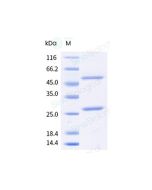
Recombinant Cynomolgus p53 Protein (Catalog#90001-CNAE)
Preparation
This antibody was produced from a hybridoma resulting from the fusion of a mouse myeloma with B cells obtained from a mouse immunized with purified, recombinant Cynomolgus p53 (Catalog#90001-CNAE; E3U906; Met1-Asp393). The IgG fraction of the cell culture supernatant was purified by Protein A affinity chromatography.
Source
Monoclonal Mouse IgG1 Clone #04
Purification
Protein A
Formulation
0.2 μm filtered solution in PBS
Conjugate
Unconjugated
Form
Liquid
Shipping
This antibody is shipped as liquid solution at ambient temperature. Upon receipt, store it immediately at the temperature recommended below.
Storage
This antibody can be stored at 2℃-8℃ for one month without detectable loss of activity. Antibody products are stable for twelve months from date of receipt when stored at -20℃ to -80℃. Preservative-Free. Avoid repeated freeze-thaw cycles.
Background Information
Full Name
tumor protein p53
Description
p53, also known as Tp53, is a DNA-binding protein which belongs to the p53 family. It contains transcription activation, DNA-binding, and oligomerization domains. p53 protein is expressed at low level in normal cells and at a high level in a variety of transformed cell lines, where it's believed to contribute to transformation and malignancy. p53 (TP53) is a transcription factor whose protein levels and post-translational modification state alter in response to cellular stress (such as DNA damage, hypoxia, spindle damage). Activation of p53 begins through a number of mechanisms including phosphorylation by ATM, ATR, Chk1 and MAPKs. MDM2 is a ubiquitin ligase that binds p53 and targets p53 for proteasomal degradation. Phosphorylation, p14ARF and USP7 prevent MDM2-p53 interactions, leading to an increase in stable p53 tetramers in the cytoplasm. Further modifications such as methylation and acetylation lead to an increase in Tp53 binding to gene specific response elements. Tp53 regulates a large number of genes (>100 genes) that control a number of key tumor suppressing functions such as cell cycle arrest, DNA repair, senescence and apoptosis. Whilst the activation of p53 often leads to apoptosis, p53 inactivation facilitates tumor progression. It is postulated to bind to a p53-binding site and activate expression of downstream genes that inhibit growth and/or invasion, and thus function as a tumor suppressor. Mutants of p53 that frequently occur in a number of different human cancers fail to bind the consensus DNA binding site, and hence cause the loss of tumor suppressor activity. Defects in TP53 are a cause of esophageal cancer, Li-Fraumeni syndrome, lung cancer and adrenocortical carcinoma.
Research Areas
Apoptosis Transcription Factors and Regulators
Cancer Drug Targets
Tumor Suppressors
Related Pathways
Death Receptor Signaling
EGFR Signaling Pathway
p53 Pathway
AKT Signaling Pathway
AMPK Signaling Pathway
Autophagy Pathway
Tags
Cancer Immunotherapy
Immune Checkpoint
Immunotherapy
Targeted Therapy
References
Bakhrat A, et al. (2010) Drosophila Chk2 and p53 proteins induce stage-specific cell death independently during oogenesis. Apoptosis. 15(12):1425-34.
Kurzhals RL, et al. (2011) Chk2 and p53 are haploinsufficient with dependent and independent functions to eliminate cells after telomere loss. PLoS Genet. 7(6):e1002103.
Pardi N, et al. (2011) In vivo effects of abolishing the single canonical sumoylation site in the C-terminal region of Drosophila p53. Acta Biol Hung. 62(4):397-412.
Wells BS, et al. (2012) Maintenance of imaginal disc plasticity and regenerative potential in Drosophila by p53. Dev Biol. 361(2):263-76.