Recombinant Human Adenylosuccinate Lyase Protein (Catalog#11287-H07E)
Preparation
This product is a recombinant monoclonal antibody expressed from HEK293 cells.
Source
Monoclonal Mouse IgG1 Clone #05
Purification
Protein A
Formulation
0.2 μm filtered solution in PBS
Conjugate
Unconjugated
Form
Liquid
Shipping
This antibody is shipped as liquid solution at ambient temperature. Upon receipt, store it immediately at the temperature recommended below.
Storage
This antibody can be stored at 2℃-8℃ for one month without detectable loss of activity. Antibody products are stable for twelve months from date of receipt when stored at -20℃ to -80℃. Preservative-Free. Avoid repeated freeze-thaw cycles.
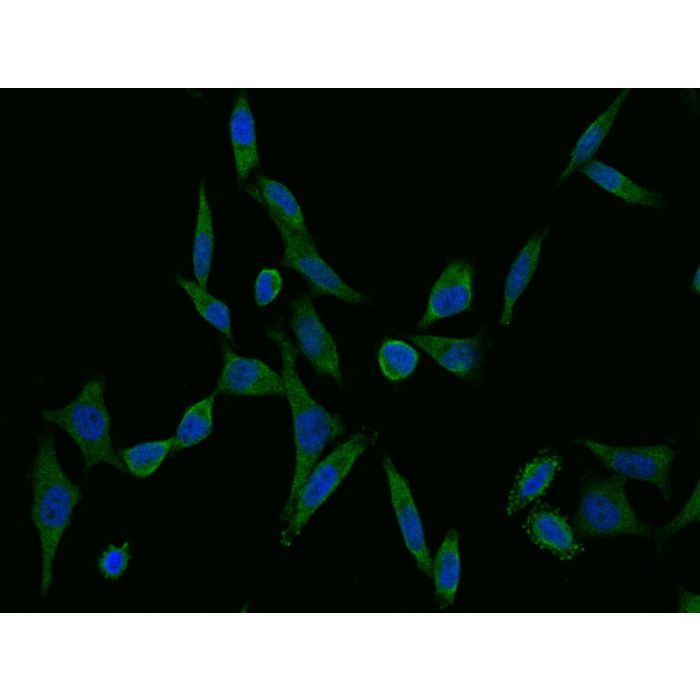
Immunofluorescence staining of His-ADSL in HeLa cells. Cells were fixed with 4% PFA, permeabilzed with 0.1% Triton X-100 in PBS,blocked with 10% serum, and incubated with mouse anti-Human His-ADSL monoclonal antibody (dilution ratio 1:60) at 4℃ overnight. Then cells were stained with the Alexa Fluor®488-conjugated Goat Anti-mouse IgG secondary antibody (green) and counterstained with DAPI (blue).Positive staining was localized to Cytoplasm.
Image 1 Alt Text
Human Adenylosuccinate Lyase Immunofluorescence(IF) 39026
Adenylosuccinate lyase, also known as adenylosuccinase, ADSL or ASL, is an enzyme implicated in the reaction of adenylosuccinat converting to AMP and fumarate as part of the purine nucleotide cycle. The two substates of adenylosuccinate lyase (ADSL) are dephosphorylated derivatives of SAICA ribotide (SAICAR) and adenylosuccinate (S-AMP), which catalyzes an important reaction in the de novo pathway of purine biosynthesis. ADSL catalyzes two distinct reactions in the synthesis of purine nucleotides, both of which involve the _-elimination of fumarate to produce either aminoimidazole carboxamide ribotide from SAICAR or AMP from S-AMP. The Adenylosuccinate lyase deficiency is a rare autosomal recessive metabolic disorder characterized by the present of SAICA riboside and succinyladenosine (S-Ado). ADSL defect in different patients is often caused by different mutations to the enzyme.
References
Nassogne M, et al. (2000) Adenylosuccinase deficiency: an unusual cause of early-onset epilepsy associated with acquired microcephaly. Brain and development. 22 (6): 383-6.
Sivendran S, et al. (2004) Two novel mutant human adenylosuccinate lyases (ASLs) associated with autism and characterization of the equivalent mutant Bacillus subtilis ASL. J Biol Chem. 279 (51): 53789-97.
Lee TT, et al. (1999) His68 and His141 are critical contributors to the intersubunit catalytic site of adenylosuccinate lyase of Bacillus subtilis. Biochemistry. 38 (1): 22-32.