Produced in rabbits immunized with E. coli-derived Human Dntt fragment, and purified by antigen affinity chromatography.
Source
Polyclonal Rabbit IgG
Purification
Protein A & Antigen Affinity
Formulation
PBS, pH7.0 with 0.03% Proclin300
Conjugate
Unconjugated
Form
Liquid
Shipping
This antibody is shipped as liquid solution at ambient temperature. Upon receipt, store it immediately at the temperature recommended below.
Storage
This antibody can be stored at 2℃-8℃ for one month without detectable loss of activity. Antibody products are stable for twelve months from date of receipt when stored at -20℃ to -80℃. Avoid repeated freeze-thaw cycles.
Synonyms: Anti-DNTT Antibody; Anti-TDT Antibody
Image / Experimental Information
Image 1 Description
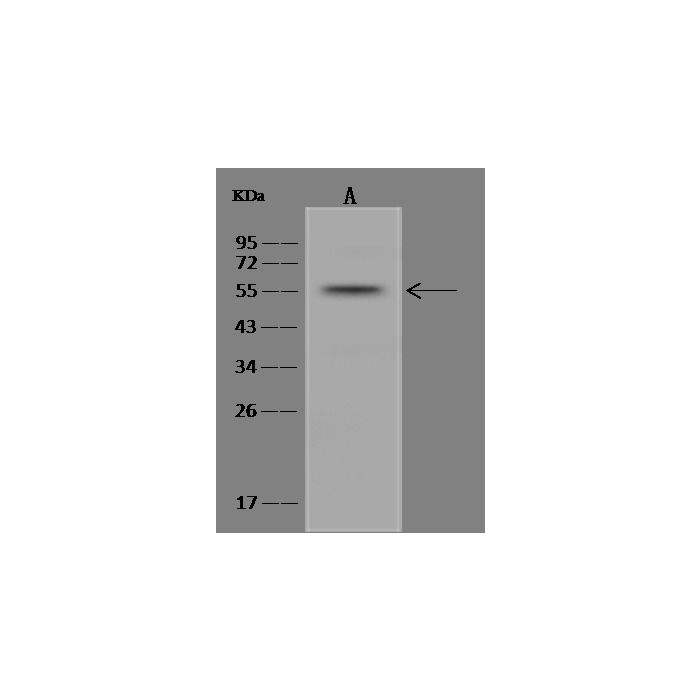
Anti-DNTT rabbit polyclonal antibody at 1:500 dilution Lane A: Jurkat Whole Cell Lysate Lysates/proteins at 30 μg per lane. Secondary Goat Anti-Rabbit IgG (H+L)/HRP at 1/10000 dilution. Developed using the ECL technique. Performed under reducing conditions. Predicted band size:58 kDa
DNA nucleotidylexotransferase (DNTT), also known as Terminal deoxynucleotidyl transferase (TdT), is a unique template-independent DNA polymerase belonging to the DNA polymerase type-X family. Encoded by the DNTT gene, this enzyme is expressed in a limited subset of pre-B and pre-T lymphocytes, both normal and malignant, during early stages of differentiation. DNTT plays a crucial role in the development of the immune system by catalyzing the random addition of deoxynucleotides to the 3'-hydroxyl terminus of DNA primers, thereby generating N-regions at the junctions of rearranged Ig heavy chain and T cell receptor gene segments. This process is essential for creating diversity in antigen receptor molecules. Furthermore, DNTT's expression in neuroendocrine carcinomas and its presence in certain types of leukemia highlight its significance as a biochemical marker for the classification of these diseases.
References
Tzorakoleftheraki SE, et al. (2017) Tdt expression in normal and neoplastic sebaceous cells. Histopathology 71 (6): 985-988.
Gholami S, et al. (2017) Terminal deoxynucleotidyl transferase (tdt) inhibiti on of cord blood derived b and t cells expansion. Adv Pharm Bull 7 (2): 215-220.
Brobeil A, et al. (2018) Expression of terminal deoxynucleotidyl transferase (tdt) in classical seminoma: A potential diagnostic pitfall. Virchows Arch 472 (3): 433-440.

-HD12NO0302-WB.png)