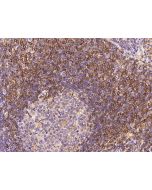
Anti-E-Cadherin Antibody, Rabbit Polyclonal sinobiological 50671-T16
$243.00
In stock
SKU
50671-T16
| Catalog No. | Size | Price (USD) |
| 50671-T16-100 | 100 µL | $251.64 |
| Catalog No. | Size | Price (USD) |
| 50671-T16-100 | 100 µL | $251.64 |
General Information
| Product name | Anti-E-Cadherin Antibody, Rabbit Polyclonal |
| Validated applications | ELISA (FAQ Protocol) |
| Species reactivity | Reacts with: Mouse |
| Specificity | Mouse E-Cadherin |
| Immunogen | Recombinant Mouse E-Cadherin Protein (Catalog#50671-M08H) |
| Preparation | Produced in rabbits immunized with purified, recombinant Mouse E-Cadherin (rM E-Cadherin; Catalog#50671-M08H; P09803; Met1-Val709). E-Cadherin specific IgG was purified by Mouse E-Cadherin affinity chromatography. |
| Source | Polyclonal Rabbit IgG |
| Purification | Protein A & Antigen Affinity |
| Formulation | 0.2 μm filtered solution in PBS |
| Conjugate | Unconjugated |
| Form | Liquid |
| Shipping | This antibody is shipped as liquid solution at ambient temperature. Upon receipt, store it immediately at the temperature recommended below. |
| Storage | This antibody can be stored at 2℃-8℃ for one month without detectable loss of activity. Antibody products are stable for twelve months from date of receipt when stored at -20℃ to -80℃. Preservative-Free. Avoid repeated freeze-thaw cycles. |
Synonyms: Anti-ARC-1 Antibody; Anti-Cdh1 Antibody; Anti-E-cad Antibody; Anti-Ecad Antibody; Anti-L-CAM Antibody; Anti-Um Antibody; Anti-UVO Antibody
Background Information
| Full Name | cadherin 1, type 1, E-cadherin (epithelial) |
| Description | Cadherins are calcium-dependent cell adhesion proteins which preferentially interact with themselves in a homophilic manner in connecting cells, and thus may contribute to the sorting of heterogeneous cell type. E-cadherin (E-Cad), also known as CDH1 and CD324, is a calcium-dependent cell adhesion molecule the intact function of which is crucial for the establishment and maintenance of epithelial tissue polarity and structural integrity. Mutations in CDH1 occur in diffuse type gastric cancer, lobular breast cancer, and endometrial cancer. In human cancers, partial or complete loss of E-cadherin expression correlates with malignancy. During apoptosis or with calcium influx, E-Cad is cleaved by the metalloproteinase to produce fragments of about 38 kDa (E-CAD/CTF1), 33 kDa (E-CAD/CTF2) and 29 kDa (E-CAD/CTF3), respectively. E-Cad has been identified as a potent invasive suppressor, as downregulation of E-cadherin expression is involved in dysfunction of the cell-cell adhesion system, and often correlates with strong invasive potential and poor prognosis of human carcinomas. |
| Research Areas |
|
| Related Pathways |
|
| References |
|
title: Spatio-temporal control on the delivery of triamcinolone acetonide using polymeric nanoparticles reduces steroid induced cataract.
authors: Dadi A Srinivasarao; S Sreenivasa Reddy; ...; Dhirendra S Katti
journal: International Journal of Pharmaceutics
date: 2020-01-24
pmid: 31279055
doi: 10.1016/j.ijpharm.2019.118474
cited_by_count: 17
techniques: Blocking Assay; Immunofluorescence; Incubation; Microscopy; Staining; Standard Deviation
bioz_score: 90