Phospho-EGF Receptor (Tyr845) Antibody, Rabbit MAb
Validated applications
WB (FAQ Protocol)
Species reactivity
Reacts with: Human, Species predicted to react based on 100% sequence homology: Mouse, rat
Specificity
Human Species predicted to react based on 100% sequence homology: Mouse, rat
Immunogen
A synthetic phosphopeptide corresponding to residues around Tyr845 of the Human Phospho-EGF Receptor
Preparation
This antibody was obtained from a rabbit immunized with a synthetic phosphopeptide corresponding to residues around Tyr845 of the Human Phospho-EGF Receptor.
Source
Monoclonal Rabbit IgG Clone #0007
Purification
Protein A
Formulation
10 mM sodium HEPES, 150 mM NaCl, 100 μg/mL BSA, 50% glycerol, pH 7.5
Conjugate
Unconjugated
Form
Liquid
Shipping
This antibody is shipped as liquid solution at ambient temperature. Upon receipt, store it immediately at the temperature recommended below.
Storage
This antibody can be stored at 2℃-8℃ for one month without detectable loss of activity. Antibody products are stable for twelve months from date of receipt when stored at -20℃ to -80℃. Preservative-Free. Avoid repeated freeze-thaw cycles.
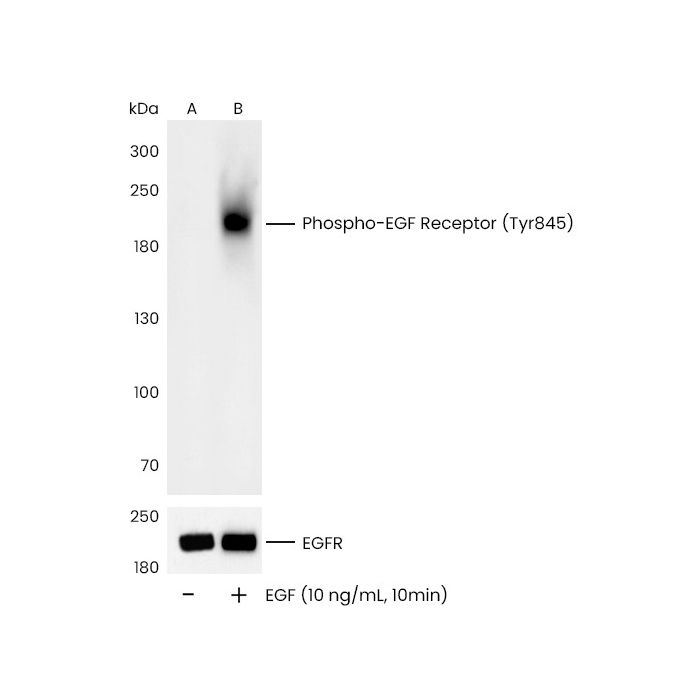
Western blot analysis of extracts from serum-starved Hela, untreated (-) or treated with EGF (10 ng/mL, 10min) using Phospho-EGF Receptor (Tyr845) rabbit monoclonal Antibody (Cat# 110828-R0007) at 1:1000 dilution (upper), Anti-EGFR Antibody (Cat# 100372-T32) at 1:1000 dilution (lower).
Western blot analysis of extracts from serum-starved Hela, untreated (-) or treated with EGF (10 ng/mL, 10min) using Phospho-EGF Receptor (Tyr845) rabbit monoclonal Antibody (Cat# 110828-R0007) at 1:1000 dilution (upper), Anti-EGFR Antibody (Cat# 100372-T32) at 1:1000 dilution (lower).
Western blot analysis of extracts from serum-starved Hela, untreated (-) or treated with EGF (10 ng/mL, 10min) using Phospho-EGF Receptor (Tyr845) rabbit monoclonal Antibody (Cat# 110828-R0007) at 1:1000 dilution (upper), Anti-EGFR Antibody (Cat# 100372-T32) at 1:1000 dilution (lower).
As a member of the epidermal growth factor receptor (EGFR) family, EGFR protein is type I transmembrane glycoprotein that binds a subset of EGF family ligands including EGF, amphiregulin, TGF-α, betacellulin, etc. EGFR protein plays a crucial role in signaling pathway in the regulation of cell proliferation, survival and differentiation. Binding of a ligand induces EGFR protein homo- or heterodimerization, the subsequent tyrosine autophosphorylation and initiates various down stream pathways (MAPK, PI3K/PKB and STAT). In addition, EGFR signaling also has been shown to exert action on carcinogenesis and disease progression, and thus EGFR protein is proposed as a target for cancer therapy currently.
Research Areas
Cancer Drug Targets
Receptor Tyrosine Kinases (RTKs)
Related Pathways
EGFR Signaling Pathway
Jak-Stat Signaling Pathway
Tags
Cancer Immunotherapy
Immune Checkpoint
Immunotherapy
Targeted Therapy
References
Schlessinger, J. (2000) Cell signaling by receptor tyrosine kinases. Cell 103(2): 211-25.
Giaccone, G. (2005) HER1/EGFR-targeted agents: predicting the future for patients with unpredictable outcomes to therapy. Ann. Oncol. 16(4): 538-48.
Yarden, Y., et al. (2001) Untangling the ErbB signalling network. Nat. Rev. Mol. Cell. Biol. 2(2): 127-37.