Produced in rabbits immunized with E. coli-derived Human FKBP12 fragment, and purified by antigen affinity chromatography.
Source
Polyclonal Rabbit IgG
Purification
Protein A & Antigen Affinity
Formulation
PBS, pH7.0 with 0.03% Proclin300
Conjugate
Unconjugated
Form
Liquid
Shipping
This antibody is shipped as liquid solution at ambient temperature. Upon receipt, store it immediately at the temperature recommended below.
Storage
This antibody can be stored at 2℃-8℃ for one month without detectable loss of activity. Antibody products are stable for twelve months from date of receipt when stored at -20℃ to -80℃. Avoid repeated freeze-thaw cycles.
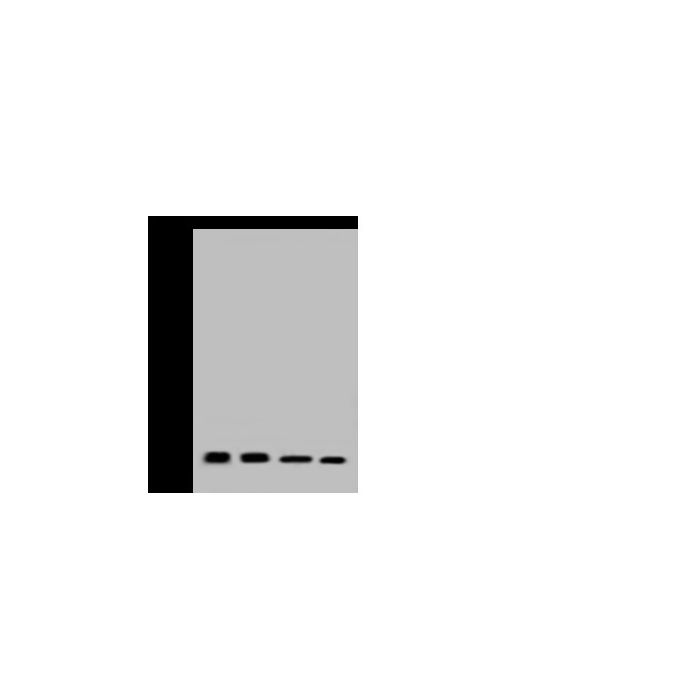
Anti-FKBP1A rabbit polyclonal antibody at 1:500 dilution Lane A: HL-60 Whole Cell Lysate Lane B: SH-SY5Y Whole Cell Lysate Lane C: A431 Whole Cell Lysate Lane D: U937 Whole Cell Lysate Lysates/proteins at 30 μg per lane. Secondary Goat Anti-Rabbit IgG (H+L)/HRP at 1/10000 dilution. Developed using the ECL technique. Performed under reducing conditions. Predicted band size:12 kDa Observed band size:13 kDa
FK506 binding protein 12 (FKBP12), also known as FKBP1, along with cyclophilin, are two major members of the immunophilin protein family who serve as receptors for the immunosuppressant drugs cyclosporin A and FK506. As a conserved molecule in many eukaryotes, FKBP12 has been characterized as a peptidyl-prolyl isomerase that catalyzes the transition between cis- and trans-proline residues, and is involved in several biochemical processes including protein folding, receptor signaling, protein trafficking and transcription. FKBP12 has attracted immense attention and its role in mediating the immunosuppressive functions. FKBP12 serves a dual role as a peptidyl-prolyl cis-trans isomerase and as a modulator of several cell signaling pathways. In one such role, FKBP12 interacts with and regulates the functional state of the ryanodine Ca2+ channel receptor by altering protein conformation and coordinating multi-protein complex formation. Another physiological role of FKBP12 is an interactor and a regulator of the type I serine/threonine kinase receptors of TGF-beta superfamily. Current data, derived from detailed biochemical studies as well as from functional studies in various systems, suggest that FKBP12 functions as a "guardian" for the type I receptors to prevent them from leaky signaling under sub-optimal ligand concentrations, thereby providing a molecular "gradient reader" for TGF-beta family morphogens. This aspect of FKBP12 function may be critical for cellular responsiveness to morphogenetic gradients of the TGF-beta family members during early development, serving to assure the translation of different ligand concentrations into different signaling readouts. In addition, FKBP12 may be involved in neuronal or astrocytic cytoskeletal organization and the abnormal metabolism of tau protein in Alzheimer's disease (AD) damaged neurons.
Research Areas
Phosphatases and Regulators
References
Wang T, et al. (2004) The immunophilin FKBP12: a molecular guardian of the TGF-beta family type I receptors. Front Biosci. 9: 619-31.
Sugata H, et al. (2009) A peptidyl-prolyl isomerase, FKBP12, accumulates in Alzheimer neurofibrillary tangles. Neurosci Lett. 459(2): 96-9.
Brath U, et al. (2009) Differential responses of the backbone and side-chain conformational dynamics in FKBP12 upon binding the transition-state analog FK506: implications for transition-state stabilization and target protein recognition. J Mol Biol. 387(1): 233-44.
Scaramello CB, et al. . (2009) FKBP12 depletion leads to loss of sarcoplasmic reticulum Ca(2+) stores in rat vas deferens. J Pharmacol Sci. 109(2): 185-92.

-HD12JU1967-WB.png)