Human, Mouse Species predicted to react based on 100% sequence homology: Rat, Cynomolgus Phospho-AKT1 (Thr450) of P31749 in UniProt.
Immunogen
A synthetic phosphopeptide corresponding to residues around (Thr450) of the Human Phospho-AKT1
Preparation
This antibody was obtained from a rabbit immunized with a synthetic phosphopeptide corresponding to residues around (Thr450) of the Human Phospho-AKT1.
Source
Monoclonal Rabbit IgG Clone #0056
Purification
Protein A
Formulation
10 mM sodium HEPES, 150 mM NaCl, 100 μg/mL BSA, 50% glycerol, pH 7.5
Conjugate
Unconjugated
Form
Liquid
Shipping
This antibody is shipped as liquid solution at ambient temperature. Upon receipt, store it immediately at the temperature recommended below.
Storage
This antibody can be stored at 2℃-8℃ for one month without detectable loss of activity. Antibody products are stable for twelve months from date of receipt when stored at -20℃ to -80℃. Preservative-Free. Avoid repeated freeze-thaw cycles.
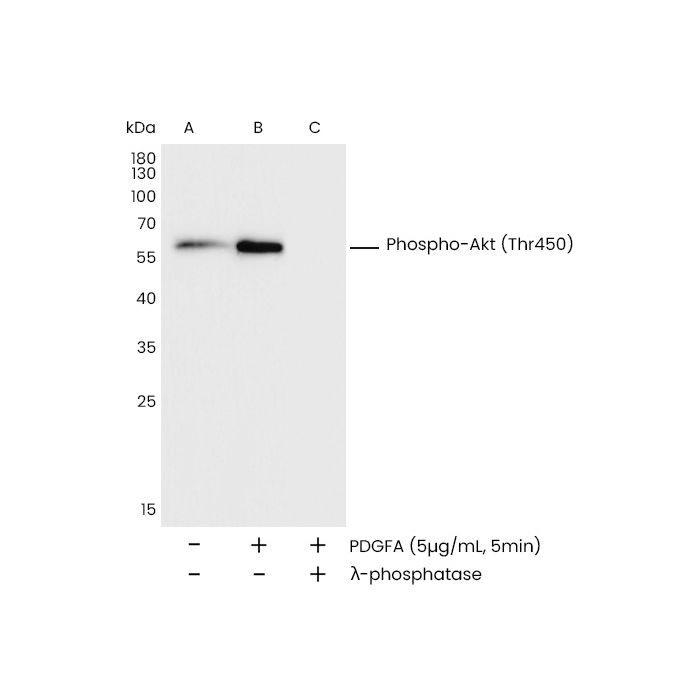
Western blot analysis of extracts from serum-starved NIH 3T3, untreated (line A); treated with PDGFA (Cat# 13081-H07Y) (5 μg/mL, 5 min; +) (line B); treated with PDGFA and λ-phosphatase (line C) using Phospho-AKT (Thr450) rabbit monoclonal Antibody (Cat# 110848-R0056) at 1:1000 dilution.
v-akt murine thymoma viral oncogene homolog 1 (AKT1), or protein kinase B-alpha (PKB-ALPHA) is a serine-threonine protein kinase, belonging to the Protein Kinase Superfamily. AKT1 is a major mediator of the responses to insulin, insulin-like growth factor 1 (IGF1), and glucose. AKT1 also plays a key role in the regulation of both muscle cell hypertrophy and atrophy. AKT1 activity is required for physiologic cardiac growth in response to IGF1 stimulation or exercise training. In contrast, AKT1 activity was found to antagonize pathologic cardiac growth that occurs in response to endothelin 1 stimulation or pressure overload. AKT1 selectively promotes physiological cardiac growth while AKT2 selectively promotes insulin-stimulated cardiac glucose metabolism. AKT1 deletion prevented tumor initiation as well as tumor progression, coincident with decreased Akt signaling in tumor tissues. AKT1 is the primary Akt isoform activated by mutant K-ras in lung tumors, and that AKT3 may oppose AKT1 in lung tumorigenesis and lung tumor progression. A number of separate studies have implicated AKT1 as an inhibitor of breast epithelial cell motility and invasion. AKT1 may have a dual role in tumorigenesis, acting not only pro-oncogenically by suppressing apoptosis but also anti-oncogenically by suppressing invasion and metastasis.
Research Areas
Cancer Drug Targets
Related Pathways
EGFR Signaling Pathway
p53 Pathway
TGF-beta Signaling
TNF Signaling
VEGF Signaling Pathway
AKT Signaling Pathway
AMPK Signaling Pathway
B Cell Receptor Signaling Pathway
Jak-Stat Signaling Pathway
T Cell Receptor Signaling Pathway
Common G-Chain signaling pathway
Tags
Cancer Immunotherapy
Immune Checkpoint
Immunotherapy
Targeted Therapy
References
Hollander MC, et al. (2011) Akt1 deletion prevents lung tumorigenesis by mutant K-ras. Oncogene. 30(15): 1812-21.
Devaney JM, et al. (2011) AKT1 polymorphisms are associated with risk for metabolic syndrome. Hum Genet. 129(2): 129-39.
Dillon RL, et al. (2010) Distinct biological roles for the akt family in mammary tumor progression. Cancer Res. 70(11): 4260-4.
Toker A, et al. (2006) Akt signaling and cancer: surviving but not moving on. Cancer Res. 66(8): 3963-6.
Muslin AJ, et al. (2006) Role of Akt in cardiac growth and metabolism. Novartis Found Symp. 274: 118-26.