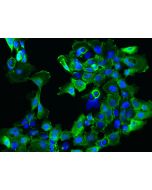
(Antibody's applications have not been validated with corresponding Listeria monocytogenes. Optimal concentrations/dilutions should be determined by the end user.)
Species reactivity
Reacts with: Listeria monocytogenes
Specificity
Listeria monocytogenes flagellin
Immunogen
Recombinant Listeria monocytogenes flagellin / flaA protein (Catalog#40067-V07E)
Preparation
Produced in rabbits immunized with purified, recombinant Listeria monocytogenes flagellin / flaA (rListeria monocytogenes flagellin / flaA; Catalog#40067-V07E; YP_013330.1; Met1-Ser287). Total IgG was purified by Protein A affinity chromatography.
Source
Polyclonal Rabbit IgG
Purification
Protein A
Formulation
0.2 μm filtered solution in PBS
Conjugate
Unconjugated
Form
Liquid
Shipping
This antibody is shipped as liquid solution at ambient temperature. Upon receipt, store it immediately at the temperature recommended below.
Storage
This antibody can be stored at 2℃-8℃ for one month without detectable loss of activity. Antibody products are stable for twelve months from date of receipt when stored at -20℃ to -80℃. Preservative-Free. Avoid repeated freeze-thaw cycles.
Background Information
Description
The role of flagella and motility in the attachment of the foodborne pathogen Listeria monocytogenes to various surfaces is mixed with some systems requiring flagella for an interaction and others needing only motility for cells to get to the surface. In nature this bacterium is a saprophyte and contaminated produce is an avenue for infection. Previous studies have documented the ability of this organism to attach to and colonize plant tissue. Motility mutants were generated in three wild type strains of L. monocytogenes by deleting either FlaA, the gene encoding flagellin, or motAB, genes encoding part of the flagellar motor, and tested for both the ability to colonize sprouts and for the fitness of that colonization. The motAB mutants were not affected in the colonization of alfalfa, radish, and broccoli sprouts; however, some of the FlaA mutants showed reduced colonization ability. The best colonizing wild type strain was reduced in colonization on all three sprout types as a result of a FlaA deletion. A mutant in another background was only affected on alfalfa. The third, a poor alfalfa colonizer was not affected in colonization ability by any of the deletions. Fitness of colonization was measured in experiments of competition between mixtures of mutant and parent strains on sprouts. Here the FlaA and motAB mutants of the three strain backgrounds were impaired in fitness of colonization of alfalfa and radish sprouts, and one strain background showed reduced fitness of both mutant types on broccoli sprouts. Together these data indicate a role for flagella for some strains to physically colonize some plants, while the fitness of that colonization is positively affected by motility in almost all cases.
References
Gorski L. et al., 2009, PLoS ONE. 4 (4): E5142.
Tresse O. et al., 2009, Can J Microbiol. 55: 189-96.