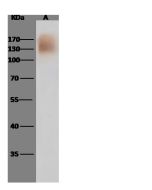
IHC, FCM, IF, IP et al. applications haven't been validated. (Antibody's applications haven't been validated with corresponding virus positive samples. Optimal concentrations/dilutions should be determined by the end user.)
Specificity
H10N3 (A/duck/Hong Kong/786/1979) HA / Hemagglutinin
Immunogen
Recombinant H10N3 (A/duck/Hong Kong/786/1979) HA / Hemagglutinin protein (Catalog#11693-V08H)
Preparation
Produced in rabbits immunized with purified, recombinant H10N3 (A/duck/Hong Kong/786/1979) HA / Hemagglutinin (Catalog#11693-V08H; BAF46762.1; Met1-Ile525). Total IgG was purified by Protein A affinity chromatography.
Source
Polyclonal Rabbit IgG
Purification
Protein A
Formulation
0.2 μm filtered solution in PBS
Conjugate
Unconjugated
Form
Liquid
Shipping
This antibody is shipped as liquid solution at ambient temperature. Upon receipt, store it immediately at the temperature recommended below.
Storage
This antibody can be stored at 2℃-8℃ for one month without detectable loss of activity. Antibody products are stable for twelve months from date of receipt when stored at -20℃ to -80℃. Preservative-Free. Avoid repeated freeze-thaw cycles.
Background Information
Full Name
Hemagglutinin
Description
The influenza viral Hemagglutinin (HA) protein is a homotrimer with a receptor binding pocket on the globular head of each monomer.HA has at least 18 different antigens. These subtypes are named H1 through H18.HA has two functions. Firstly, it allows the recognition of target vertebrate cells, accomplished through the binding to these cells' sialic acid-containing receptors. Secondly, once bound it facilitates the entry of the viral genome into the target cells by causing the fusion of the host endosomal membrane with the viral membrane. The influenza virus Hemagglutinin (HA) protein is translated in cells as a single protein, HA, or hemagglutinin precursor protein. For viral activation, hemagglutinin precursor protein (HA) must be cleaved by a trypsin-like serine endoprotease at a specific site, normally coded for by a single basic amino acid (usually arginine) between the HA1 and HA2 domains of the protein. After cleavage, the two disulfide-bonded protein domains produce the mature form of the protein subunits as a prerequisite for the conformational change necessary for fusion and hence viral infectivity.
References
White JM, Hoffman LR, Arevalo JH, et al. Attachment and entry of influenza virus into host cells. Pivotal roles of hemagglutinin. In Chiu W, Burnett RM, Garcea RL. Structural Biology of Viruses.1997
Suzuki Y.Sialobiology of influenza: molecular mechanism of host range variation of influenza viruses. Biol. Pharm. Bull. 2005.
Senne DA, Panigrahy B, Kawaoka Y, et al. Survey of the hemagglutinin (HA) cleavage site sequence of H5 and H7 avian influenza viruses: amino acid sequence at the HA cleavage site as a marker of pathogenicity potential. Avian Dis. 1996
Donald J. Benton,Influenza hemagglutinin membrane anchor,PNAS,2018