Recombinant Human GPA33 protein (Catalog#11277-H08H)
Preparation
Produced in rabbits immunized with purified, recombinant Human GPA33 (rh GPA33; Catalog#11277-H08H; Q99795-1; Met 1-Val 235). GPA33 specific IgG was purified by Human GPA33 affinity chromatography.
Source
Polyclonal Rabbit IgG
Purification
Protein A & Antigen Affinity
Formulation
0.2 μm filtered solution in PBS
Conjugate
Unconjugated
Form
Liquid
Shipping
This antibody is shipped as liquid solution at ambient temperature. Upon receipt, store it immediately at the temperature recommended below.
Storage
This antibody can be stored at 2℃-8℃ for one month without detectable loss of activity. Antibody products are stable for twelve months from date of receipt when stored at -20℃ to -80℃. Preservative-Free. Avoid repeated freeze-thaw cycles.
Synonyms: Anti-A33 Antibody
Image / Experimental Information
Image 1 Description
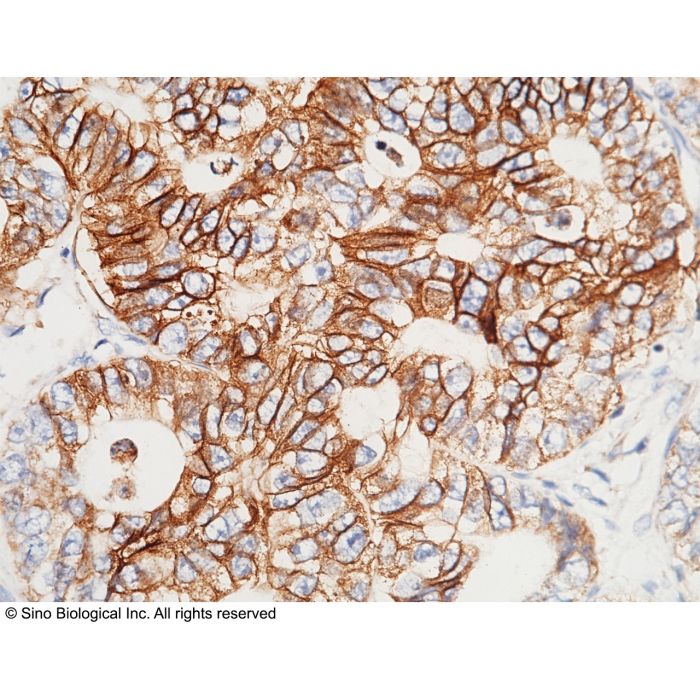
Immunochemical staining of human GPA33 in human rectal cancer with rabbit polyclonal antibody (1:1000, formalin-fixed paraffin embedded sections). Positive staining was localized to epithelium.
Immunochemical staining of human GPA33 in human rectal cancer with rabbit polyclonal antibody (1:1000, formalin-fixed paraffin embedded sections). Positive staining was localized to epithelium.
Immunochemical staining of human GPA33 in human rectal cancer with rabbit polyclonal antibody (1:1000, formalin-fixed paraffin embedded sections). Positive staining was localized to epithelium.
Immunochemical staining of human GPA33 in human rectal cancer with rabbit polyclonal antibody (1:1000, formalin-fixed paraffin embedded sections). Positive staining was localized to epithelium.
Cell surface A33 antigen, also known as glycoprotein A33, is a single-pass type I membrane protein that is expressed in the normal gastrointestinal epithelium and 95% of colon cancers. GPA33 contains one Ig-like C2-type (immunoglobulin-like) domain and one Ig-like V-type (immunoglobulin-like) domain. The open reading frame encodes a 319-amino acid polypeptide having a putative secretory signal sequence and 3 potential glycosylation sites. The predicted mature protein has a 213-amino acid extracellular region, a single transmembrane domain, and a 62-amino acid intracellular tail. Intracellular traffic and recycling to the cell surface appear to play a major role in GPA33 function and to have an influence on its surface density superseding translational regulation. GPA33 has become a promising target of immunologic therapy strategies, but its biologic function and potential role in tumorigenesis are unknown. EpCAM protein and GPA33 mRNA expressions are specific and sensitive markers of Barrett's metaplasia (BM). GPA33 may also play a role in cell-cell recognition and signaling.
Research Areas
Cancer Drug Targets
Tags
Cancer Immunotherapy
Immune Checkpoint
Immunotherapy
Targeted Therapy
References
Heath J.K., et al., 1997, Proc. Natl. Acad. Sci. USA. 94:469-74.
Ritter G., et al., 1997, Biochem. Biophys. Res. Commun. 236:682-6.
Frey,D. et al., 2008, Cancer Biother Radiopharm 23 (1):65-73.
Rageul,J. et al., 2009, Int J Cancer 125 (12):2802-9.

-1ug-rectal-cancer.png)
-1ug-colon.png)
-1ug-colon-carcinoma.png)
-1ug-appendix.png)