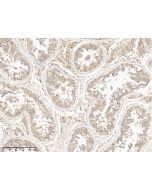
Recombinant Human Angiopoietin-1/ANGPT1 Protein (Catalog#13667-H02H1)
Preparation
This antibody was produced from a hybridoma resulting from the fusion of a mouse myeloma with B cells obtained from a mouse immunized with purified, recombinant Human Angiopoietin-1/ANGPT1 (rh Angiopoietin-1/ANGPT1; Catalog#13667-H02H1; NP_001137.2; Met1-Leu261 and Arg277-Phe498). The IgG fraction of the cell culture supernatant was purified by Protein A affinity chromatography.
Source
Monoclonal Mouse IgG2a Clone #02
Purification
Protein A
Formulation
0.2 μm filtered solution in PBS
Conjugate
Unconjugated
Form
Liquid
Shipping
This antibody is shipped as liquid solution at ambient temperature. Upon receipt, store it immediately at the temperature recommended below.
Storage
This antibody can be stored at 2℃-8℃ for one month without detectable loss of activity. Antibody products are stable for twelve months from date of receipt when stored at -20℃ to -80℃. Preservative-Free. Avoid repeated freeze-thaw cycles.
The angiopoietin (ANGPT)-TIE2/TEK signaling pathway is essential for blood and lymphatic vascular homeostasis. ANGPT1 is a potent TIE2 activator, whereas ANGPT2 functions as a context-dependent agonist/antagonist. In disease, ANGPT2-mediated inhibition of TIE2 in blood vessels is linked to vascular leak, inflammation, and metastasis. Primary congenital glaucoma (PCG) is a leading cause of blindness in children worldwide and is caused by developmental defects in 2 aqueous humor outflow structures, Schlemm's canal (SC) and the trabecular meshwork. We previously identified loss-of-function mutations in the angiopoietin (ANGPT) receptor TEK in families with PCG and showed that ANGPT/TEK signaling is essential for SC development. A role for the major ANGPT ligands in the development of the aqueous outflow pathway. We determined that ANGPT1 is essential for SC development, and that Angpt1-knockout mice form a severely hypomorphic canal with elevated intraocular pressure. By linking ANGPT1 with PCG, these results highlight the importance of ANGPT/TEK signaling in glaucoma pathogenesis and identify a candidate target for therapeutic development.