A synthetic peptide corresponding to the C-terminus of the Human Ago4
Preparation
Produced in rabbits immunized with a synthetic peptide corresponding to the C-terminus of the Human Ago4, and purified by antigen affinity chromatography.
Source
Polyclonal Rabbit IgG
Purification
Protein A & Antigen Affinity
Formulation
0.2 μm filtered solution in PBS
Conjugate
Unconjugated
Form
Liquid
Shipping
This antibody is shipped as liquid solution at ambient temperature. Upon receipt, store it immediately at the temperature recommended below.
Storage
This antibody can be stored at 2℃-8℃ for one month without detectable loss of activity. Antibody products are stable for twelve months from date of receipt when stored at -20℃ to -80℃. Preservative-Free. Avoid repeated freeze-thaw cycles.
The four mammalian Argonaute family members are thought to share redundant functions in the microRNA pathway, yet only AGO2 possesses the catalytic "slicer" function required for RNAi. Argonaute (AGO) proteins are core components of small RNA-induced silencing pathways, which negatively regulate gene expression in a sequence-specific manner. In the post-transcriptional gene silencing (PTGS) pathway, AGO proteins bind to small RNAs such as miRNAs, tasiRNAs, or piRNAs and mediate gene silencing through degradation and/or translational suppression of the target mRNAs. AGO proteins are highly conserved and present in various life forms ranging from Archaea to humans. Each AGO protein is characterized by three conserved domains: PAZ, MID, and PIWI. The PAZ domain recognizes and binds the 3- end of small RNAs.
References
Duan CG, et al. (2015) Specific but interdependent functions for arabidopsis ago4 and ago6 in rna-directed DNA methylation. Embo j 34 (5): 581-592.

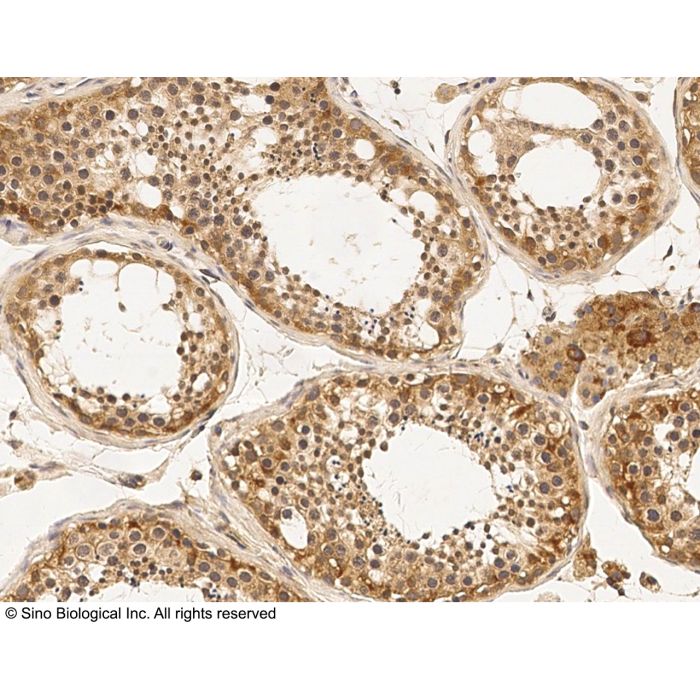
-HD09JA2105-3ug-testis-IHC-P.png)