A synthetic peptide corresponding to the center region of the Human ARHGAP11A
Preparation
Produced in rabbits immunized with a synthetic peptide corresponding to the center region of the Human ARHGAP11A, and purified by antigen affinity chromatography.
Source
Polyclonal Rabbit IgG
Purification
Protein A & Antigen Affinity
Formulation
PBS, pH7.0 with 0.03% Proclin300
Conjugate
Unconjugated
Form
Liquid
Shipping
This antibody is shipped as liquid solution at ambient temperature. Upon receipt, store it immediately at the temperature recommended below.
Storage
This antibody can be stored at 2℃-8℃ for one month without detectable loss of activity. Antibody products are stable for twelve months from date of receipt when stored at -20℃ to -80℃. Avoid repeated freeze-thaw cycles.
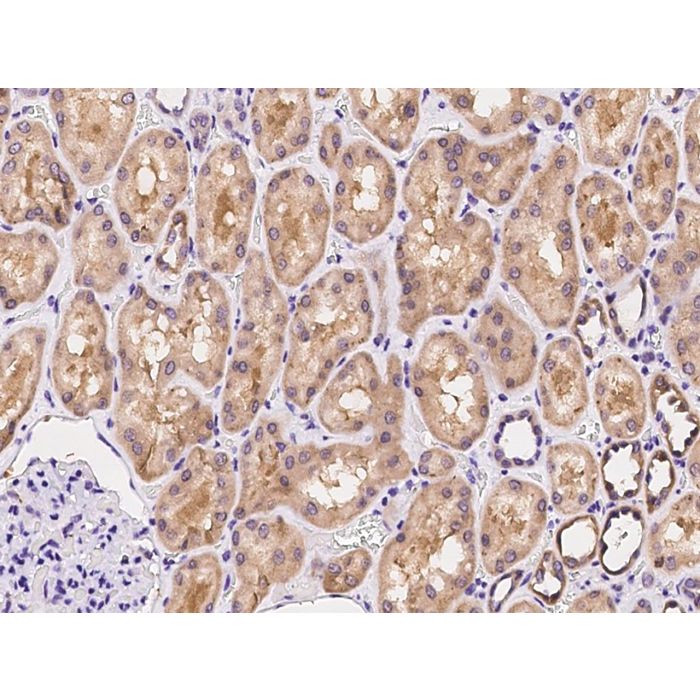
Immunochemical staining of human ARHGAP11A in human kidney with rabbit polyclonal antibody at 1:1000 dilution, formalin-fixed paraffin embedded sections.
Knockdown of ArhGAP11A caused CDKN1B/p27-mediated arrest in the G1 phase of the cell cycle, whereas depletion of RacGAP1 inhibited growth through the combined effects of cytokinesis failure, CDKN1A/p21-mediated RB1 inhibition, and the onset of senescence. Random migration was suppressed or enhanced by the knockdown of ArhGAP11A or RacGAP1, respectively. Cell spreading and levels of GTP-bound RhoA were increased upon depletion of either RhoGAP. Via the suppression of RhoA, ArhGAP11A and RacGAP1 are both critical drivers of BLBC growth, and propose that RhoGAPs can act as oncogenes in cancer. ARHGAP11A, a cell cycle-dependent RhoGAP, is a critical regulator of cancer cell mobility and is thus a promising therapeutic target in invasive cancers. Expression of ARHGAP11A in cancer cells suppressed RhoA-dependent mechanisms, such as stress fiber formation and focal adhesion, which made the cells more prone to migrate.And RhoA suppression by ARHGAP11A induced augmentation of relative Rac1 activity, leading to an increase in the invasive properties. The RhoGAP ArhGAP11A induces cell-cycle arrest and apoptosis by binding to the tumor suppressor p53.

-HD12JA1038-1000-human-kidney-IHC-P.png)