A synthetic peptide corresponding to residues around Ser428 of Human ATR
Preparation
This antibody was obtained from a rabbit immunized with a synthetic peptide corresponding to residues around Ser428 of Human ATR.
Source
Monoclonal Rabbit IgG Clone #0025
Purification
Protein A
Formulation
10 mM sodium HEPES, 150 mM NaCl, 100 μg/mL BSA, 50% glycerol, pH 7.5
Conjugate
Unconjugated
Form
Liquid
Shipping
This antibody is shipped as liquid solution at ambient temperature. Upon receipt, store it immediately at the temperature recommended below.
Storage
This antibody can be stored at 2℃-8℃ for one month without detectable loss of activity. Antibody products are stable for twelve months from date of receipt when stored at -20℃ to -80℃. Preservative-Free. Avoid repeated freeze-thaw cycles.
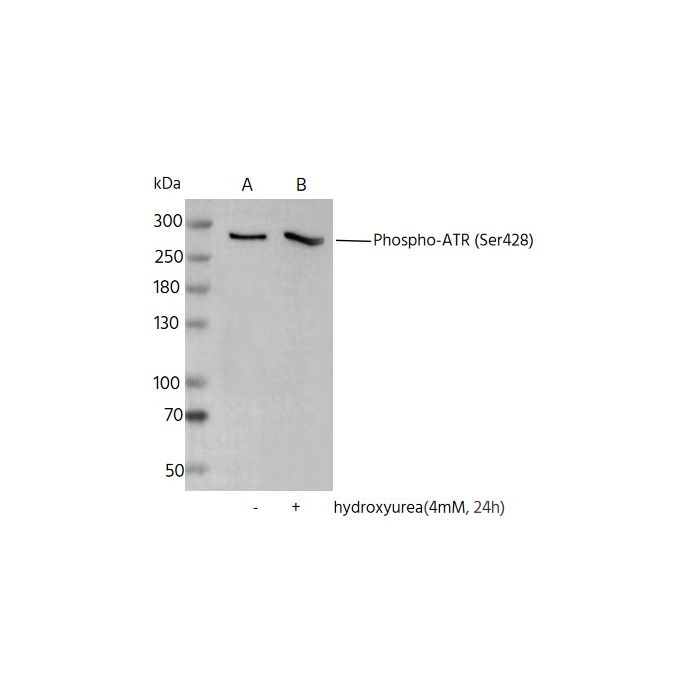
Western blot analysis of extracts from Hela, untreated(line A) or treated with hydroxyurea(4mM, 24h; +)(line B), using Phospho-ATR (Ser428) rabbit monoclonal Antibody (Cat: 111263-R0025 ) at 1:1000 dilution.
Western blot analysis of extracts from Hela, untreated(line A) or treated with hydroxyurea(4mM, 24h; +)(line B), using Phospho-ATR (Ser428) rabbit monoclonal Antibody (Cat: 111263-R0025 ) at 1:1000 dilution.
ATR is a serine/threonine protein kinase and ATR kinase inhibitors potentiate chemotherapy and radiation. The ATR kinase inhibitor VX-970 (NSC 780162) is in clinical development in combination with primary cytotoxic agents and as a monotherapy for tumors harboring specific mutations. Nucleotide excision repair (NER) is the sole mechanism of UV-induced DNA lesion repair in mammals. A single round of NER requires multiple components including seven core NER factors, xeroderma pigmentosum A-G (XPA-XPG), and many auxiliary effector proteins including ATR serine/threonine kinase. The ataxia telangiectasia mutated serine/threonine kinase (ATM)/checkpoint kinase 2 (CHEK2, best known as CHK2) and the ATM and Rad3-related serine/threonine kinase (ATR)/CHEK1 (best known as CHK1) cascades are the 2 major signaling pathways driving the DNA damage response (DDR), a network of processes crucial for the preservation of genomic stability that act as a barrier against tumorigenesis and tumor progression.