Human B7-H3 No cross-reactivity in ELISA with Human cell lysate (293 cell line)
Immunogen
Recombinant Human B7-H3 / CD276 protein (Catalog#11188-H08H)
Preparation
This antibody was produced from a hybridoma resulting from the fusion of a mouse myeloma with B cells obtained from a mouse immunized with purified, recombinant Human B7-H3 / CD276 (rh B7-H3 / CD276; Catalog#11188-H08H; Q5ZPR3-1; Met 1-Thr 461). The IgG fraction of the cell culture supernatant was purified by Protein A affinity chromatography.
Source
Monoclonal Mouse IgG2b Clone #06
Purification
Protein A
Formulation
0.2 μm filtered solution in PBS
Conjugate
Unconjugated
Form
Liquid
Shipping
This antibody is shipped as liquid solution at ambient temperature. Upon receipt, store it immediately at the temperature recommended below.
Storage
This antibody can be stored at 2℃-8℃ for one month without detectable loss of activity. Antibody products are stable for twelve months from date of receipt when stored at -20℃ to -80℃. Preservative-Free. Avoid repeated freeze-thaw cycles.
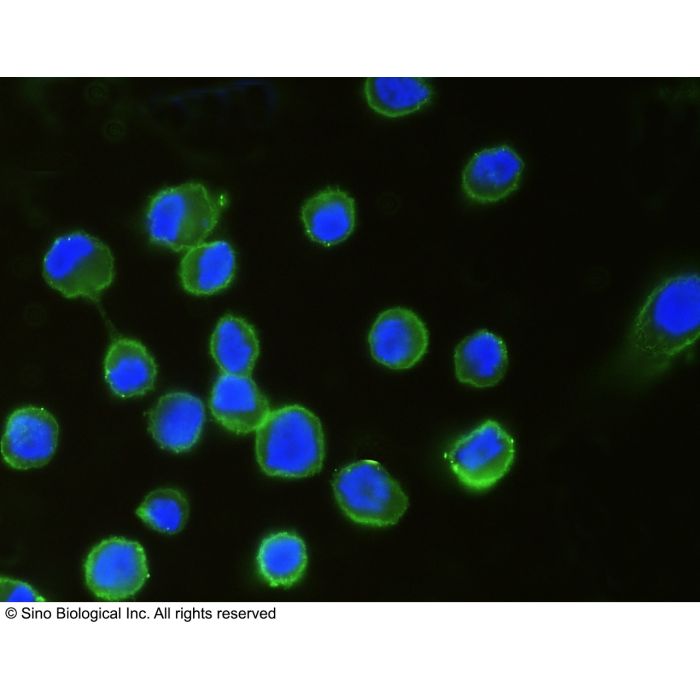
Immunofluorescence staining of Human B7H3 in PC3 cells. Cells were fixed with 4% PFA, blocked with 10% serum, and incubated with Mouse anti-Human B7H3 monoclonal antibody (1:100) at 4℃ overnight. Then cells were stained with the Alexa Fluor® 488-conjugated Goat Anti-mouse IgG secondary antibody (green) and counterstained with DAPI (blue). Positive staining was localized to plasma membrane.
Immunofluorescence staining of Human B7H3 in PC3 cells. Cells were fixed with 4% PFA, blocked with 10% serum, and incubated with Mouse anti-Human B7H3 monoclonal antibody (1:100) at 4℃ overnight. Then cells were stained with the Alexa Fluor® 488-conjugated Goat Anti-mouse IgG secondary antibody (green) and counterstained with DAPI (blue). Positive staining was localized to plasma membrane.
B7-H3 is a member of the B7 family of immune regulatory ligands that is thought to attenuate peripheral immune responses through co-inhibition. It plays an important role in adaptive immune responses, and was shown to either promote or inhibit T-cell responses in various experimental systems. B7-H3 may play an important role in muscle-immune interactions, providing further evidence of the active role of muscle cells in local immunoregulatory processes. B7-H3 is a novel protein structurally related to the B7 family of ligands by the presence of a single set of immunoglobulin-V-like and immunoglobulin-C-like (VC) domains. Previous studies have correlated its overexpression with poor prognosis and decreased tumor-infiltrating lymphocytes in various carcinomas including uterine endometrioid carcinomas, and mounting evidence supports an immuno-inhibitory role in ovarian cancer prognosis. Recently, B7-H3 expression has been reported in several human cancers indicating an additional function of B7-H3 as a regulator of antitumor immunity.
Research Areas
Cancer Drug Targets
Tags
Cancer Immunotherapy
Co-inhibitory Immune Checkpoint Targets
Immune Checkpoint
Immune Checkpoint Detection: Antibodies
Immune Checkpoint Detection: ELISA Antibodies
Immune Checkpoint Detection: FCM Antibodies
Immune Checkpoint Detection: ICC Antibodies
Immune Checkpoint Detection: IP Antibodies
Immune Checkpoint Detection: WB Antibodies
Immune Checkpoint Targets
Immunotherapy
Targeted Therapy
References
Suh WK, et al. (2004) The immune regulatory protein B7-H3 promotes osteoblast differentiation and bone mineralization. Proc Natl Acad Sci U S A. 101(35): 12969-73.
Waschbisch A, et al. (2008) Human muscle cells express the costimulatory molecule B7-H3, which modulates muscle-immune interactions. Arthritis Rheum. 58(11): 3600-8.
Loos M, et al. (2010) B7-h3 and its role in antitumor immunity. Clin Dev Immunol. 2010: 683875.
Zang X, et al. (2010) Tumor associated endothelial expression of B7-H3 predicts survival in ovarian carcinomas. Mod Pathol. 23(8): 1104-12.
Sun J, et al. (2010) Clinical significance and regulation of the costimulatory molecule B7-H3 in human colorectal carcinoma. Cancer Immunol Immunother. 59(8): 1163-71.


-MM06-Purified-PC-3.png)