Recombinant Human BACE1 / ASP2 protein (Catalog#10064-H08H)
Preparation
This antibody was obtained from a rabbit immunized with purified, recombinant Human BACE1 / ASP2 (rh BACE1 / ASP2; Catalog#10064-H08H; NP_036236.1; Met 1-Thr 457) and conjugated with FITC under optimum conditions, the unreacted FITC was removed.
Source
Monoclonal Rabbit IgG Clone #027
Purification
Protein A
Formulation
PBS solution containing 0.5% BSA and 0.09% sodium azide
Concentration
10 μl/Test, 0.1 mg/ml
Conjugate
FITC
Form
Liquid
Shipping
This antibody is shipped as liquid solution at ambient temperature. Upon receipt, store it immediately at the temperature recommended below.
Storage
This antibody can be stored at 2℃-8℃ for twelve months without detectable loss of activity. Protected from prolonged exposure to light. Do not freeze ! Sodium azide is toxic to cells and should be disposed of properly. Flush with large volumes of water during disposal.
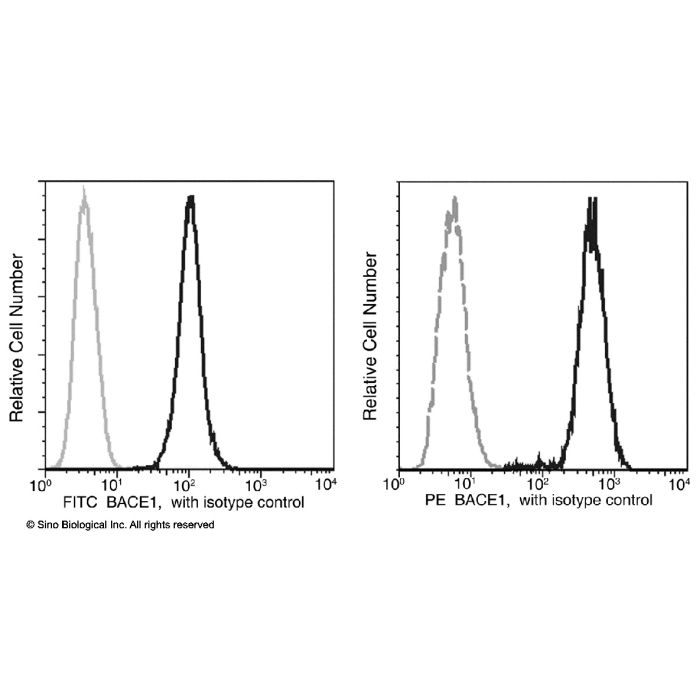
Flow cytometric analysis of Human BACE1 expression in Jurkat cells. The cells were treated according to manufacturer’s manual (BD Pharmingen™ Cat. No. 554714), and then stained with FITC Rabbit anti-BACE1 (10064-R027-F). The fluorescence histograms were derived from gated events with the forward and side light-scatter characteristics of intact cells.
Beta-site APP-cleaving enzyme 1 (BACE1) is an aspartic-acid protease important in the formation of myelin sheaths in peripheral nerve cells. In the brain, This protein is expressed highly in the substantia nigra, locus coruleus and medulla oblongata. Strong BACE1 expression has also been described in pancreatic tissue. BACE1 has a pivotal role in the pathogenesis of Alzheimer's disease. In Alzheimer's disease patients, BACE1 levels were elevated although mRNA levels were not changed. It has been found that BACE1 gene expression is controlled by a TATA-less promoter. The translational repression as a new mechanism controlling its expression. And the low concentrations of Ca(2+) (microM range) significantly increased the proteolytic activity of BACE1. Furthermore, BACE1 protein is ubiquitinated, and the degradation of BACE1 proteins and amyloid precursor protein processing are regulated by the ubiquitin-proteasome pathway. It has also been identified as the rate limiting enzyme for amyloid-beta-peptide (Abeta) production.
References
Christensen MA, et al. (2004) Transcriptional regulation of BACE1, the beta-amyloid precursor protein beta-secretase, by Sp1. Mol Cell Biol. 24(2):865-74.
Stockley JH, et al. (2007) The proteins BACE1 and BACE2 and beta-secretase activity in normal and Alzheimer's disease brain. Biochem Soc Trans. 35(Pt 3): 574-6.
Savonenko AV, et al. (2008) Alteration of BACE1-dependent NRG1/ErbB4 signaling and schizophrenia-like phenotypes in BACE1-null mice. Proc Natl Acad Sci U S A. 105(14): 5585-90.
Hayley M, et al. (2009) Calcium enhances the proteolytic activity of BACE1: An in vitro biophysical and biochemical characterization of the BACE1-calcium interaction. Biochim Biophys Acta. 1788(9): 1933-8.
title: Microvesicles from cerebrospinal fluid of patients with Alzheimer’s disease display reduced concentrations of tau and APP protein authors: Philipp Spitzer; Linda-Marie Mulzer; ...; Juan Manuel Maler journal: Scientific Reports date: 2019-05-08 pmid: 31068645 doi: 10.1038/s41598-019-43607-7 pmcid: 6506501 cited_by_count: 31 techniques: Binding Assay; Flow Cytometry; Fluorescence; Incubation; Staining bioz_score: 90