A synthetic peptide corresponding to the N-terminus of the Human Bcl-2.
Preparation
This antibody was obtained from a rabbit immunized with purified, the synthetic peptide corresponding to the N-terminus of the Human Bcl-2.
Source
Monoclonal Rabbit IgG Clone #001
Purification
Protein A
Formulation
0.2 μm filtered solution in PBS
Conjugate
Unconjugated
Form
Liquid
Shipping
This antibody is shipped as liquid solution at ambient temperature. Upon receipt, store it immediately at the temperature recommended below.
Storage
This antibody can be stored at 2℃-8℃ for one month without detectable loss of activity. Antibody products are stable for twelve months from date of receipt when stored at -20℃ to -80℃. Preservative-Free. Avoid repeated freeze-thaw cycles.
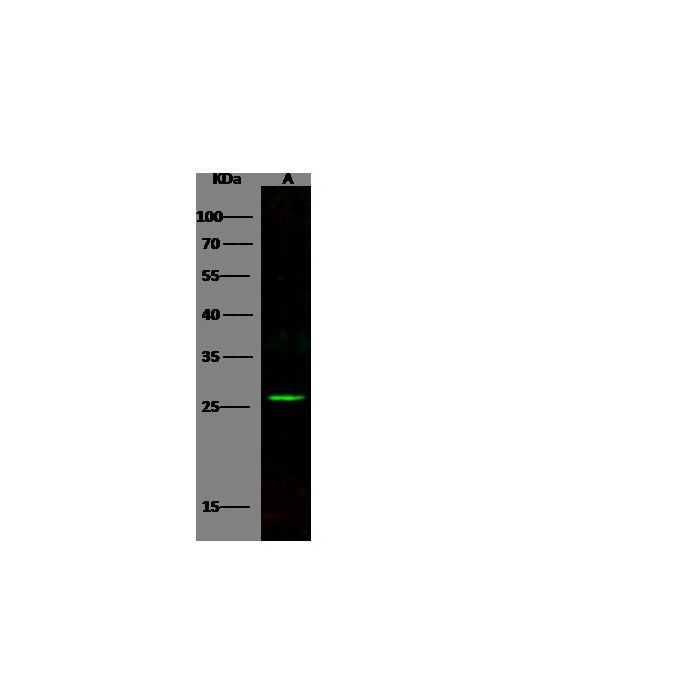
Anti-Bcl-2 rabbit monoclonal antibody at 1:500 dilution Lane A: Jurkat Whole Cell Lysate Lysates/proteins at 30 μg per lane. Secondary Goat Anti-Rabbit IgG H&L (Dylight800) at 1/10000 dilution. Developed using the Odyssey technique. Performed under reducing conditions. Predicted band size:26 kDa Observed band size:26 kDa
BCL2 (B-cell leukemia/lymphoma 2, N-Histidine-tagged), also known as Bcl-2, belongs to the Bcl-2 family. Bcl-2 family proteins regulate and contribute to programmed cell death or apoptosis. It is a large protein family and all members contain at least one of four BH (bcl-2 homology) domains. Certain members such as Bcl-2, Bcl-xl and Mcl1 are anti-apoptotic, whilst others are pro-apoptotic. Most Bcl-2 family members contain a C-terminal transmembrane domain that functions to target these proteins to the outer mitochondrial and other intracellular membranes. It is expressed in a variety of tissues. BCL2 blocks the apoptotic death of some cells such as lymphocytes. It also regulates cell death by controlling the mitochondrial membrane permeability and inhibits caspase activity either by preventing the release of cytochrome c from the mitochondria and/or by binding to the apoptosis-activating factor. Constitutive expression of BCL2, such as in the case of translocation of BCL2 to Ig heavy chain locus, is thought to be the cause of follicular lymphoma. Two transcript variants, produced by alternate splicing, differ in their C-terminal ends.
Research Areas
Cancer Drug Targets
Related Pathways
Death Receptor Signaling
p53 Pathway
TNF Signaling
AKT Signaling Pathway
Autophagy Pathway
Tags
Cancer Immunotherapy
Immune Checkpoint
Immunotherapy
Targeted Therapy
References
Tsujimoto Y, et al. (1984) Cloning of the chromosome breakpoint of neoplastic B cells with the t(14;18) chromosome translocation. Science. 226(4678):1097-99.
Cleary ML, et al. (1986) Cloning and structural analysis of cDNAs for bcl-2 and a hybrid bcl-2/immunoglobulin transcript resulting from the t(14;18) translocation. Cell. 47(1):19-28.
Otake Y, et al. (2007) Overexpression of nucleolin in chronic lymphocytic leukemia cells induces stabilization of Bcl-2 / Bcl-2 mRNA. Blood. 109(7):3069-75.