Recombinant Human c-Abl / ABL1 Protein (Catalog#11199-H09B)
Preparation
Produced in rabbits immunized with purified, recombinant Human c-Abl / ABL1 (rh c-Abl / ABL1; Catalog#11199-H09B; NP_009297.2; Pro137-Ser554). c-Abl / ABL1 specific IgG was purified by Human c-Abl / ABL1 affinity chromatography.
Source
Polyclonal Rabbit IgG
Purification
Protein A & Antigen Affinity
Formulation
0.2 μm filtered solution in PBS
Conjugate
Unconjugated
Form
Liquid
Shipping
This antibody is shipped as liquid solution at ambient temperature. Upon receipt, store it immediately at the temperature recommended below.
Storage
This antibody can be stored at 2℃-8℃ for one month without detectable loss of activity. Antibody products are stable for twelve months from date of receipt when stored at -20℃ to -80℃. Preservative-Free. Avoid repeated freeze-thaw cycles.
c-Abl belongs to the class of tyrosine kinases and is the prototype of a subfamily which includes two members, c-Abl and Arg (Abl-related gene). Both proteins are localized at the cell membrane, actin cytoskeleton and cytosol, and c-Abl is present in the nucleus as well. c-Abl is a non-receptor tyrosine kinase that participates in multiple signaling pathways linking the cell surface, cytoskeleton, and the nucleus. Recent in vitro studies have also linked c-Abl to amyloid-beta-induced toxicity and tau phosphorylation. c-Abl has been implicated in many cellular processes including differentiation, division, adhesion, death, and stress response. c-Abl is a latent tyrosine kinase that becomes activated in response to numerous extra- and intra-cellular stimuli. The c-Abl protein is a ubiquitously expressed nonreceptor tyrosine kinase involved in the development and function of many mammalian organ systems, including the immune system and bone. It regulates the cellular response to TAM through functional interaction with the estrogen receptor, which suggests c-Abl as a therapeutic target and a prognostic tumor marker for breast cancer. c-Abl also plays a key role in signaling chemokine-induced T-cell migration. In addition, c-Abl contains NLSs (nuclear localization signals) and DNA-binding sequences important for nuclear functions. c-Abl has become an important therapeutic target in human chronic myeloid leukaemia.
Research Areas
Cancer Drug Targets
Related Pathways
Jak-Stat Signaling Pathway
Tags
Cancer Immunotherapy
Immune Checkpoint
Immunotherapy
Targeted Therapy
References
Qiu Z, et al. (2010) c-Abl tyrosine kinase regulates cardiac growth and development. Proc Natl Acad Sci U S A. 107(3): 1136-41.
Huang Y, et al. (2008) The c-Abl tyrosine kinase regulates actin remodeling at the immune synapse. Blood. 112(1): 111-9.
Sirvent A, et al. (2008) Cytoplasmic signalling by the c-Abl tyrosine kinase in normal and cancer cells. Biol Cell. 100(11): 617-31.
Shaul Y, et al. (2005) Role of c-Abl in the DNA damage stress response. Cell Res. 15(1): 33-5.

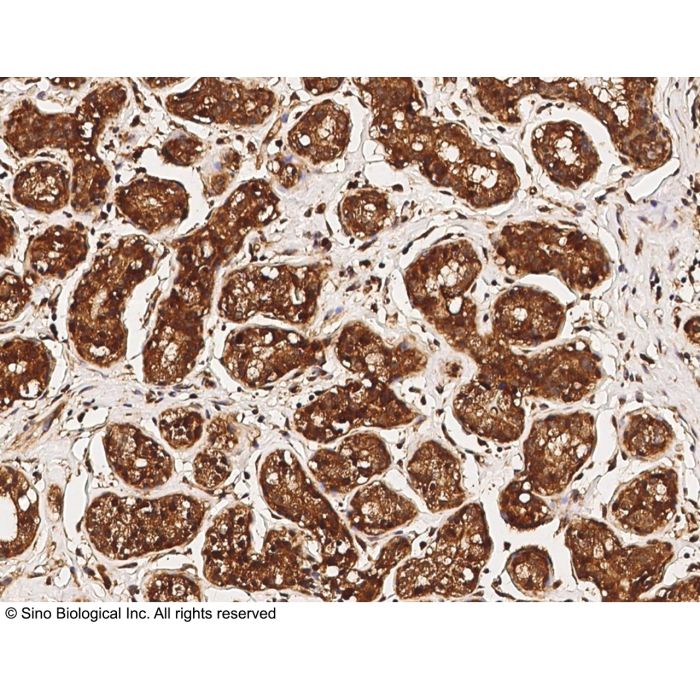


-HD09NO0207-1ug-breast-carcinoma-IHC-P.png)
-HD09NO0207-1ug-HeLa-IF.png)