A synthetic peptide corresponding to the center region of the Human Argonaute-2/AGO2
Preparation
Produced in rabbits immunized with a synthetic peptide corresponding to the center region of the Human Argonaute-2/AGO2, and purified by antigen affinity chromatography.
Source
Polyclonal Rabbit IgG
Purification
Protein A & Antigen Affinity
Formulation
0.2 μm filtered solution in PBS
Conjugate
Unconjugated
Form
Liquid
Shipping
This antibody is shipped as liquid solution at ambient temperature. Upon receipt, store it immediately at the temperature recommended below.
Storage
This antibody can be stored at 2℃-8℃ for one month without detectable loss of activity. Antibody products are stable for twelve months from date of receipt when stored at -20℃ to -80℃. Preservative-Free. Avoid repeated freeze-thaw cycles.
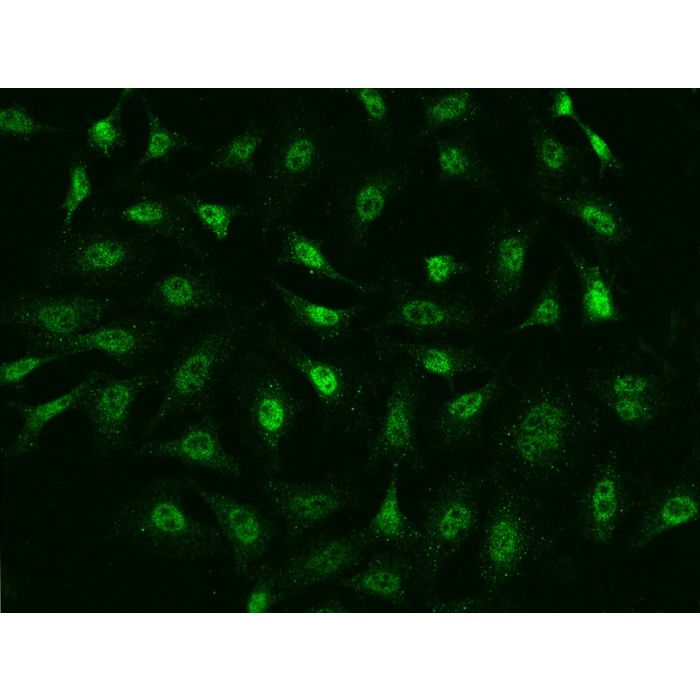
Immunofluorescence staining of AGO2 in Hela cells. Cells were fixed with 4% PFA, permeabilzed with 0.1% Triton X-100 in PBS,blocked with 10% serum, and incubated with rabbit anti-Human AGO2 polyclonal antibody (dilution ratio 1:200) at 4℃ overnight. Then cells were stained with the Alexa Fluor®488-conjugated Goat Anti-rabbit IgG secondary antibody (green). Positive staining was localized to Nucleus .
Argonaute 2 (AGO2), also known as Eukaryotic translation initiation factor 2C2 (EIF2C2), belongs to the Argonaute family, AGO subfamily, which is a component of the RNA-induced silencing complex (RISC) and mediates small interfering RNA (siRNA)-directed mRNA cleavage and microRNA translational suppression. AGO2 protein is the catalytic engine of mammalian RNAi. It contains a PIWI domain that is structurally related to RNases H and possibly shares with them a two-metal-ion catalysis mechanism. Human AGO2 was unable to cleave preformed RNA duplexes and exhibited weaker binding affinity for RNA duplexes compared with the single strand RNA. The enzyme exhibited greater RNase H activity in the presence of Mn2+ compared with Mg2+. Human AGO2 exhibited weaker binding affinities and reduced cleavage activities for antisense RNAs with either a 5'-terminal hydroxyl or abasic nucleotide. In mouse hematopoiesis, AGO2 controls early development of lymphoid and erythroid cells. AGO2 is a highly specialized member of the Argonaute family with an essential nonredundant Slicer-independent function within the mammalian miRNA pathway. AGO2 regulates dFMR1 expression, and the relationship between dFMR1 and AGO2 was defined by their physical interaction and co-regulation of downstream targets. AGO2 and dFMR1 are also connected through a regulatory relationship. AGO2 is a regulator of dFMR1 expression and have clarified an important developmental role for AGO2 in the nervous system and germ line that requires dFMR1 function. In addition, AGO2 is regulated at both the transcriptional and posttranslational level, and also implicate AGO2 and enhanced micro-RNA activity in the tumorigenic progression of breast cancer cell lines.
References
O'Carroll D, et al. (2007) A Slicer-independent role for Argonaute 2 in hematopoiesis and the microRNA pathway. Genes Dev. 21(16): 1999-2004.
Pepper AS, et al. (2009) Argonaute2 suppresses Drosophila fragile X expression preventing neurogenesis and oogenesis defects. PLoS One. 4(10): e7618.
Lima WF, et al. (2009) Binding and cleavage specificities of human Argonaute2. J Biol Chem. 284(38): 26017-28.
Adams BD, et al. (2009) Argonaute-2 expression is regulated by epidermal growth factor receptor and mitogen-activated protein kinase signaling and correlates with a transformed phenotype in breast cancer cells. Endocrinology. 150(1): 14-23.
Salvatore V, et al. (2010) Bacterial expression of mouse argonaute 2 for functional and mutational studies. Int J Mol Sci. 11(2): 745-53.
Wilson JA, et al. (2011) Human Ago2 is required for efficient microRNA 122 regulation of hepatitis C virus RNA accumulation and translation. J Virol. 85(5): 2342-50.

-HD12JU0640-200-Hela-IF.png)