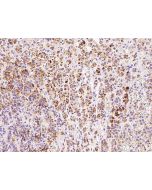
Recombinant Human Complement C1s protein (Catalog#10220-H08H)
Preparation
Produced in rabbits immunized with purified, recombinant Human Complement C1s (rh Complement C1s; Catalog#10220-H08H; NP_001725.1, Met 1-Asp 688). Total IgG was purified by Protein A affinity chromatography.
Source
Polyclonal Rabbit IgG
Purification
Protein A
Formulation
0.2 μm filtered solution in PBS
Conjugate
Unconjugated
Form
Liquid
Shipping
This antibody is shipped as liquid solution at ambient temperature. Upon receipt, store it immediately at the temperature recommended below.
Storage
This antibody can be stored at 2℃-8℃ for one month without detectable loss of activity. Antibody products are stable for twelve months from date of receipt when stored at -20℃ to -80℃. Preservative-Free. Avoid repeated freeze-thaw cycles.
Synonyms: Anti-C1S Antibody; Anti-EDSPD2 Antibody
Background Information
Full Name
complement component 1, s subcomponent
Description
Complement is an integral component of the adaptive and innate immune systems and represents one of the major effector systems for the immune responses. The classical complement pathway is triggered by C1, a complex composed of the binding protein C1q and two proenzymes, C1r and C1s. Upon binding of IgG to the head of C1q, C1r undergoes autoactivation and in turn cleaves and activates C1s. C1r and C1s, the proteases responsible for activation and proteolytic activity of the C1 complex of complement, share similar overall structural organizations featuring five nonenzymic protein modules (two CUB modules surrounding a single EGF module, and a pair of CCP modules) followed by a serine protease domain. Besides highly specific proteolytic activities, both proteases exhibit interaction properties associated with their N-terminal regions. In contrast, C1r and C1s widely differ from each other by their glycosylation patterns: both proteins contain Asn-linked carbohydrates, but four glycosylation sites are present on C1r, and only two on C1s. As a highly specific serine protease, C1s executes the catalytic function of the C1 complex: the cleavage of C4 and C2, and thus instigates a sequence of activation steps of other components of the complement system, culminating in the formation of the membrane attack complex which induces cell lysis. Like other complement serine proteases C1s has restricted substrate specificity and it is engaged into specific interactions with other subcomponents of the complement system. The only other protein known to interact with C1s physiologically is SerpinC1, an inhibitor of serine protease, which inhibits C1s activity and thus plays a regulatory role in controlling the function of C1s enzyme.
Related Pathways
Complement Activation Pathways
References
Arlaud GJ, et al. (1989) Structure and function of C1r and C1s: current concepts. Behring Inst Mitt. (84): 56-64.
Thielens NM, et al. (1999) Structure and functions of the interaction domains of C1r and C1s: keystones of the architecture of the C1 complex. Immunopharmacology. 42(1-3): 3-13.
Gl P, et al. (2002) C1s, the protease messenger of C1. Structure, function and physiological significance. Immunobiology. 205(4-5): 383-94.