Recombinant Human CALML3 protein (Catalog#12480-H07E)
Preparation
Produced in rabbits immunized with purified, recombinant Human CALML3 (rh CALML3; Catalog#12480-H07E; P27482; Met1-Lys149). CALML3 specific IgG was purified by Human CALML3 affinity chromatography.
Source
Polyclonal Rabbit IgG
Purification
Protein A & Antigen Affinity
Formulation
0.2 μm filtered solution in PBS
Conjugate
Unconjugated
Form
Liquid
Shipping
This antibody is shipped as liquid solution at ambient temperature. Upon receipt, store it immediately at the temperature recommended below.
Storage
This antibody can be stored at 2℃-8℃ for one month without detectable loss of activity. Antibody products are stable for twelve months from date of receipt when stored at -20℃ to -80℃. Preservative-Free. Avoid repeated freeze-thaw cycles.
Synonyms: Anti-CLP Antibody
Image / Experimental Information
Image 1 Description
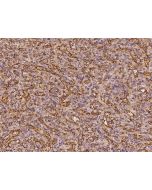
Immunochemical staining of human CALML3 in human breast carcinoma (from 4 donors) with rabbit polyclonal antibody (1:1000, formalin-fixed paraffin embedded sections).
Immunochemical staining of human CALML3 in human breast carcinoma (from 4 donors) with rabbit polyclonal antibody (1:1000, formalin-fixed paraffin embedded sections).
Immunochemical staining of human CALML3 in human breast carcinoma (from 4 donors) with rabbit polyclonal antibody (1:1000, formalin-fixed paraffin embedded sections).
Calmodulin-like protein 3 (CALML3) is similar to that of authentic calmodulin and may actually compete with calmodulin by binding, with different affinity, to cellular substrates. Calmodulin-like protein 3 (CALML3) is a tumor-sensitive protein specifically expressed in normal epithelial cells but downregulated in tumorigenesis. Downregulation of the protein is an early event in breast cancer development. One of the most pressing questions raised by the discovery of CLP/CALML3 is that of its potential targets. Although it is 85% identical to human calmodulin, the distinct properties of CLP suggest that it has specific targets or targets that only partially overlap with those of calmodulin. Research has identified the unconventional myosin-10 (Myo10) as a specific target of CALML3. The discovery of Myo10 as a specific target of CALML3 is highly significant and suggests multiple lines of further research such as investigations of the Ca2+ regulation of Myo10 and the role of the loss of CLP in epithelial differentiation, adhesion, and cancer. Cells expressing CALML3 displayed a striking increase in the number and length of myosin-10-positive filopodia and showed increased mobility in a wound healing assay.
Related Pathways
Actin Dynamics Signaling Pathway
B Cell Receptor Signaling Pathway
T Cell Receptor Signaling Pathway
References
Bennett RD, et al. (2007) Calmodulin-like protein increases filopodia-dependent cell motility via up-regulation of myosin-10. J Biol Chem. 282(5): 3205-12.
Perochon A, et al. (2011) Calmodulin and calmodulin-like proteins in plant calcium signaling. Biochimie. 93(12): 2048-53.
Chinpongpanich A, et al. (2011) Biophysical characterization of calmodulin and calmodulin-like proteins from rice, Oryza sativa L. Acta Biochim Biophys Sin (Shanghai). 43(11): 867-76.