WB (FAQ Protocol), ICC/IF (FAQ Protocol), IP (FAQ Protocol)
Species reactivity
Reacts with: Human
Specificity
Human CAP1
Immunogen
A synthetic peptide corresponding to the center region of the Human CAP1
Preparation
Produced in rabbits immunized with a synthetic peptide corresponding to the center region of the Human CAP1, and purified by antigen affinity chromatography.
Source
Polyclonal Rabbit IgG
Purification
Protein A & Antigen Affinity
Formulation
PBS, pH7.0 with 0.03% Proclin300
Conjugate
Unconjugated
Form
Liquid
Shipping
This antibody is shipped as liquid solution at ambient temperature. Upon receipt, store it immediately at the temperature recommended below.
Storage
This antibody can be stored at 2℃-8℃ for one month without detectable loss of activity. Antibody products are stable for twelve months from date of receipt when stored at -20℃ to -80℃. Avoid repeated freeze-thaw cycles.
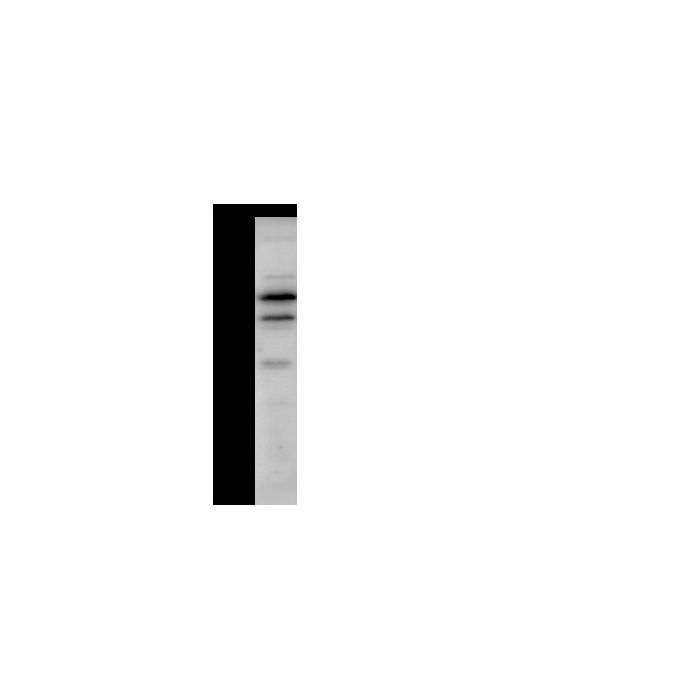
Anti-CAP1 rabbit polyclonal antibody at 1:500 dilution Lane A: HeLa Whole Cell Lysate Lysates/proteins at 30 μg per lane. Secondary Goat Anti-Rabbit IgG (H+L)/HRP at 1/10000 dilution. Developed using the ECL technique. Performed under reducing conditions. Predicted band size:52 kDa
Anti-CAP1 rabbit polyclonal antibody at 1:500 dilution Lane A: HeLa Whole Cell Lysate Lysates/proteins at 30 μg per lane. Secondary Goat Anti-Rabbit IgG (H+L)/HRP at 1/10000 dilution. Developed using the ECL technique. Performed under reducing conditions. Predicted band size:52 kDa
Anti-CAP1 rabbit polyclonal antibody at 1:500 dilution Lane A: HeLa Whole Cell Lysate Lysates/proteins at 30 μg per lane. Secondary Goat Anti-Rabbit IgG (H+L)/HRP at 1/10000 dilution. Developed using the ECL technique. Performed under reducing conditions. Predicted band size:52 kDa
CAP, adenylate cyclase-associated protein 1 (yeast)
Description
The highly conserved 56 kDa multidomain cyclase associated protein 1 (CAP1) works in concert with cofilin and profilin to modulate actin filament turnover by facilitating cofilin-mediated actin filament severing and depolymerisation and catalysing profilin-mediated regeneration of actin monomers for reutilisation in growing filaments. CAP1 is abundant in platelets. Rap1 proteins are members of the Ras subfamily of small GTPases involved in many biological responses, including adhesion, cell proliferation, and differentiation. Like all small GTPases, they work as molecular allosteric units that are active in signaling only when associated with the proper membrane compartment. In obesity, adipose tissue secretes additional resistin, which prompts a proinflammatory effect through its action on adenylate cyclase-associated protein 1 (CAP1). The RETN and CAP1 polymorphisms and gene expression may be potential biomarkers for breast cancer risk. The expression of resistin and CAP1 in synovial tissue was stronger in RA than in osteoarthritis (OA). Resistin contributes to the pathogenesis of RA by increasing chemokine production by FLSs via CAP1 in synovial tissue.

-HD12JA1001-WB.png)
-HD12JA1001-1000-Hela-IF.png)
