Recombinant Anti-CXADR/CAR Antibody, Rabbit Monoclonal sinobiological 10799-R271
| Catalog No. | Size | Price (USD) |
| 10799-R271-1 | 1 mL | $1,969.87 |
| 10799-R271-20 | 20 µL | $118.49 |
| 10799-R271-50 | 50 µL | $177.58 |
| 10799-R271-100 | 100 µL | $340.51 |
| Catalog No. | Size | Price (USD) |
| 10799-R271-1 | 1 mL | $1,969.87 |
| 10799-R271-20 | 20 µL | $118.49 |
| 10799-R271-50 | 50 µL | $177.58 |
| 10799-R271-100 | 100 µL | $340.51 |
General Information
| Product name | Recombinant Anti-CXADR/CAR Antibody, Rabbit Monoclonal |
| Validated applications | ELISA(Det) (FAQ Protocol), FCM (FAQ Protocol), ICC/IF (FAQ Protocol) |
| Species reactivity | Reacts with: Human |
| Specificity | Human CXADR/CAR |
| Immunogen | Recombinant Human CXADR / CAR protein (Catalog#10799-H08H) |
| Preparation | This antibody was obtained from a rabbit immunized with purified, recombinant Human CXADR / CAR (rh CXADR / CAR; Catalog#10799-H08H; NP_001329.1; Met1-Gly237). |
| Source | Monoclonal Rabbit IgG Clone #271 |
| Purification | Protein A |
| Formulation | 0.2 μm filtered solution in PBS with 10% Trehalose, pH7.0 |
| Conjugate | Unconjugated |
| Form | Liquid |
| Shipping | This antibody is shipped as liquid solution at ambient temperature. Upon receipt, store it immediately at the temperature recommended below. |
| Storage | This antibody can be stored at 2℃-8℃ for one month without detectable loss of activity. Antibody products are stable for twelve months from date of receipt when stored at -20℃ to -80℃. Preservative-Free. Avoid repeated freeze-thaw cycles. |
Synonyms: Anti-CAR Antibody; Anti-CAR4/6 Antibody; Anti-HCAR Antibody
Image / Experimental Information
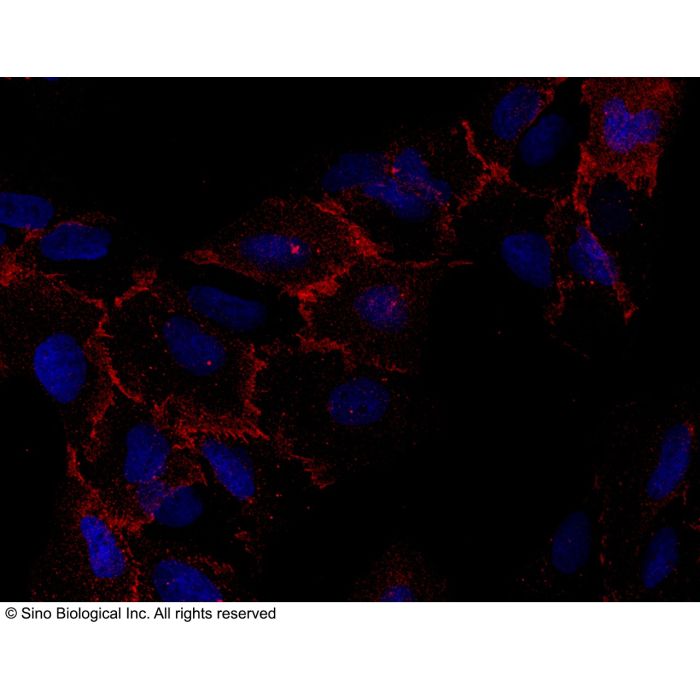
| Image 1 Description | Immunofluorescence staining of Human CXADR in U2OS cells. Cells were fixed with 4% PFA, permeabilzed with 0.3% Triton X-100 in PBS, blocked with 10% serum, and incubated with rabbit anti-Human CXADR monoclonal antibody (1:60) at 4℃ overnight. Then cells were stained with the Alexa Fluor® 594-conjugated Goat Anti-rabbit IgG secondary antibody (red) and counterstained with DAPI (blue). Positive staining was localized to cells membrane. |
| Image 1 Alt Text | Human CXADR / CAR Immunohistochemistry(IHC) 2947 |
| Image 1 URL | Source image |
| Image 2 Description | Immunofluorescence staining of Human CXADR in U2OS cells. Cells were fixed with 4% PFA, permeabilzed with 0.3% Triton X-100 in PBS, blocked with 10% serum, and incubated with rabbit anti-Human CXADR monoclonal antibody (1:60) at 4℃ overnight. Then cells were stained with the Alexa Fluor® 594-conjugated Goat Anti-rabbit IgG secondary antibody (red) and counterstained with DAPI (blue). Positive staining was localized to cells membrane. |
| Image 2 Alt Text | Human CXADR / CAR Flow Cytometry (FC) 5195 |
| Image 2 URL | Source image |
Background Information
| Full Name | coxsackie virus and adenovirus receptor |
| Description | CXADR (coxsackie virus and adenovirus receptor), also known as CAR, is a type I transmembrane glycoprotein belonging to the CTX family of the Ig superfamily, and is essential for normal cardiac development in the mouse. Proposed as a homophilic cell adhesion molecule, CXADR is a component of the epithelial apical junction complex that is essential for the tight junction integrity, and probably involved in transepithelial migration of polymorphonuclear leukocytes (PMN). Mature mouse CXADR structrually comprises a 218 aa extracellular domain (ECD) with a V-type (D1) and a C2-type (D2) Ig-like domain, a 21 aa transmembrane segment and a 17 aa intracellular domain, among which,D1 is thought to be responsible for homodimer formation in trans within tight junctions. The ECD of mouse CXADR shares 97%, 9% sequence identity with the corresponding regions of rat, human CXADR. |
| References |
|
title: Combining receptor engineering and intracellular gelation for cell-based antiviral therapy against coxsackievirus B3.
authors: Tonggong Liu; Wenjuan Liu; ...; Dayong Gu
journal: Journal of Nanobiotechnology
date: 2026-05-17
pmid: 42144598
doi: 10.1186/s12951-026-04559-z
cited_by_count: 0
techniques: Bicinchoninic Acid Protein Assay; Control; Electrotransfer; Imaging; Incubation; Lysis; Protease Inhibitor; Staining; Western Blot
bioz_score: 94
title: A novel Gorilla-derived oncolytic Adenovirus with natural selective replication in cancer cells
authors: Scala Romina; Cela Ilaria; ...; Raggioli Angelo
journal: bioRxiv
date: 2026-03-01
doi: 10.64898/2026.02.26.708271
cited_by_count: 0
techniques: Control; Cytometry; Derivative Assay; Direct ELISA; Expressing; Fluorescence; Incubation; Infection; Plasmid Preparation; Positive Control; Produced; SDS Page; Sequencing; Western Blot
bioz_score: 94
title: HAX1 , gene responsible for Kostmann syndrome, regulates gingival epithelial barrier function via intracellular trafficking of JAM1
authors: Keita Tanigaki; Tsukasa Tamamori; ...; Masae Kuboniwa
journal: Frontiers in Cell and Developmental Biology
date: 2025-08-13
cited_by_count: 0
bioz_score: 94
title: SLC37A4 , gene responsible for glycogen storage disease type 1b, regulates gingival epithelial barrier function via JAM1 expression
authors: Keita Tanigaki; Risako Matsumura; ...; Hiroki Takeuchi
journal: Scientific Reports
date: 2024-10-22
pmid: 39433915
pmcid: 11494063
cited_by_count: 1
bioz_score: 94
title: Cigarette smoke extract impairs gingival epithelial barrier function
authors: Shunsuke Yamaga; Keita Tanigaki; ...; Hiroki Takeuchi
journal: Scientific Reports
date: 2023-06-07
pmid: 37286570
doi: 10.1038/s41598-023-36366-z
pmcid: 10244868
cited_by_count: 3
bioz_score: 94
title: The Murine Neuronal Receptor NgR1 Is Dispensable for Reovirus Pathogenesis.
authors: Pavithra Aravamudhan; Camila Guzman-Cardozo; ...; Terence S Dermody
journal: Journal of virology
date: 2022-04-29
pmid: 35353001
doi: 10.1128/jvi.00055-22
cited_by_count: 9
techniques: Binding Assay; Cell Culture; Expressing; Flow Cytometry; Incubation; Infection; Plasmid Preparation; Software; Transfection
bioz_score: 94
title: Microbubble-mediated delivery of human adenoviruses does not elicit innate and adaptive immunity response in an immunocompetent mouse model of prostate cancer.
authors: Flavia De Carlo; Litty Thomas; ...; Candace M Howard
journal: Journal of Translational Medicine
date: 2020-04-06
pmid: 30635014
doi: 10.1186/s12967-019-1771-0
cited_by_count: 9
techniques: FACS; Incubation; Labeling; Staining; Suspension
bioz_score: 94