Recombinant Anti-Carbonic Anhydrase III / CAIII Antibody, Rabbit Monoclonal
Validated applications
IHC-P (FAQ Protocol)
Species reactivity
Reacts with: Human
Specificity
Human Carbonic Anhydrase III / CAIII No cross-reactivity in ELISA with Human CA2 Human CA4 Human CA5a Human CA5b Human CA7 Human CA8 Human CA9 Human CA10 Human CA13 Human CA14
Immunogen
Recombinant Human Carbonic Anhydrase III / CA3 protein (Catalog#10503-H08E)
Preparation
This antibody was obtained from a rabbit immunized with purified, recombinant Human Carbonic Anhydrase III / CA3 (rh Carbonic Anhydrase III / CA3; Catalog#10503-H08E; NP_005172.1; Met1-Lys260).
Source
Monoclonal Rabbit IgG Clone #002
Purification
Protein A
Formulation
0.2 μm filtered solution in PBS
Conjugate
Unconjugated
Form
Liquid
Shipping
This antibody is shipped as liquid solution at ambient temperature. Upon receipt, store it immediately at the temperature recommended below.
Storage
This antibody can be stored at 2℃-8℃ for one month without detectable loss of activity. Antibody products are stable for twelve months from date of receipt when stored at -20℃ to -80℃. Preservative-Free. Avoid repeated freeze-thaw cycles.
Synonyms: Anti-CAIII Antibody; Anti-Car3 Antibody
Image / Experimental Information
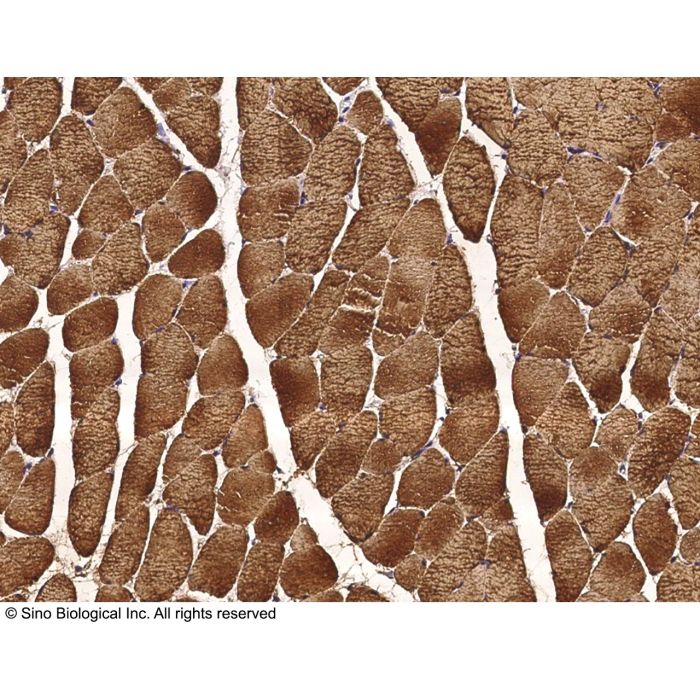
Image 1 Description
Immunochemical staining of human CA3 in human muscle with rabbit monoclonal antibody (1:200, formalin-fixed paraffin embedded sections).
Image 1 Alt Text
Human Carbonic Anhydrase III Immunohistochemistry(IHC) 4630
Carbonic anhydrases (CAs) are a large family of zinc metalloenzymes first discovered in 1933 that catalyze the reversible hydration of carbon dioxide. CAs participate in a variety of biological processes, including respiration, calcification, acid-base balance, bone resorption, and the formation of aqueous humor, cerebrospinal fluid, saliva, and gastric acid. Carbonic anhydrases (CAs) form a family of enzymes that catalyze the rapid conversion of carbon dioxide and water to bicarbonate and protons, a reaction that occurs rather slowly in the absence of a catalyst. The active site of most carbonic anhydrases contains a zinc ion, they are therefore classified as metalloenzymes. Several forms of carbonic anhydrase occur in nature. The primary function of the enzyme in animals is to interconvert carbon dioxide and bicarbonate to maintain acid-base balance in blood and other tissues, and to help transport carbon dioxide out of tissues. Plants contain a different form called β-carbonic anhydrase, which, from an evolutionary standpoint, is a distinct enzyme, but participates in the same reaction and also uses a zinc ion in its active site. Carbonic anhydrase 3, also known as Carbonate dehydratase III, CA-III and CA3, is a cytoplasm protein which belongs to thealpha-carbonic anhydrase family. CA3 is activated by proton donors such as imidazole and the dipeptide histidylhistidine. It is inhibited by coumarins and sulfonamide derivatives such as acetazolamide. At 6 weeks gestation, transcripts accumulate at low levels in the somites and at high levels throughout the notochord. As gestation continues, CA3 becomes abundant in all developing muscle masses and continues at high to moderate levels in the notochord.
References
Ivanov, S.V. et al., 1998, Proc. Natl. Acad. Sci. USA 95:12596-601.
Sowden J. et al., 1998, Gene 214:157- 65.
Strausberg, R.L. et al., 2002, Proc. Natl. Acad. Sci. USA 99:16899-903.
Liao, S.Y. et al., 2003, J. Med. Genet. 40: 257-62.
Bataller,L. et al., 2004, Ann Neurol 56 (4): 575-9.